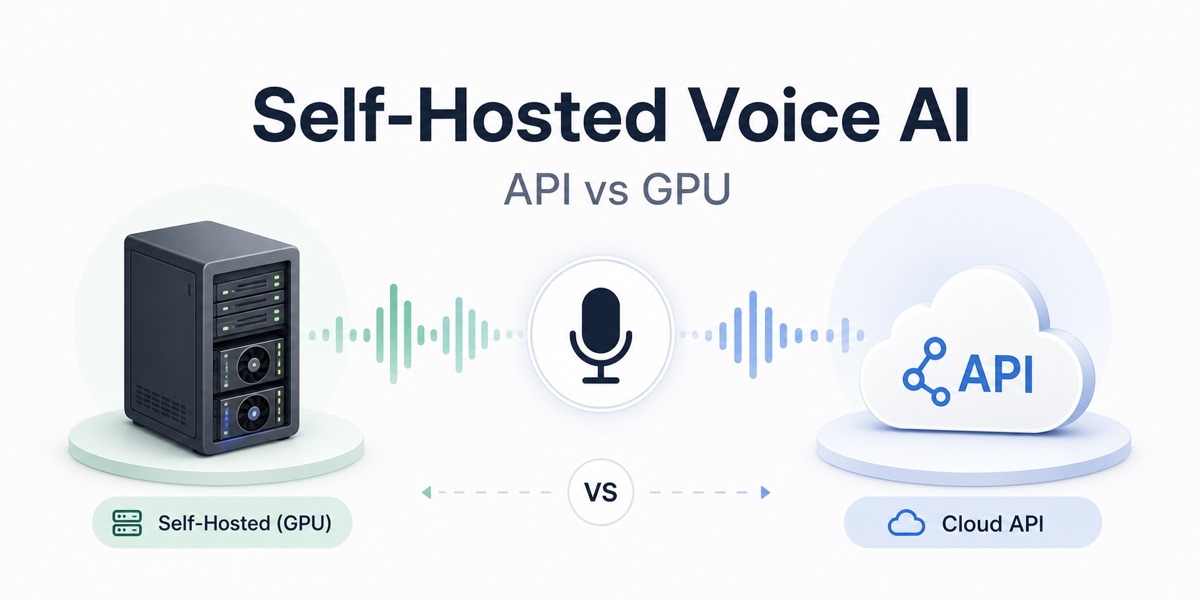
Voice AI is now realistic for small teams, not just research labs. You can transcribe voice memos, summarize calls, search audio notes, generate replies and even build voice agents with public APIs or open-source models. The real question is no longer “is it possible?” but “which parts should you host yourself, and which parts should stay API-first?”
Short Answer
Yes, you can self-host parts of a Voice AI stack in 2026, especially batch speech-to-text. But most SaaS teams should not self-host everything. Use APIs for early product discovery, realtime agents and fast iteration. Consider self-hosted transcription only when volume, privacy or unit economics justify the operational work.
For client-facing workflows, the business question is simpler: do you need to run the model yourself, or do you need to turn spoken context into a useful output? For most teams, voice notes to action items, voice intake forms and structured summaries matter more than model ownership.
| Decision | Best default | Why |
|---|---|---|
| Early SaaS product | API-first | Faster learning, less infrastructure |
| High-volume batch transcription | Hybrid or self-hosted test | Cost and privacy may justify it |
| Realtime voice agents | API-first | Latency and reliability are hard |
| Client intake workflows | Workflow-first | Briefs and action items create the business value |
If you are building a product around voice notes, customer calls, podcast workflows or asynchronous updates, self-hosting can look attractive. You control the data, tune the stack and avoid per-minute API costs at scale. But you also inherit GPUs, queues, latency, observability, model updates and compliance.
This guide gives you a practical way to decide when to use APIs, when to self-host speech-to-text, and how to think about Voice AI infrastructure in 2026.
What Does Self-Hosted Voice AI Mean?
Self-hosted Voice AI means running the audio models and processing pipeline on infrastructure you control. That can include speech-to-text, speaker diarization, audio summarization, text-to-speech, voice agents or verified voice cloning.
In practice, most teams do not self-host everything. A good architecture is usually hybrid:
- Use APIs for early product discovery, realtime voice agents and fast iteration.
- Self-host batch transcription when volume, privacy or cost make it worth the operational work.
- Keep sensitive or risky features, such as voice cloning, behind stronger consent and review flows.
For VocalJet, this matters because a voice memo is not just an audio file. It can become a searchable transcript, a summary, an email, a follow-up, a task list or a client update. That is the product opportunity behind an AI voice recorder.
The Main Voice AI Building Blocks
Before choosing infrastructure, separate the workflow into components.
| Layer | What it does | API-first fit | Self-hosting fit |
|---|---|---|---|
| Speech-to-text | Converts audio to text | Excellent for accuracy and speed to market | Strong for batch volume and privacy |
| Diarization | Detects who spoke when | Good if included by provider | Possible, but needs quality testing |
| Summarization | Turns transcript into notes or action items | Excellent with LLM APIs | Usually not worth self-hosting early |
| Voice agents | Realtime voice conversation | API-first is usually best | Hard because latency matters |
| Text-to-speech | Generates spoken audio | API-first for natural voices | Possible, but quality varies |
| Voice cloning | Creates a synthetic voice | Only with verified consent | High risk, needs strong controls |
This is why a voice product should not start with “we will self-host everything.” Start with the user workflow. If the workflow is to transcribe voice memos, summarize them, search them and share them by email, the first architecture can be much simpler than a full realtime agent stack.
APIs Are Still the Fastest Way to Ship
Voice AI APIs are better than they were even two years ago. OpenAI lists gpt-4o-transcribe as a speech-to-text model powered by GPT-4o, positioned for more accurate transcripts than original Whisper models on the official model page. OpenAI also documents realtime audio and voice-agent workflows in its Realtime API guide and Voice agents guide.
Specialized providers also make it easy to avoid infrastructure too early. Deepgram publishes pricing and scale options for speech-to-text, text-to-speech and voice-agent APIs on its pricing page. AssemblyAI publishes speech-to-text and audio intelligence pricing, including pay-as-you-go and enterprise deployment options, on its pricing page.
For most startups, APIs win at the start because they reduce risk:
- No GPU provisioning.
- No model serving infrastructure.
- No queue tuning for long audio files.
- Faster experiments with product messaging and UX.
- Easier access to realtime features.
The tradeoff is that API cost can grow with usage, and you need to review data processing, retention and compliance terms carefully.
When Self-Hosting Starts to Make Sense
Self-hosting starts to become interesting when one of these conditions is true:
- You process many hours of audio every day and per-minute cost dominates your margin.
- You need stricter control over where voice data is processed.
- Your workload is mostly batch, not realtime.
- You can accept model evaluation and infrastructure work as part of the product.
- You have a narrow domain where you can benchmark quality consistently.
Speech-to-text is the best first candidate. Open-source ASR models are mature enough to test seriously. The Whisper large-v3-turbo model card describes a faster pruned version of Whisper large-v3, with fewer decoding layers and a tradeoff of speed versus minor quality degradation. NVIDIA’s Parakeet TDT 0.6B V2 model card describes a 600M parameter English ASR model with punctuation, capitalization and word-level timestamps.
Those are credible building blocks for a self-hosted transcription pipeline, but you still need to test them on your actual audio. Voice memos recorded from a phone, sales calls, podcasts, noisy WhatsApp audio and client updates do not behave the same.
If you want a broader market overview, VocalJet already has a guide on open-source speech-to-text models and a primer on OpenAI Whisper.
A Practical Cost Model
Do not compare “API price per hour” with “GPU rental price per hour” too quickly. That misses engineering time and utilization.
Use this simple model:
| Cost item | API-first | Self-hosted |
|---|---|---|
| Direct processing cost | Per minute, token or request | GPU hours, storage and bandwidth |
| Engineering cost | Low at launch | Medium to high |
| Quality maintenance | Provider-owned | Your responsibility |
| Scaling | Provider-owned | Your queues and capacity planning |
| Compliance review | Provider terms and controls | Your full stack and policies |
| Latency tuning | Provider plus integration | Your model, GPU and network path |
Self-hosting usually wins only if you can keep GPUs busy or if privacy/control is the main requirement. If your workload is spiky, APIs can still be cheaper because idle GPUs are expensive.
For a product like VocalJet, the strongest near-term path is often hybrid:
- API-first for realtime transcription and summaries.
- Self-hosted batch ASR experiments for long voice notes and archives.
- Product-level differentiation around workflow: folders, search, email sharing, summaries and async communication.
Voice Agents Are Harder Than Batch Transcription
Realtime voice agents are a different problem from transcribing uploaded voice memos.
A voice agent needs low latency across the whole loop:
- Capture microphone audio.
- Detect voice activity.
- Transcribe or interpret speech.
- Decide what to say.
- Generate speech.
- Stream audio back naturally.
Even small delays feel bad in conversation. That is why APIs are still the practical default for most voice-agent projects. A self-hosted voice agent can work, but it is closer to operating a realtime communications system than a simple transcription service.
If your product goal is to help people communicate faster, you may not need a full agent at first. A voice memo that becomes a summary, transcript and shareable email can deliver value with less realtime complexity. That is exactly where voice message to email workflows are still underrated.
Compliance Is Part of the Product
Voice data is personal. Synthetic voice can also create impersonation risk. If your roadmap includes text-to-speech, voice cloning or voice agents, trust cannot be an afterthought.
The EU AI Act’s Article 50 summary says providers must inform users when they interact directly with an AI system, and deployers of systems that generate or manipulate deepfake image, audio or video content must disclose that the content was artificially generated or manipulated. You can read the official summary on the AI Act Service Desk.
For product builders, that means:
- Get consent before processing sensitive recordings.
- Make AI-generated audio clearly identifiable.
- Avoid cloning voices without verification.
- Keep logs for abuse review.
- Separate “transcribe my own audio” from “generate audio that sounds like a person.”
- Give users deletion and retention controls.
Verified voice cloning may become a useful product feature, but only if it is built around permission, identity and disclosure. It should not be the first acquisition wedge for a productivity SaaS unless the compliance model is ready.
Recommended Architecture for a Small Team
If you are building a Voice AI product in 2026, start with this stack:
- Upload or record audio in the browser.
- Store the original audio securely.
- Send audio to an API-based speech-to-text provider.
- Save transcript segments and timestamps.
- Generate summaries, action items and searchable metadata.
- Let users share the result as a link or email.
- Benchmark open-source ASR in the background on the same audio.
- Move batch transcription to self-hosted infrastructure only when the numbers justify it.
This lets you ship the user experience first. You can still build the self-hosting path, but you are not betting the entire product on infrastructure before you know what users want.
VocalJet’s strongest wedge is not “we run a model.” It is that people can record a voice memo, get a transcript, summarize it, search it, and share it in a workflow that reduces typing and meetings. That connects naturally to audio summarization and searchable voice notes.
Decision Checklist
Use this checklist before self-hosting:
- Do you process enough audio every month to offset engineering time?
- Is the workload batch, realtime or both?
- Do users care more about cost, accuracy, speed or privacy?
- Do you have a representative audio test set?
- Can you measure word error rate, diarization quality and summary usefulness?
- Can you handle retries, stuck jobs and partial failures?
- Do you have a data retention policy?
- Are AI-generated voices clearly disclosed?
- Can users delete audio, transcripts and summaries?
If the answer to most of these is “not yet”, stay API-first and build better workflows. If the answer is “yes”, start with self-hosted batch speech-to-text, not realtime agents or voice cloning.
What This Means for Agencies and Client Workflows
Agencies rarely need to own Voice AI infrastructure. They need better client context.
For that use case, optimize the workflow before the model stack:
| Client workflow | Useful output | Suggested page |
|---|---|---|
| New project inquiry | Goals, constraints, open questions | Client intake software for agencies |
| First-pass project context | Voice intake brief | Voice intake form |
| Revision feedback | Action items and scope risks | Async client feedback tool |
| Long client explanation | Transcript, summary and follow-up | Voice message to email |
This is the practical moat: not “we run ASR,” but “we turn messy spoken client context into a brief, scope signal and next action faster than a meeting.”
FAQ
Can you self-host speech-to-text in 2026?
Yes. Open-source ASR models like Whisper large-v3-turbo and NVIDIA Parakeet make self-hosted speech-to-text practical for teams that can operate GPUs and evaluate accuracy on their own audio.
Should a startup self-host Voice AI from day one?
Usually no. APIs are faster for product discovery. Self-hosting becomes attractive when audio volume, privacy requirements or unit economics justify the operational work.
Is voice cloning easy to self-host?
Technically, many models can clone or imitate voices. Product-wise, it is high risk. Verified consent, disclosure and abuse prevention should come before launch.
What is the easiest Voice AI feature to ship first?
Batch voice memo transcription is usually the easiest. It can unlock summaries, search, action items and voice-to-email without requiring realtime voice-agent latency.
Do agencies need self-hosted Voice AI?
Usually no. Agencies need a reliable way to collect client context, extract action items and reduce unclear scope. API-first or hybrid infrastructure is usually enough unless privacy, volume or compliance demands self-hosting.
Final Takeaway
You can self-host Voice AI in 2026, but you should be selective. Self-host speech-to-text when volume or privacy makes it worthwhile. Use APIs for realtime voice agents and early product learning. Treat voice cloning as a verified, consent-based feature, not a shortcut to growth.
The best Voice AI products will not win because they host every model themselves. They will win because they turn spoken thoughts into useful workflows faster than typing.