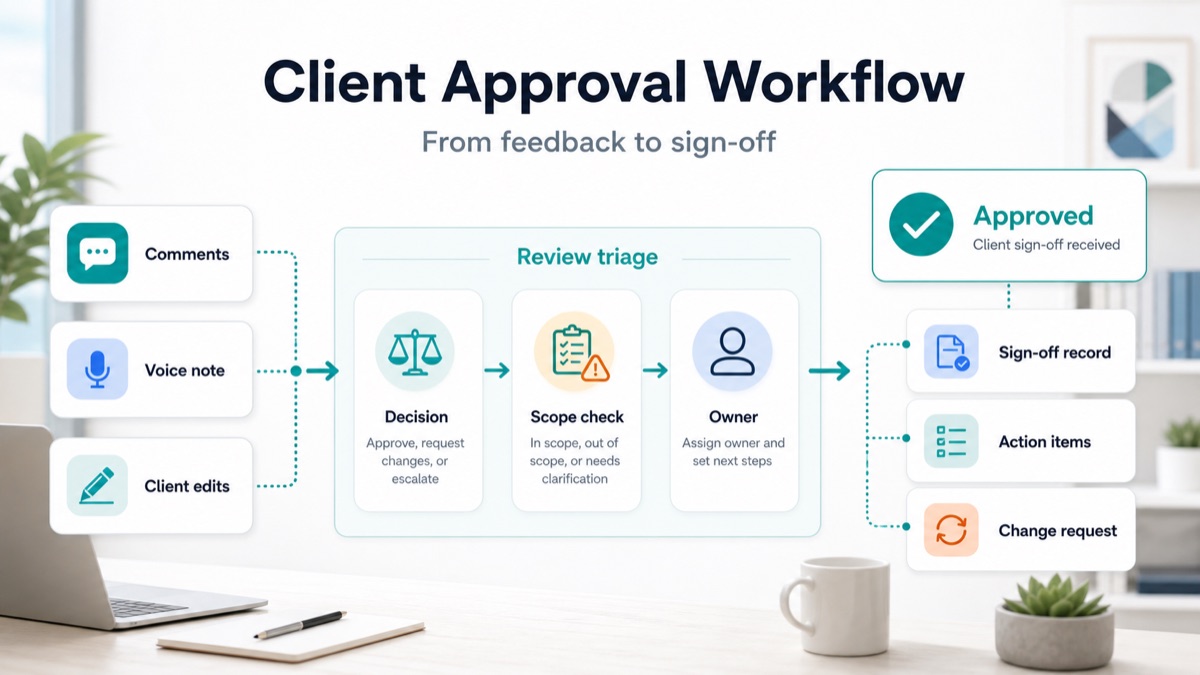
Client approval should be the point where a project moves forward with confidence. In practice, many agencies treat approval as a vague comment in an email thread: “looks good,” “approved with changes,” or “we can move ahead after legal checks the claim.” Those phrases sound positive, but they do not always say which version is approved, who approved it, what still needs work or whether a new request changed scope.
For agencies, consultants, creative studios and freelancers, a weak approval process creates stalled launches, re-opened revisions and unpaid work. Feedback turns into tasks too quickly. Stakeholders approve different versions. New requests get bundled into sign-off.
This guide gives agencies a practical client approval workflow: collect feedback, capture voice context when comments are vague, run a scope check, record sign-off evidence and separate approved work from change requests.
Quick Answer
A client approval workflow is the process an agency uses to move a deliverable from review to decision, sign-off and next action. It defines what is being approved, who has authority to approve it, which version is in review, what feedback means and what happens when the client requests changes.
To run client approvals without scope creep, do not treat feedback as approval. First classify the response as approved, changes requested, rejected, open question, dependency or change request. Then capture the approval record in writing with the version, approver, date, decision and next step.
The strongest agency workflow is hybrid: use comments for asset-specific feedback, voice notes for context, a decision owner for sign-off and a written summary before the team starts the next round.
| Client response | Approval status | What the agency should do |
|---|---|---|
| “Approved, launch it” | Approved | Record sign-off and move to launch or handoff |
| “Approved, but change the CTA” | Changes requested | Confirm whether the change is included or new scope |
| “Legal still needs to check claims” | Dependency | Assign client action item before approval |
| “Can we add another section?” | Change request | Estimate, defer or swap scope |
| “Looks good to me” | Ambiguous | Ask for explicit approval language |
If approvals are attached to feedback, connect this workflow to async client feedback, an async client feedback tool, voice feedback for agencies, client feedback to action items, client feedback software for agencies, client voice notes to action items and scope creep client intake.
Why Client Approval Workflows Break
Client approval workflows break when approval is treated as a mood instead of a decision. A client may like the direction, but still require changes. A stakeholder may approve a draft, but not have authority. A reviewer may approve the concept, while another person later rejects the claims, copy or final layout.
Asana’s project closure guidance treats sign-off and documentation as part of finishing work cleanly. That matters before final closeout too: each approval gate should clarify what was approved, what still needs work and whether the current deliverable matches the agreed scope.
The common failure modes are:
- no named approver;
- approval attached to the wrong version;
- feedback treated as execution-ready tasks too early;
- conditional approvals lost in the thread;
- new requests hidden inside approval comments;
- no written record of what happens next.
The approval workflow should protect the relationship by making decisions explicit before the team spends more time.
What A Client Approval Workflow Should Define
Every agency approval workflow should answer six questions before work moves forward.
| Approval element | Question to answer | Why it matters |
|---|---|---|
| Artifact | What exact deliverable or version is being reviewed? | Prevents approval of the wrong draft |
| Authority | Who can approve this stage? | Avoids late stakeholder reversals |
| Decision | Is it approved, rejected or changes requested? | Turns feedback into a clear status |
| Scope | Does the feedback change deliverables, timeline or budget? | Prevents unpaid work |
| Owner | Who acts next? | Avoids vague handoffs |
| Evidence | Where is the approval record stored? | Makes sign-off searchable later |
Atlassian’s DACI framework is useful because it separates contributors from the one approver who makes the decision. Agencies can apply the same principle to client reviews: many people can comment, but one person should own sign-off for the review stage.
The Agency Client Approval Workflow
Use this workflow when sending a design, website draft, campaign asset, project brief, proposal, report or revision set for client approval.
1. Send A Review-Ready Package
Do not ask for approval on an undefined thread. Send a short review package:
- deliverable name;
- version or link;
- review goal;
- what feedback is useful now;
- what is out of scope for this round;
- final approver;
- due date;
- decision options.
Figma’s comments guide is useful for design and prototype work because comments can stay connected to the exact asset location. That solves the “where is the comment?” problem. The agency still has to solve the “what does this comment mean?” problem.
2. Give The Client Clear Decision Options
Offer decision options that separate sign-off from feedback:
| Option | Meaning | Next step |
|---|---|---|
| Approved | The deliverable/version is accepted | Move to launch, handoff or next phase |
| Changes requested | In-scope changes are needed | Convert approved changes into tasks |
| Rejected | The deliverable does not meet the brief | Clarify gap before rework |
| Blocked | Client input or approval is missing | Assign dependency to client |
| Change request | New scope is requested | Estimate, defer or swap scope |
Asana’s approval guidance uses approval outcomes such as approved, changes requested and rejected. Agencies can adapt that logic even if they are not using Asana: make the client choose a decision state rather than leaving the team to infer it from comments.
3. Use Voice Feedback For Ambiguous Approvals
Some approval comments need context. If a client writes “approved but make it stronger,” do not send that straight to production. Ask for a short voice note that explains what “stronger” means, who approves the change and whether it affects scope.
Use this prompt:
1 | Could you record a short voice note before we start the next revision? |
Async voice feedback helps agencies capture the reasoning behind an approval before a vague comment becomes unpaid revision work.
4. Run A Scope Check Before Assigning Tasks
Before assigning revision tasks, check whether the comment changes the agreement.
| Client approval note | In scope? | Agency response |
|---|---|---|
| “Approved, fix the typo on slide 4” | Yes | Create task and keep approval moving |
| “Approved if legal confirms the claim” | Blocked | Assign legal approval dependency |
| “Approved, but add a customer quote section” | Maybe not | Confirm if this is a change request |
| “Approved by marketing, CEO wants to review” | Not final | Ask for one final approver |
| “Approved, but rebuild the hero” | Likely new scope | Estimate, defer or swap |
A scope check is the step where an agency compares client feedback against the agreed deliverables, timeline, approval path and budget before work begins.
5. Record The Sign-Off
The approval record should be short and findable.
1 | Approval record |
This record protects both sides. The client sees what the agency understood. The agency gets a clean handoff from feedback to execution.
Raw Feedback To Approval Record Example
Here is what the workflow looks like with a realistic client response.
Raw client feedback
1 | The landing page direction is approved overall. The headline is better, but Legal still needs to approve the ROI claim. Also, can we add a short comparison section before the demo CTA? Sales thinks it will help the launch campaign. If that is quick, let's include it before Friday. |
Structured approval output
| Field | Extracted output |
|---|---|
| Approved | Landing page direction and current layout direction |
| Changes requested | Headline may need legal-safe ROI wording |
| Dependency | Legal approval required for quantified claim |
| Scope risk | New comparison section may add copy, design and approval work |
| Decision owner | Confirm whether marketing lead or legal has final copy approval |
| Agency action item | Prepare legal-safe headline option |
| Client action item | Confirm claim approval and comparison section priority |
| Follow-up | Send included revision plus optional change-request estimate |
Client approval is not the same as client feedback. Approval confirms a decision on a specific version; feedback explains what should change, why it matters and whether more work is needed.
Client Approval Email Template
Use this email when asking for sign-off.
1 | Subject: Approval request: [Deliverable] [Version] |
The template works because it gives the client language that separates approval from feedback and feedback from new scope.
Best Workflow For Agencies, Consultants And Freelancers
For agencies, consultants and freelancers, the safest approval workflow is:
- Define the approver before the review starts.
- Send one version with a clear review goal.
- Collect comments, voice notes or annotated feedback.
- Classify every response as approval, change, blocker or scope risk.
- Ask for voice context when approval language is vague.
- Record sign-off with version, approver, date and next step.
- Treat new deliverables after sign-off as change requests.
Asana’s stakeholder guidance is relevant here because approval depends on knowing who can influence the work and who has decision authority. In client service work, the approval workflow should identify both.
How VocalJet Fits This Workflow
VocalJet helps agencies when approval comments need more context than a short written reply can provide. A client can record a voice note explaining what is approved, what still feels unclear, who needs to sign off and whether a request changes scope.
The team can then turn that voice note into a transcript, approval summary, decision list, scope risks, action items and follow-up-ready email. That makes VocalJet useful for design approvals, website revision rounds, campaign reviews, consultant deliverables and client sign-off handoffs.
The goal is not to replace formal sign-off. The goal is to make the context around sign-off clear enough that the approval record is accurate.
FAQ
What is a client approval workflow?
A client approval workflow is the process an agency uses to route a deliverable through review, feedback, decision, sign-off and next action.
What should a client approval record include?
A client approval record should include the project, deliverable, version, decision, approver, date, included changes, dependencies, scope note and next step.
Is client feedback the same as approval?
No. Client feedback explains what the client thinks or wants changed. Client approval confirms a decision on a specific version and authorizes the agency to move forward.
How do agencies avoid scope creep during approvals?
Agencies avoid scope creep during approvals by checking whether each comment changes deliverables, timeline, budget, approval path or revision rounds before assigning tasks.
When should an agency ask for voice feedback during approval?
An agency should ask for voice feedback when approval language is vague, conditional, emotionally sensitive, tied to a stakeholder conflict or likely to affect scope.
How can VocalJet help with client approvals?
VocalJet helps with client approvals by turning client voice notes into transcripts, approval summaries, decisions, scope risks, action items and follow-up-ready text.