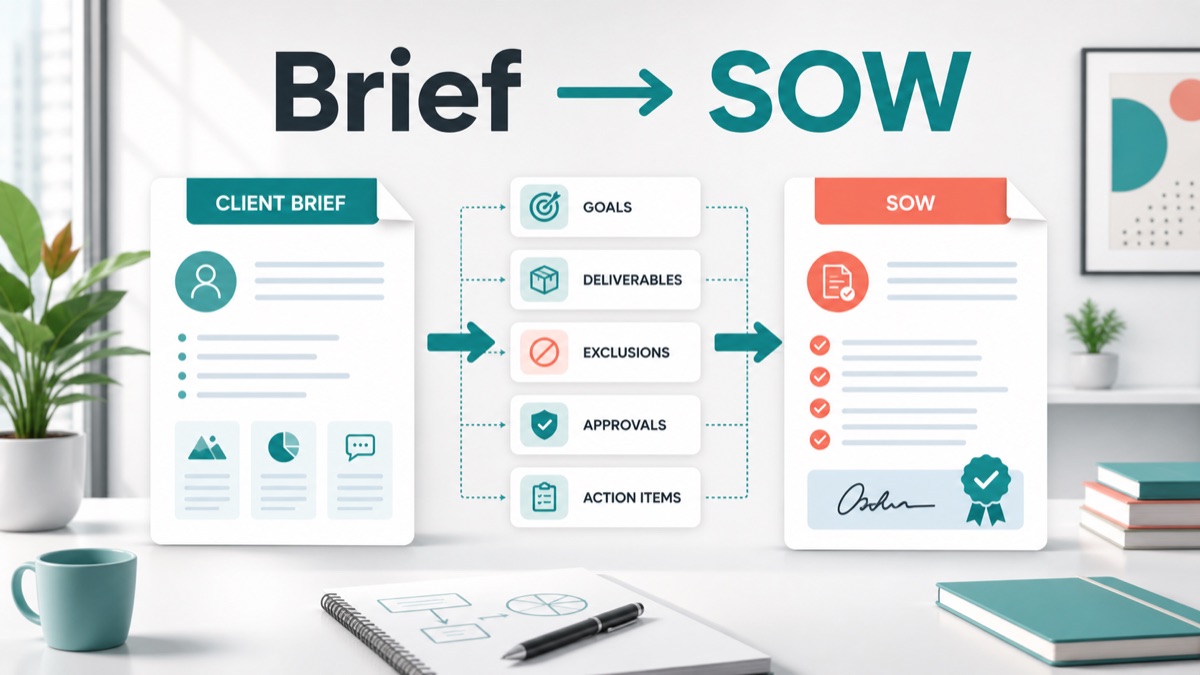
A client brief and a statement of work are often treated like interchangeable documents. For agencies, consultants, creative studios and freelancers, that mistake creates risk before the project even starts.
The client brief explains the context: what the client wants, why it matters, who is involved, what constraints exist and what still needs clarification. The statement of work turns that context into commercial boundaries: deliverables, exclusions, responsibilities, timeline, acceptance criteria and change rules.
If the brief is vague, the SOW inherits assumptions. If the SOW is written too early, the team may price unclear work, miss hidden dependencies or promise revisions that should have been scoped separately. This guide gives client-facing teams a practical way to move from raw client context to a usable brief, then from brief to scope-ready SOW inputs.
Quick Answer
A client brief is an intake and alignment document that captures the client’s goals, context, requirements, stakeholders, constraints and open questions. A statement of work is a scope document that defines what will be delivered, what is excluded, who is responsible, when milestones happen and how changes are handled.
For agencies and consultants, the client brief should come before the statement of work. The brief helps the team understand the client request. The SOW converts that understanding into a project agreement the team can price, schedule and defend.
Use this quick comparison before kickoff:
| Document | Main job | Best timing | Primary risk if skipped |
|---|---|---|---|
| Client brief | Capture goals, context, stakeholders, constraints and open questions | Before proposal, pricing or kickoff | The team writes a scope around assumptions |
| Statement of work | Define deliverables, exclusions, responsibilities, milestones and change rules | After discovery is clear enough to price | The client and agency disagree about what is included |
| Confirmation summary | Check that the agency interpreted the client correctly | Between brief and SOW | Misunderstandings become contractual or delivery problems |
The best workflow is to collect client context first, convert it into a structured brief, mark scope gaps, ask only the missing clarification questions, and then draft SOW inputs. VocalJet fits this workflow when a client can explain context faster by voice: the client records a note, and the team turns that note into a brief, scope questions, action items and follow-up-ready text.
Client Brief vs Statement Of Work
A client brief is the operating context for a project. It should answer what the client is trying to accomplish, why the project matters now, who needs to be involved, what constraints exist and what the agency still needs to know.
A statement of work is the project boundary. It should answer what work is included, what work is not included, what each side is responsible for, how delivery will be accepted, what timeline applies and what happens when the client asks for something new.
Asana’s guide to a project brief frames the brief as a concise source of truth for goals, scope, timeline and target audience. Atlassian’s guide to scope of work focuses on objectives, deliverables, inclusions, exclusions, constraints and timelines.
For client services, the practical distinction is simple: the brief explains the project; the SOW controls the work.
| Question | Belongs in the client brief | Belongs in the SOW |
|---|---|---|
| Why is the client doing this project now? | Yes | Usually summarized |
| What does success look like? | Yes | Converted into acceptance criteria when possible |
| Which deliverables are included? | Drafted or inferred | Yes, explicitly |
| Which deliverables are excluded? | Flagged as scope risk | Yes, explicitly |
| Who gives input and who approves? | Yes | Yes, as responsibility and approval rules |
| What assets, access or decisions are missing? | Yes | Yes, as dependencies or assumptions |
| How will changes be handled? | Flagged as a risk | Yes, as a change rule |
| What is the price? | No | Often yes, depending on format |
A client brief is not a substitute for a SOW. A SOW is not a substitute for intake. Agencies need both when a project has real scope, budget, timeline or stakeholder risk.
Why Agencies Should Not Write The SOW First
Writing the SOW first feels efficient when the client asks for a proposal quickly. The problem is that a fast SOW often hides unanswered questions inside polished language.
Common examples:
- “Homepage redesign” may include copywriting, UX, visual design, development, analytics, migration and QA.
- “Brand refresh” may include strategy, logo updates, templates, social assets, messaging and rollout support.
- “Campaign landing page” may include email copy, ad creative, conversion tracking, reporting and stakeholder reviews.
- “Quick audit” may include a live readout, written report, roadmap, implementation support and executive summary.
PMI’s scope management guidance emphasizes documenting and approving requirements or parameters before moving into later project phases. For agencies, that means the brief should expose assumptions before the SOW turns them into commitments.
The SOW should not be the first place where scope becomes clear. It should be the place where already-clarified scope becomes explicit.
The Brief-To-SOW Workflow
Use this workflow when a client request is promising but not yet safe to price.
1. Capture Raw Client Context
Start with the client’s own words. Preserve the original email, form response, call note or voice note before translating it into agency language.
If the client struggles to write a complete intake response, send a voice intake form or use voice client intake. Voice client intake is a workflow where clients explain project context asynchronously by voice, then the agency turns that recording into structured project context.
Ask the client to cover:
- what they want changed or created;
- why the project matters now;
- what deadline or event is driving the request;
- who will review and approve;
- what assets, access or examples exist;
- what feels uncertain, risky or hard to explain.
2. Turn Context Into A Client Brief
The first structured output should be a brief, not a contract-style document.
1 | Client brief |
An AI client brief generator turns spoken client context into structured goals, constraints, risks and next steps. In VocalJet, this is the useful middle layer between a raw client voice note and a scope-ready project plan.
3. Separate Brief Inputs From SOW Inputs
Once the brief exists, split each item into one of four buckets.
| Brief item | SOW treatment | Example |
|---|---|---|
| Confirmed deliverable | Include in scope | One homepage wireframe and one final visual design |
| Possible deliverable | Ask or price as option | Three paid social post concepts |
| Client dependency | Add as responsibility or assumption | Client provides approved product screenshots |
| Unclear request | Convert into clarification question | Does “messaging help” mean copy direction or final copywriting? |
This prevents the team from copying every client wish into the SOW as if it were included work.
4. Ask The Missing Scope Questions
Do not send another long questionnaire if the brief already answers most of the project. Send only the questions that change scope, timeline, responsibility or approval.
1 | Before I prepare the statement of work, I need to confirm five scope points: |
Client scope clarification questions help agencies separate requested deliverables from assumptions before proposal or kickoff.
5. Draft SOW Inputs From Confirmed Scope
The SOW can now be drafted from confirmed information rather than guesswork.
Atlassian’s Confluence guide to a scope of work template highlights deliverables, tasks, timelines, responsibilities, requirements and assumptions. Those are the exact fields agencies should derive from the brief.
1 | SOW inputs |
The SOW should be specific enough that a project manager can create tasks, a client can understand responsibilities and the team can identify when a new request is outside the agreement.
Raw Client Note To Brief And SOW Example
Here is a realistic before-and-after example.
Raw Client Voice Note
1 | We need the product launch page to feel more credible before the September campaign. The page exists, but sales says prospects still ask basic trust questions. We probably need stronger messaging, customer proof, maybe a comparison section and a cleaner design. Legal may need to review claims. We can send the latest deck, but some screenshots are still being updated. Leadership wants to see a version next week. |
Structured Client Brief Output
| Brief field | Extracted context |
|---|---|
| Business goal | Improve credibility for a September product campaign |
| Requested outcome | Stronger launch page messaging and cleaner design |
| Likely deliverables | Messaging structure, customer proof section, comparison section, page design |
| Stakeholders | Sales, legal, leadership and client project owner |
| Constraints | Leadership wants a version next week |
| Dependencies | Latest deck, updated screenshots, approved claims |
| Scope risks | Copywriting vs messaging direction, comparison section depth, legal review timing |
| Open questions | Who owns final copy? Are screenshots final? Is legal review inside timeline? |
| Next steps | Confirm deliverables, assets, approver and change rule before SOW |
SOW-Ready Scope Inputs
| SOW field | Draft input |
|---|---|
| Included | Launch page messaging structure, one customer proof section, one comparison section outline, one page design direction |
| Excluded unless added | Final legal claim writing, screenshot production, paid ad creative, development, analytics setup |
| Client responsibilities | Provide deck, screenshots, approved claims and one final decision owner |
| Agency responsibilities | Create messaging structure, design direction and scoped page recommendations |
| Assumptions | Client legal review happens within agreed review window |
| Change rule | New sections, additional pages, development or extra review rounds require separate approval |
This is the kind of transformation VocalJet is designed to support: collect the client’s spoken context, create a searchable transcript and summary, extract action items, flag scope risks and prepare a follow-up summary the client can confirm.
Best Workflow For Agencies, Consultants And Freelancers
For most client-facing service businesses, the strongest workflow is not “brief or SOW.” It is a sequence.
Step 1: Use Intake For Context
Use client intake software for agencies to collect the basics: contact details, project type, timeline, budget range and files. Then use voice when the client needs to explain nuance.
Voice is useful when the client says things like:
- “It is hard to explain in a form.”
- “There are a few stakeholders involved.”
- “The project changed since we first discussed it.”
- “We need this quickly, but there are dependencies.”
- “We are not sure what should be included.”
Step 2: Generate The Brief
Use an AI client brief generator to turn the intake into goals, deliverables, risks, assumptions, open questions and next steps.
The brief should be readable by both the client and the delivery team. If it only makes sense internally, it cannot protect the relationship.
Step 3: Confirm Scope Before Writing The SOW
Send the client a short confirmation summary.
1 | Here is how I understand the project before we prepare the SOW: |
This turns clarification into a normal part of the process instead of an awkward negotiation after work begins.
Step 4: Convert Confirmed Items Into Action Items
Every open question should become a task, decision, dependency or scope label. Client voice notes to action items is the operational layer: it helps the team move from “the client said something important” to “someone owns the next step.”
| Input | Action item |
|---|---|
| “Legal may need to review claims” | Client confirms legal reviewer and review window |
| “Screenshots are still being updated” | Client sends final screenshots by Friday |
| “Leadership wants to see it next week” | Agency confirms whether leadership review is a milestone |
| “Maybe a comparison section” | Client decides whether comparison is included in this phase |
Step 5: Keep Feedback Connected To Scope
After kickoff, use async client feedback to collect revision context without turning every comment into included work. Feedback should be sorted into decisions, tasks, questions and scope changes before it reaches the delivery queue.
GitLab’s communication handbook emphasizes asynchronous communication, durable documentation and writing down conclusions from offline conversations. Client projects need the same habit: if a scope decision happens in a call, voice note or comment thread, it should become written project context.
Decision Table: Brief, SOW Or Follow-Up?
Use this table when a client sends new context.
| Client signal | Best next document | Why |
|---|---|---|
| “We need help with a launch page” | Client brief | The request needs goals, context and deliverables |
| “The homepage, pricing page and demo page are included” | SOW | Deliverables are concrete enough to scope |
| “We may want social posts too” | Follow-up question | Optional work should not silently enter scope |
| “Legal must approve claims” | Brief and SOW | It is both context and a responsibility/timeline risk |
| “Can we add one more landing page?” | Change request or SOW update | The request may change deliverables, timeline and price |
| “Leadership has final approval” | Brief and SOW | Approval ownership affects review workflow |
The safest rule is simple: use the brief to understand, use the SOW to commit, and use follow-up questions whenever the client input is still ambiguous.
FAQ
What is the difference between a client brief and a statement of work?
A client brief captures the project’s goals, context, stakeholders, constraints, assumptions and open questions. A statement of work defines the agreed deliverables, exclusions, responsibilities, timeline, acceptance criteria and change rules.
Should an agency write the client brief or the SOW first?
An agency should usually write the client brief first. The brief turns raw client context into a clear understanding of the project, while the SOW turns that understanding into scope commitments.
Can a client brief replace a statement of work?
A client brief should not replace a statement of work when the project has meaningful scope, budget, timeline or approval risk. The brief explains the project, but the SOW defines the commercial and delivery boundaries.
What should be included in a client brief before drafting a SOW?
Include the business goal, background, requested outcome, likely deliverables, stakeholders, constraints, dependencies, assumptions, scope risks, open questions and next steps.
How does voice intake help with client briefs and SOWs?
Voice intake helps clients explain nuance, urgency, stakeholder context and hidden concerns faster than a long form. The agency can then turn the recording into a structured brief, scope questions, action items and SOW-ready inputs.
How can agencies prevent scope creep between brief and SOW?
Agencies can prevent scope creep by labeling every client request as included, optional, excluded, unclear or client-owned before drafting the SOW. New deliverables, extra approval rounds and late changes should have a written change rule.