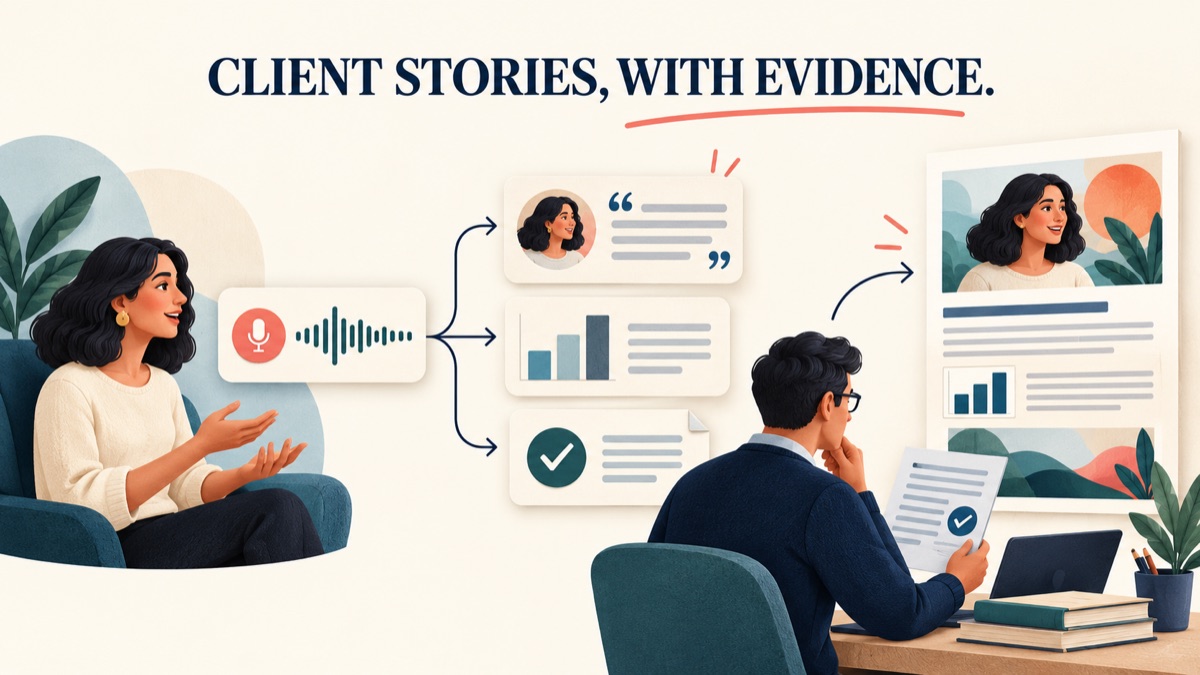
A client says the project went well. Your agency wants to turn that experience into a case study, but the answers are thin: “Great team,” “Much easier now,” and “We saved a lot of time.” Nobody can find the original baseline, the person with the figures missed the interview, and the writer is waiting for another call.
This guide is for agency account leads, consultants and freelance writers who need usable client stories without an endless interview-and-chase cycle. A short voice client intake can collect the client’s explanation asynchronously. VocalJet provides a transcript and summary; your team checks the details and builds the source brief.
The questions below focus on a completed engagement: what changed, what supports that account, and what the client is ready to share. Use the interview packet, evidence record and follow-up email to move from positive feedback to material a writer can responsibly use.
Quick Answer
Client case study interview questions should uncover the original problem, the work performed, the changes the client observed and the evidence behind those changes. Start with one concrete incident before the project, ask what happened during the engagement, then request a specific example or source for each proposed result.
A client case study interview collects the problem, work performed, observed changes and supporting evidence needed to describe a completed engagement. Ask the person who experienced the work to tell the story. Ask the person who owns the relevant records to check any numerical claims. They may be different people.
For an async interview, send a small question packet, let the client answer by voice or text, and follow up only on the gaps. Keep factual verification and permission to publish as separate checks: a statement can be accurate but unavailable for public use, or approved in principle but still unsupported.
| What you need | Question to start with | Useful output |
|---|---|---|
| A concrete problem | “Walk me through one instance before we started.” | A scene the reader can understand |
| A clear account of the work | “What did our team change, and what did your team change?” | A fair description of each contribution |
| A supported result | “What changed, over which period, and where can we check it?” | An observation or metric with a source |
| A usable client perspective | “How would you describe the difference to a colleague?” | Original wording to review as a possible quote |
| A publication decision | “Who should check the draft and proposed uses?” | A named reviewer and explicit next step |
Choose The Story And The Right Interviewees
Pick one engagement and one reader problem. A consultant’s onboarding redesign might support a story about clearer handovers. It does not need to become a claim about the client’s entire business performance.
Interview someone close enough to the work to describe specific events. The account sponsor may explain why the project mattered, while an operations lead can describe what changed day to day. A reporting owner may be needed to confirm definitions and figures. One person can hold several of these roles; do not assume the most senior contact has every answer.
HubSpot’s case study question guide covers the client’s problem, selection process, experience and results. For service engagements, add a practical check to that narrative: who can substantiate each result you hope to include?
Invite participation after there is something meaningful to describe. Project completion does not always mean outcomes are measurable. If the work has just launched, capture implementation details now and agree a later date to revisit results. Keep participation separate from the obligations in your client offboarding checklist.
16 Client Case Study Interview Questions
Use this as a question bank, not a compulsory questionnaire. Read the project record first, prefill facts you already know, and select questions that address the missing story. The prompts below are designed for an agency’s own client engagement; a freelance writer can adapt “our team” to the provider being featured.
The Situation Before The Work
- What happened on a particular day that made this problem hard to ignore? Ask for an event, stalled task or recurring exchange. This gives the writer something more concrete than “our process was inefficient.”
- Who was affected, and what did they have to do to work around it? Capture the person’s role and actual workaround. Avoid assigning a cost or time saving that the client has not established.
- What had you already tried, and where did it fall short? This reveals constraints and explains why the next approach was different. It also prevents presenting an existing improvement as something the agency introduced.
- Before the engagement, what would a useful result have looked like to your team? Compare the answer with the original brief. If priorities changed, preserve both the original objective and the later decision.
What Happened During The Engagement
- Which part of the work changed how your team handled the problem? Ask the client to name a deliverable, decision or working practice. “The workshop” becomes more useful when they explain which decision from it mattered.
- What did our team do, and what did your team implement afterward? Separate advice, production, adoption and ongoing operation. Readers should understand who did what.
- Where did the first approach need adjustment? A specific obstacle and response can explain the work better than an uninterrupted success story. Ask what changed in response to the obstacle.
- What else changed during the same period? New staff, a different offer, seasonality or another supplier may also have influenced outcomes. Record these factors before making a causal claim.
Results And Supporting Evidence
- What is one thing your team can do now that was difficult before? Ask for an observable example. A changed handover, clearer decision or newly usable resource may be meaningful even without a numerical result.
- If you mention a number, what exactly does it measure? Establish the unit, population and calculation. “Faster delivery” might refer to elapsed days, staff hours or a subjective impression; those are different claims.
- Which before-and-after periods are being compared, and are they comparable? Record dates and changes in workload or project mix. Two numbers without context can create a misleading comparison.
- Who owns the source, and what can they share for checking? Ask for the relevant report, record or explanation through an appropriate channel. The writer rarely needs an entire account export to check one proposed statement.
Client Perspective And Publication Review
- How would you explain the difference to a colleague facing the same problem? Let the client choose their language. Do not feed them a polished endorsement and treat their agreement as a spontaneous quote.
- What would you tell that colleague to prepare before starting similar work? This can surface a useful lesson, dependency or limitation for the reader.
- Which details should stay internal, and who can review the proposed names, figures and quotes? Identify the review owner early. Willingness to answer questions does not settle which material the client wants published.
- What should we send back for review, and where are you comfortable with the finished story appearing? Make the proposed asset and uses concrete, such as a website case study and a sales PDF. Record the response and resolve open points before publication.
A Short Async Interview Packet
For a busy client, start with questions 1, 5, 8, 9, 12 and 15. They cover the problem, the work, other influences, an observed change, evidence ownership and review boundaries. This six-question starting point is a suggested workflow, not a research-backed completion rule.
Send the project name and intended story angle with the questions. Offer a voice reply or written answers, and tell the client that “I don’t know” is useful. They can identify the right colleague instead of guessing.
1 | We would like to explore a case study about [engagement / reader problem]. |
Keep evidence files in the agreed document location and refer to them by name. A voice recording is useful for explaining a result; a report is usually a better place to verify it.
Turn Answers Into A Case Study Source Brief
A case study source brief connects each proposed statement to its source, verification status and publication status. It gives the writer a clear boundary between material they can use and questions that remain open.
VocalJet’s AI client brief generator can help organize spoken context. For this workflow, the agency adapts the reviewed transcript and summary into the record below. The evidence checks and publication decisions are work for the people involved.
1 | Case study source brief |
A client-reported result is an observation or recollection; a verified metric has a defined measure, comparison period and checked source. Preserve that distinction when writing the draft.
A qualitative case study can describe a documented process change and an attributed client experience. It does not need an invented percentage. If the client cannot verify “we saved half our time,” use the specific change you can support or leave the claim out.
Before And After: A Voice Reply Becomes A Source Brief
The following example is fictional. A consultant has helped a professional services firm improve its internal project handovers.
Raw Client Voice Reply
“We used to spend most Fridays chasing updates. Now handovers feel faster, maybe half as long. Lena has the figures. Your workshop helped, although we also hired a coordinator. The checklist makes it easier to see what’s missing. You can quote me about the checklist, but I need to check with our director before you use our name.”
A premature draft might say that the consultant cut handover time by 50%. The recording does not establish that. It contains a tentative estimate, another possible influence and an unresolved publication decision.
Reviewed Evidence Record
| Source material | What the writer can establish now | Next check |
|---|---|---|
| Fridays spent chasing updates | The interviewee describes a recurring difficulty | Ask for one specific example; keep it attributed |
| “Maybe half as long” | A tentative recollection, not a checked measurement | Ask Lena for the measure, periods and source; hold the percentage |
| Workshop plus new coordinator | More than one change may have contributed | Describe both; do not assign the entire outcome to the workshop |
| Checklist comment | A candidate quote present in the recording | Check the exact wording and send the excerpt for review |
| Director must check name use | Client identification remains unresolved | Ask who will review the proposed attribution and uses |
The working story angle is now “making missing handover information easier to identify.” The time-saving claim stays open. The writer can develop the structure while the evidence owner checks the numbers.
Use the client voice note to action items workflow to prepare the follow-ups, then review and assign them in your project system. Here, the agency lead contacts Lena, the writer checks the quote against the audio, and the client contact identifies the publication reviewer. Add dates only once they are agreed.
An AI summary is a drafting aid, not a verbatim client quote. In this example, “The checklist makes it easier to see what’s missing” appears in the fictional original. A rewritten phrase such as “The consultant transformed our efficiency” does not. Keep paraphrases out of quotation marks and submit edited quote wording for explicit review.
Follow-Up Email For Missing Case Study Evidence
Ask for the remaining facts, not another full interview. Reference the statement or question so the client can route it to the right person.
1 | Subject: Three checks for the [project] case study |
Best Workflow For Agencies, Consultants And Freelancers
Choose one story owner. Give the writer or account lead responsibility for the source brief, open questions and draft version. Multiple colleagues can contribute without creating separate versions of the client’s story.
Collect the explanation in the client’s preferred format. An async client feedback tool can capture nuance without finding a shared calendar slot. Explain the purpose first, and offer text when the client prefers it.
Review the source before drafting claims. Check names, numbers and proposed quotes against the recording and documents. Preserve uncertainty from the original answer. A fluent summary should not turn “I think” into a confirmed fact.
Resolve evidence gaps in one focused packet. Ask the reporting owner for a source and the interviewee for a concrete example. GitLab’s communication handbook emphasizes writing down conclusions from offline conversations. Apply that principle here by updating the shared source brief after each clarification.
Request review of a specific version. Send the proposed text, attribution, figures and intended uses together. Record corrections and publication decisions against that version. If a quote or result changes afterward, send the changed material back for review.
VocalJet supports the capture and preparation steps through voice links, transcripts, summaries and follow-up-ready text. The team supplies the evidence judgment and editorial review. Compare VocalJet pricing if this is a recurring part of your client communication workflow.
Voice Reply, Document Request Or Live Interview?
| Situation | Best next step | Why |
|---|---|---|
| The client remembers the experience but dislikes long forms | Short voice reply | Captures examples and context in their own words |
| The story depends on an exact metric | Request the relevant record and its definition | A more confident retelling does not verify a number |
| Several people give conflicting accounts | Focused live interview with the relevant owners | Lets them clarify events and responsibilities together |
| The client is unsure how to describe the problem | A brief live conversation with specific probes | Immediate follow-up may uncover the missing example |
| Only the draft wording needs review | A versioned document with precise review requests | Keeps corrections attached to the text that may be published |
Move to a call when the next useful question depends on the previous answer or when the accounts conflict. Keep it focused on the unresolved issue, then add the outcome to the source brief.
FAQ
What should I ask a client in a case study interview?
Ask about a specific problem before the engagement, the work performed, the changes they observed and the evidence behind those changes. Include questions about other contributing factors, who can check the facts and who should review the proposed publication.
How many case study questions should I send first?
Start with a small set that covers the missing story. The six-question starter in this guide covers the problem, work, other influences, observed change, evidence owner and review boundaries. Add follow-ups only where the answers leave a useful gap.
Can a client answer case study questions by voice?
Yes. A guided voice reply can capture the client’s experience asynchronously. Review the transcript against the recording, request documents for factual checks and send proposed quotes and publication details back for review.
Can I write a client case study without numerical results?
Yes. Use specific, supported descriptions of what changed and clearly attributed client experience. Do not turn a rough estimate into a percentage. Explain the limits of the evidence and leave unsupported claims out.
Can I use an AI summary as a client quote?
An AI summary should not be presented as a verbatim quote. Check exact excerpts against the original recording or written answer. If you propose edited wording, label it as a proposed quote and ask the client to review it explicitly.
How does VocalJet help with a case study interview?
VocalJet lets clients share spoken context and provides transcripts, summaries and follow-up-ready text. Agencies can use that material to prepare a case study source brief and evidence requests. People still need to verify the facts, check quotes and confirm publication decisions.