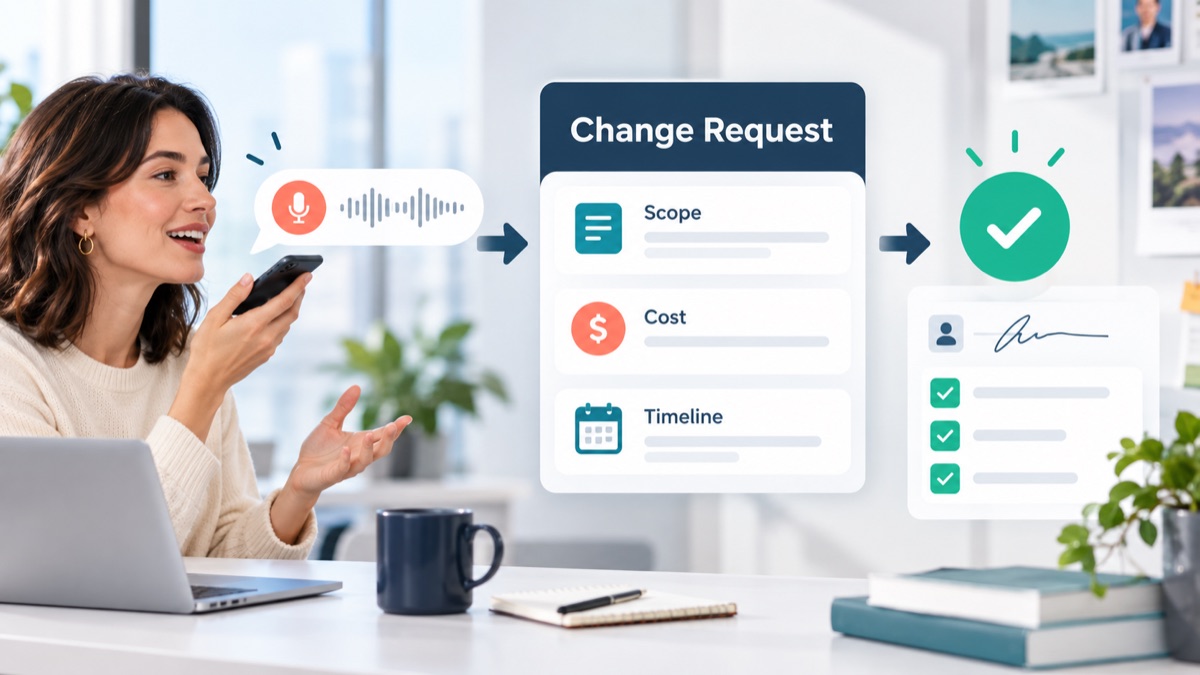
Client change requests are where many agency projects quietly lose margin. A client asks for “one more section,” a stakeholder adds a new requirement during feedback, or a voice note explains a useful idea that was never in the original plan. The request may be reasonable, but the workflow around it decides whether the agency protects scope or absorbs unpaid work.
A client change request workflow gives the team a calm way to capture the ask, assess impact, get the right decision and turn the result into action items. It is not a defensive script. It is a shared record that separates the client’s desired outcome from the scope, timeline, budget, dependencies and approval needed to deliver it.
This guide gives agencies, consultants, studios and freelancers a reusable change request template, a decision table, a raw voice-note example and an approval email. Use it when client feedback creates work that may change the project agreement.
Quick Answer
A client change request workflow is the process an agency uses to capture a requested change, assess its impact, approve or reject it, communicate the decision and update the delivery plan. It keeps client requests from becoming hidden scope creep.
The best workflow separates four records: the original client request, the agency’s impact assessment, the client’s approval decision and the action items that follow. A request is not ready for production until those records are clear.
Use this quick routing table before assigning work.
| Client signal | Workflow route | What to do next |
|---|---|---|
| Small edit within agreed deliverable | Normal task | Confirm owner, version and deadline |
| Request is unclear but may fit scope | Scope clarification | Ask one focused question before estimating |
| Request changes deliverable, timeline or budget | Change request | Assess impact and get approval |
| Request adds a new service or stakeholder review | Change request or new proposal | Confirm commercial and scheduling impact |
| Request is useful but not urgent | Backlog decision | Record it and ask whether it replaces current work |
Client change control is a workflow for turning proposed changes into visible decisions before delivery work starts.
Why Change Requests Break In Agencies
Change requests break when the agency treats every client ask as either a yes or a no. Most requests need a third step first: translation.
“Can we add a comparison section?” might mean a copy edit, a new landing page module, a design revision, a legal review, a CMS build and analytics tracking. The client’s words describe the desired outcome. The agency still has to identify the delivery impact.
Asana describes a change control process as a structured way to submit, review and approve changes, with steps for request initiation, assessment, analysis, implementation and closure. Source: Asana change control process.
For client services, the same principle applies in a lighter, client-friendly way. The agency needs a visible record before the change becomes work.
Scope creep often starts when a reasonable request skips that record. Atlassian frames scope creep as project work expanding beyond the original plan without matching control over scope, timing or resources. Source: Atlassian scope creep guide.
Change Request vs Task vs Scope Clarification
Do not make every request a formal change request. That creates friction and trains clients to avoid sharing useful context. The goal is to route the request correctly.
| Item | Definition | Example | Record needed |
|---|---|---|---|
| Task | Work already covered by the agreed scope | Replace approved copy in one existing section | Task with owner and date |
| Scope clarification | Missing information before the agency can classify the request | “Make the page stronger for enterprise buyers” | Question, answer and revised summary |
| Change request | Proposed work that changes scope, timeline, budget, deliverables or responsibilities | Add a new integration, page, review round or stakeholder | Impact assessment and approval |
| Change order | Approved documentation authorizing the change | Signed add-on, approved estimate or written decision | Approval record and updated plan |
| Backlog item | Valuable idea not approved for current delivery | Future calculator, extra case study, new campaign | Backlog owner and review date |
Use client request intake workflow for the first capture step. Use scope creep client intake when a request starts changing deliverables, assumptions, stakeholders, timeline or approval rules.
Client Change Request Template
Use this template inside your project tool, shared document or client workspace. Keep it short enough that the account lead will actually use it.
1 | CLIENT CHANGE REQUEST |
A client change request template is useful because it preserves the client’s reason, not just the task. The reason often determines whether the agency should implement exactly what was requested or suggest a better route.
The Impact Assessment Matrix
Before sending the change back to the client, assess impact across five dimensions. The request may be simple in one dimension and risky in another.
| Impact area | Question to answer | Example risk |
|---|---|---|
| Scope | Does this add or change a deliverable? | A new page section becomes copy, design, build and QA |
| Timeline | Does it affect a milestone or review date? | Extra review pushes launch by one week |
| Budget or capacity | Does it require additional paid work or retainer capacity? | Included service fits, but the month is already committed |
| Dependencies | What assets, access or decisions are required? | Client wants new testimonials but has not provided approvals |
| Approval | Who can approve the impact? | A stakeholder requests the change but procurement owns budget |
PMI’s scope management guidance emphasizes that baseline changes should be identified, communicated, coordinated and approved before work starts. Source: PMI scope management.
Agencies do not need heavyweight governance for every client project. They do need one habit: do not start changed work until the changed work has a visible decision.
Raw Client Voice Note To Change Request Example
Here is a fictional voice note from a SaaS client during a website project:
“I just looked at the pricing page again. Could we add a comparison table against the two main competitors? It would help sales. Also, can we make the CTA go to a demo booking form instead of the signup page? I know we are close to launch, but this feels important.”
The request is valuable, but it mixes a new content asset, possible legal review, a conversion path decision and a timing risk.
Structured Change Request
| Field | Reviewed output |
|---|---|
| Requested outcome | Strengthen pricing page for sales conversations before launch |
| Possible included task | Change CTA destination if demo booking form already exists and tracking is simple |
| Change request item | Add competitor comparison table to pricing page |
| Scope impact | New copy, design, stakeholder review and QA |
| Timeline impact | Could affect launch if included before current deadline |
| Dependency | Competitor claims, legal/compliance review, final demo form URL |
| Decision needed | Swap with another section, approve add-on, or defer post-launch |
Action Items
| Owner | Action | Due |
|---|---|---|
| Client | Confirm whether comparison table is required before launch | Today |
| Agency lead | Estimate copy, design, build and QA impact | Today |
| Client approver | Approve swap, add-on or deferral | Before production starts |
| Delivery lead | Update tasks only after approval | After decision |
Use voice feedback for agencies when the client needs to explain why the change matters. Use client voice notes to action items when the recording needs to become tasks, questions, scope labels and follow-up-ready text.
Approval Email Template
Send the client options instead of a vague warning about scope. This keeps the tone collaborative while making the tradeoff explicit.
1 | Subject: Change request options for [project / deliverable] |
If the request is actually out of scope and needs a boundary-setting response, use a separate response workflow. If it is a valid change that needs approval, this email keeps the conversation focused on options.
Best Workflow For Agencies, Consultants And Freelancers
1. Capture The Client’s Original Words
Keep the source message, voice note, comment or email. Do not rewrite the request into a task too early. The original wording often contains the business reason, urgency and hidden assumption.
For new projects, connect this record to client intake software for agencies. For active projects, connect it to your request queue or decision log.
2. Classify Before Estimating
Decide whether the request is a task, clarification, change request, new proposal or backlog item. This classification comes before scheduling. A request can be easy to do and still require approval because it changes the agreement.
3. Assess Impact In Plain Language
Avoid internal shorthand. The client should understand what changes if the request is approved. Say what happens to scope, timing, cost, dependencies and decision ownership.
If feedback is scattered across comments and voice notes, use async client feedback to collect context before summarizing the change.
4. Get The Right Approval
The person who wants the change may not be the person who can approve it. Record the approver and decision source. If the change affects project direction or sign-off, also add it to a client decision log.
5. Convert Approval Into Action Items
Once approved, turn the change into delivery work with owners, due dates, acceptance criteria and dependencies. Use client feedback to action items when the source is feedback-heavy and the team needs clean next steps.
6. Close The Loop
After implementation, record what changed and where the approved decision lives. GitLab’s communication handbook is a useful model for documented, asynchronous collaboration because decisions stay findable instead of disappearing into meetings. Source: GitLab communication handbook.
How VocalJet Fits This Workflow
VocalJet fits at the messy-input stage. A client can explain the requested change by voice, including why it matters, what outcome they want and what tradeoff they expect. That spoken context can become a transcript, summary, action items, scope signals and follow-up text for the agency to review.
The important part is review. VocalJet can help structure the request, but the agency still validates scope, pricing, schedule and approval authority. The workflow is strongest when voice context becomes a reviewed change request record before production begins.
Client change request workflows work especially well with async client feedback, because the client can explain nuance without booking another meeting and the agency can respond with a concrete decision path.
FAQ
What Is A Client Change Request Workflow?
A client change request workflow is the process an agency uses to capture, assess, approve, communicate and implement requested changes to a client project.
What Should A Client Change Request Include?
A client change request should include the original request, desired outcome, affected deliverable, scope impact, timeline impact, budget or capacity impact, dependencies, approver and final decision.
When Should A Client Request Become A Change Request?
A client request should become a change request when it changes agreed deliverables, timeline, budget, responsibilities, approval rules, dependencies or project assumptions.
Is A Change Request The Same As Scope Creep?
A change request is not automatically scope creep. It becomes scope creep when changed work is accepted or performed without clear assessment, approval and matching adjustment to scope, time or budget.
Can Voice Notes Help With Client Change Requests?
Voice notes help when the client needs to explain context, urgency or tradeoffs. The agency should convert the voice note into a reviewed change request record before assigning work.
How Do Agencies Keep Change Requests From Slowing Down Projects?
Agencies keep change requests fast by using one template, one impact matrix, clear approval owners and a short list of decision options instead of reopening the whole project plan.
Sources
- Asana: Change control process - request, assessment, approval, implementation and closure.
- Atlassian: Scope creep guide - how uncontrolled scope expansion affects projects.
- PMI: Scope management - baseline changes, authorization and audit trail.
- GitLab: Communication handbook - documented asynchronous communication practices.