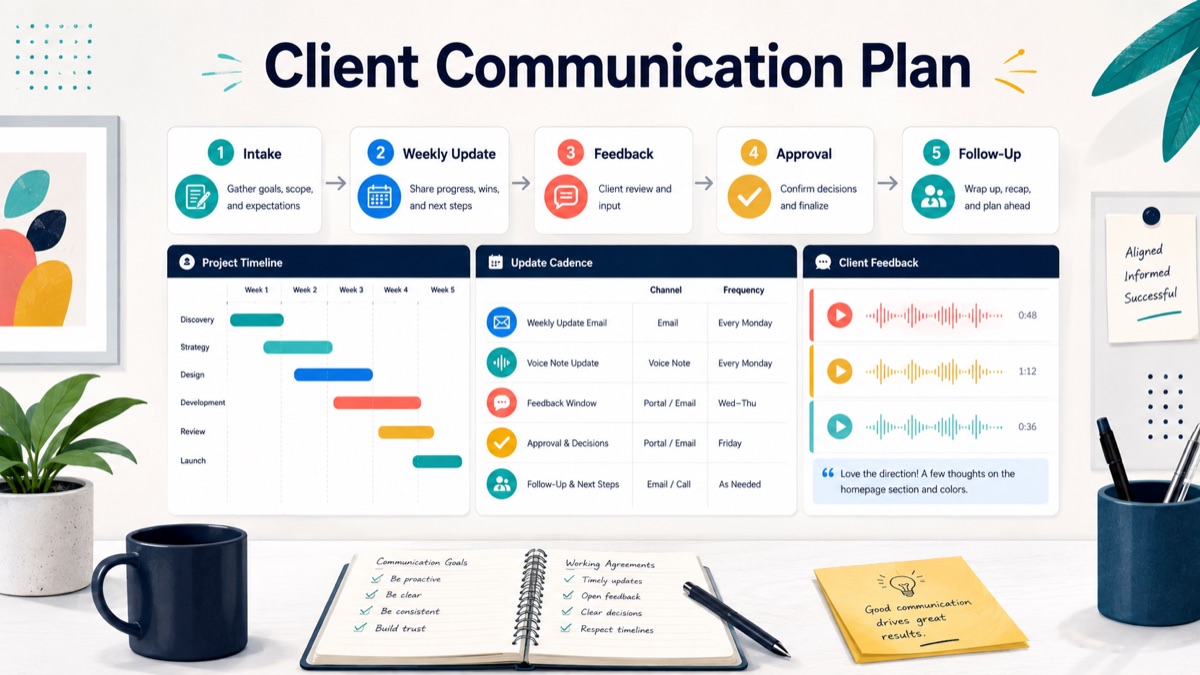
Most agency communication problems do not come from silence. They come from scattered updates, unclear channels, vague client feedback, missed follow-up and too many small questions becoming calls.
For agencies, consultants, creative studios and freelancers, a client communication plan is the operating agreement that tells both sides how updates, feedback, approvals, requests and risks will move through the project. Without it, the team spends delivery time answering “where are we?”, “who has this?”, “did we approve that?”, and “can we also add this?”
This guide gives you a practical client communication plan for agencies. It includes an update cadence, channel rules, client feedback workflow, voice-note prompt, before-and-after example, follow-up scripts and a template you can reuse on client projects.
Quick Answer
A client communication plan for agencies is a written workflow that defines who communicates with the client, which channels are used, how often updates happen, how feedback is collected, who approves decisions and how follow-up is confirmed.
The best client communication plan does not add more meetings. It separates routine updates from decisions, async feedback from live discussion, and new requests from in-scope work. That gives the client predictable visibility while protecting the agency from scattered messages and hidden scope creep.
Use this quick structure:
| Communication need | Best format | Owner | Output |
|---|---|---|---|
| Weekly project status | Async written or voice update | Agency lead | Progress, blockers, next steps |
| Detailed client context | Voice note or intake link | Client owner | Transcript, summary, brief or action items |
| Asset-specific feedback | Comments plus summary | Client reviewers | Confirmed revision list |
| Approval decision | Written decision record | Final approver | Approved, blocked, changes requested or change request |
| New request | Intake queue | Agency lead | Task, question, dependency or scope risk |
| Risk or conflict | Short live call after async prep | Decision owners | Decision and written recap |
For a product-led setup, connect client intake software for agencies, async client feedback, an async client feedback tool, voice feedback for agencies, client feedback to action items, client voice notes to action items and scope creep client intake.
Why Agency Client Communication Breaks
Client communication breaks when the team has conversations but no operating record.
An account manager may send a status email. A designer may receive comments in Figma. A strategist may get a voice note from the founder. A project manager may hear about a deadline change on a call. Each message may be reasonable, but the project becomes fragile when no one knows which message is the source of truth.
Asana’s communication plan guide frames the core elements clearly: audience, key message, channel, frequency and owner. For agencies, those elements need one extra layer: scope status. Client messages often change deliverables, approval paths, dependencies or deadlines.
Atlassian’s stakeholder communication plan play also emphasizes the practical goal: share the right information, through the right channels, at the right cadence. In client service work, cadence matters because clients often ask for ad hoc updates when they do not know when the next real update is coming.
A client communication plan is the source of truth for client updates, feedback, approvals, requests and escalation rules during a project.
What The Plan Should Define
Every agency client communication plan should answer seven questions before work gets busy.
| Plan element | Question to answer | Why it matters |
|---|---|---|
| Client contacts | Who gives input and who approves? | Prevents mixed stakeholder comments from becoming instructions |
| Agency owner | Who sends updates and routes requests? | Avoids duplicated replies and missed follow-up |
| Channels | Where do updates, feedback and approvals live? | Keeps the team from chasing email, chat and comments |
| Cadence | When will the client hear from the agency? | Reduces random status checks |
| Feedback rules | How should revision feedback be shared? | Turns comments into usable action items |
| Scope rules | What happens when a request changes work? | Protects budget, timeline and margin |
| Escalation path | When does async become a call? | Keeps hard decisions from drifting |
The plan should be short enough to use. If it becomes a long internal policy document, the client will ignore it and the team will fall back to old habits.
Client Communication Plan Template For Agencies
Copy this into your kickoff doc, client workspace or project management tool.
1 | Client communication plan |
This template works because it gives communication a shape before the client project becomes noisy.
The Best Workflow For Agencies, Consultants And Freelancers
For agencies, consultants and freelancers, the strongest workflow is not “more proactive communication.” It is a predictable loop.
1. Set The Communication Plan During Intake
Do not wait for the first missed update.
During intake or kickoff, ask how the client wants to receive updates, who approves work, what counts as urgent and where feedback should live. If the client gives vague answers, use a voice intake form to capture context in their own words.
Voice client intake helps when the client can explain stakeholders, deadlines, review concerns and past project issues faster by speaking than by filling out another form.
2. Send A Weekly Async Update
A weekly update should make the client feel informed without starting another thread of scattered questions.
Use this format:
1 | Subject: Weekly update: [Project] - [Date] |
GitLab’s communication handbook is useful here because it treats async communication as a way to move projects forward without requiring everyone to be present at the same time, while still writing down offline conclusions. Agency updates need the same discipline.
3. Separate Feedback From Decisions
Client feedback is not the same as client approval.
Feedback explains what should change. Approval confirms whether a specific version can move forward. A communication plan should give the client language for both.
| Client message | Meaning | Agency response |
|---|---|---|
| “Looks good” | Ambiguous | Ask whether this is approval or directional feedback |
| “Change the hero CTA” | Revision feedback | Add action item if in scope |
| “Legal needs to review” | Client dependency | Assign client owner and deadline |
| “Can we add a comparison section?” | Possible scope change | Estimate, defer or swap scope |
| “Approved for launch” | Decision | Record approver, version, date and next step |
Use voice feedback for agencies when the client needs to explain why a comment matters. Then turn the result into client feedback to action items before production starts.
4. Route New Requests Through Intake
New requests should not bypass the communication plan.
Teamwork’s client project management guide is written for client work and highlights the added complexity of managing scope, approvals, communication and profitability at the same time. That is the agency reality: a client update can become a scope decision quickly.
When a client asks for something new, classify it before assigning work:
| Request category | Example | Next action |
|---|---|---|
| Included task | “Fix the typo on slide 4” | Add to current revision queue |
| Clarification | “Make it more premium” | Ask for examples or voice context |
| Client dependency | “We can send assets next week” | Assign client owner and due date |
| Approval issue | “The CEO wants to review too” | Confirm final approver |
| Scope change | “Add another landing page” | Estimate, defer or swap |
| Backlog | “Useful for next quarter” | Park for later phase |
Use scope creep client intake when the request changes deliverables, timing, budget, review rounds or approval owners.
5. Confirm Follow-Up In Writing
Every live call, voice note or messy feedback thread should end with a written confirmation.
1 | Follow-up summary |
Use client voice notes to action items when a spoken update needs to become tasks, owners, open questions and follow-up-ready email text.
Raw Client Update To Structured Communication Record
Here is what the workflow looks like in practice.
Raw Client Voice Note
1 | The homepage draft is close. Sales likes the new structure, but they are worried the offer is still not obvious before pricing. Legal has not approved the ROI line yet. Also, the founder asked if we can add a short comparison section, but I do not know if that changes the launch date. We still need to go live next Friday if possible. |
Structured Communication Record
| Field | Output |
|---|---|
| Status | Homepage draft is close, but launch has approval and scope risk |
| Positive signal | Sales likes the new structure |
| Feedback | Offer may need clearer explanation before pricing |
| Dependency | Legal must approve or replace ROI line |
| New request | Founder requested a comparison section |
| Scope status | Comparison section needs estimate, deferral or swap |
| Timeline risk | Next Friday launch may be affected |
| Client owner | Marketing lead for legal and founder decision |
| Agency owner | Project lead for options and revised launch path |
Follow-Up Email
1 | Hi [Name], |
This is the difference between a client update and a client communication workflow. The first shares information. The second turns information into decisions, action items and scope clarity.
When To Use Async, Voice Or A Meeting
Not every communication belongs in the same channel.
| Situation | Best channel | Why |
|---|---|---|
| Routine progress update | Async written update | Keeps status visible and searchable |
| Nuanced feedback | Voice note plus summary | Captures reasoning, tone and priority |
| Asset-specific edits | Comments on the deliverable | Keeps feedback attached to the work |
| Approval | Written decision record | Creates a clear project history |
| Scope change | Written options and estimate | Protects budget and timeline |
| Conflict or high-stakes tradeoff | Short call with written recap | Speeds decision while preserving record |
Async client feedback helps agencies collect richer client context without scheduling another meeting. A meeting is still useful when the team needs trust, conflict resolution or a live tradeoff decision.
FAQ
What is a client communication plan for agencies?
A client communication plan for agencies is a written workflow that defines update cadence, communication channels, owners, feedback rules, approval rules, scope-change handling and follow-up expectations for a client project.
What should an agency client communication plan include?
An agency client communication plan should include client contacts, final approvers, agency owners, update cadence, channels, feedback process, approval process, scope rules, escalation rules and follow-up format.
How often should agencies update clients?
Most agencies should send a weekly project update, plus milestone updates before reviews, approvals or launches. High-risk projects may need more frequent updates, while small one-off projects can use milestone-based communication.
Is async communication enough for client projects?
Async communication is enough for routine updates, feedback collection and follow-up when the plan is clear. Use live calls for conflict, strategy changes, urgent launch risks, stakeholder disagreement or scope decisions that cannot be resolved from written context.
How can voice notes improve client communication?
Voice notes improve client communication when the client needs to explain nuance, urgency, stakeholder pressure or uncertainty. The agency should convert the recording into a transcript, summary, action items, scope labels and a written follow-up.
How does VocalJet help with client communication plans?
VocalJet helps agencies collect client voice context, transcribe it, summarize it, extract action items, identify open questions and turn follow-up into written text that fits the client communication plan.
Final Recommendation
Start with one page. Define who owns client updates, where feedback lives, when the client hears from you, how approvals are recorded and what happens when a request changes scope.
Then make voice part of the workflow where it helps most: unclear context, nuanced feedback, stakeholder pressure and follow-up. VocalJet is useful when a client communication plan needs more than a meeting cadence. It turns spoken client context into transcripts, summaries, action items and written follow-up your agency can actually deliver against.