Consulting projects rarely fail because nobody talked. They fail because the context from the first conversation never becomes a usable operating document.
The client explains the situation in fragments. One stakeholder describes the business problem. Another mentions the timeline. A third person casually adds a hidden dependency. By the end of the discovery call, the consultant has pages of notes, but not a clear picture of goals, constraints, risks, ownership and next steps.
That is why discovery notes matter. Good client discovery notes do more than summarize a conversation. They capture decision-ready context that can turn into a project brief, a scope check, an action plan and a follow-up message the client can confirm.
Client discovery notes are structured records of the goals, constraints, stakeholders, risks and next steps discussed during a consulting discovery conversation. The fastest discovery-note workflow is the one that captures raw context quickly, then turns it into a brief before details get lost.
Quick Answer
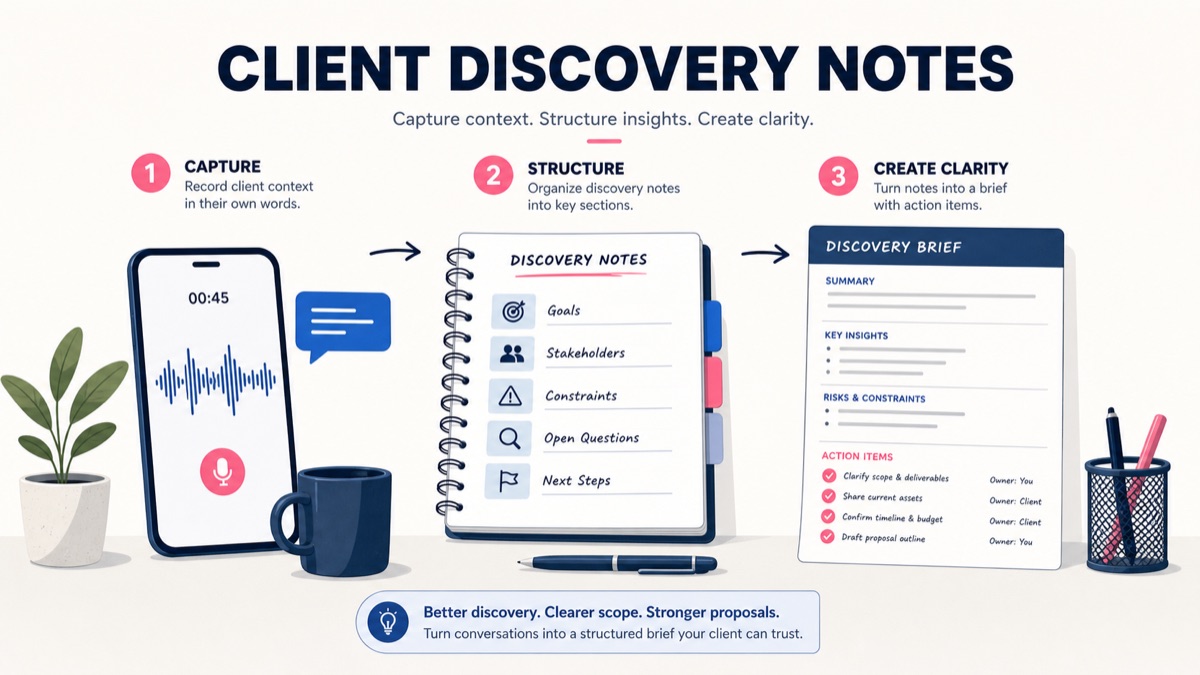
To capture client discovery notes faster, consultants should stop trying to write a perfect transcript during the conversation. Instead, capture the client’s raw context, organize notes into a repeatable structure, then convert the result into a short brief with goals, constraints, risks, open questions and action items.
The most practical workflow is:
- Capture the client’s context in their own words.
- Sort notes into business problem, stakeholders, constraints, scope signals and next steps.
- Turn the notes into a structured discovery summary immediately after the conversation.
- Send a confirmation recap before writing the proposal or kickoff plan.
Client discovery notes are not the same as a transcript. A transcript records everything. Discovery notes keep only the information needed to scope, price, brief or follow up correctly.
| Discovery note method | Best for | Main weakness | Best output |
|---|---|---|---|
| Live handwritten notes | High-attention conversations | Easy to miss details | Key themes and decisions |
| Full transcript | Searchability and recall | Too much raw text | Source material |
| Structured discovery notes | Consulting delivery and scoping | Needs a repeatable template | Brief, risks and next steps |
| Follow-up email only | Fast confirmation | Too short for internal reuse | Client-facing recap |
For a product-led workflow, combine voice client intake, an AI client brief generator, client voice notes to action items, and scope creep client intake.
Why Consultants Lose Discovery Context
Consultants usually lose context in one of four places:
- during the call, because they are trying to listen, ask questions and write at the same time;
- after the call, because raw notes are never cleaned into a reusable summary;
- during scoping, because vague notes turn assumptions into requirements;
- during follow-up, because the client only sees a short recap while the internal team still works from fragmented notes.
Asana’s guide to meeting notes explains that useful notes should capture discussion points, action items, key decisions and takeaways, then be reviewed and shared quickly. That is the right baseline for consulting discovery.
GitLab’s handbook on asynchronous communication also reinforces a practical rule: important context needs a written home. For consultants, discovery notes are that written home before the project becomes a proposal, workshop, audit or implementation plan.
What Good Client Discovery Notes Should Capture
A consultant does not need to capture every sentence. The goal is to capture the details that affect delivery.
Use this structure:
| Discovery section | What to capture | Why it matters |
|---|---|---|
| Business problem | What the client says is not working | Prevents shallow solutioning |
| Goal | What outcome the client wants | Anchors the scope |
| Stakeholders | Who gives input and who approves | Prevents review chaos |
| Constraints | Timeline, budget, tools, legal or access limits | Shapes feasibility |
| Current workflow | What the client does today | Reveals friction and risk |
| Scope signals | What sounds included, optional or unclear | Protects margin |
| Open questions | What still needs clarification | Stops premature quoting |
| Next steps | What happens after discovery | Keeps momentum |
Atlassian’s requirements template is useful here because it explicitly includes project context, assumptions, goals, requirements, questions and out-of-scope items. That structure maps well to consultant discovery notes, even when the engagement is not software.
Scope clarification questions help consultants separate requested deliverables from assumptions before proposal or kickoff.
A Practical Client Discovery Notes Template
Here is a reusable template for consultants.
1 | Client discovery notes |
This template is better than a blank note page because it forces the consultant to distinguish business context from scope assumptions.
Raw Notes To Structured Brief Example
Here is what the transformation should look like.
Raw Discovery Notes
- Client says onboarding is “messy” and partners do not know what to do next
- Wants a cleaner activation workflow before Q3
- Sales, customer success and product all touch onboarding
- No one owns the current process end to end
- Team may need new messaging, revised email sequence and handoff checklist
- VP of Customer Success approves, but product lead will have strong opinions
- They want something “practical, not a giant strategy project”
- Existing documentation is spread across Notion, email and slides
Structured Discovery Summary
| Section | Structured output |
|---|---|
| Business problem | Onboarding context is fragmented, causing partner confusion and weak handoffs |
| Goal | Create a clearer activation workflow before Q3 |
| Stakeholders | Sales, customer success, product; VP approves final direction |
| Constraints | Existing documentation is scattered; approval may slow if product disagrees |
| Scope signals | Workflow mapping and handoff clarity sound in scope; full strategy reset may be out of scope |
| Open questions | Are email rewrites included? Is tooling change part of the project? What exact deadline matters? |
| Next steps | Confirm deliverables, collect current assets, define exclusions, draft proposal |
A client brief generator turns discovery notes into structured goals, constraints, risks and next steps. That is the bridge between note-taking and actual consulting delivery.
How To Turn Discovery Notes Into Action Items
Do not let the notes stop at “interesting context.” Convert them into actions.
Asana’s guide to action items defines action items as specific tasks with an owner and deadline that come out of a discussion. That rule works well for consulting discovery.
Use this triage table:
| Note type | Meaning | Action |
|---|---|---|
| Confirmed fact | Reliable project context | Move into the brief |
| Open assumption | Something sounds true but is not confirmed | Ask a clarification question |
| Scope risk | Delivery may expand or slow down | Mark for proposal or exclusion |
| Decision dependency | Another person must confirm | Assign an owner and follow-up |
| Client task | The client owes information or access | Add to the next-step list |
Strong discovery-note action items answer four questions:
- What needs to happen?
- Who owns it?
- When is it needed?
- Why does it matter to scope, timing or approval?
This is where client voice notes to action items becomes relevant. The highest-value workflow is not storing more notes. It is converting client context into usable work.
Best Workflow For Consultants
Step 1: Capture Raw Context Fast
Do not optimize for polished notes during the conversation. Optimize for listening.
If the conversation is live, capture short bullets. If the client sends spoken context asynchronously, use a voice intake form or voice client intake workflow so the context exists before the call or instead of the call.
Step 2: Clean The Notes Immediately
Within the same day, rewrite the notes into the discovery template. This is when you still remember what the client implied but did not say explicitly.
Step 3: Separate Scope From Context
Not every business pain is a deliverable. Distinguish:
- the business problem;
- the likely project scope;
- the missing information;
- the hidden risks.
This is what protects the proposal from vague discovery notes.
Step 4: Send A Confirmation Summary
Before pricing or kickoff, send a short recap:
1 | Thanks for the discovery conversation. Here is my current understanding of the engagement: |
This keeps the client aligned and gives you a checkpoint before assumptions harden.
Step 5: Convert Notes Into A Brief
Once the client confirms the summary, turn the notes into a brief, scope check and action plan. This is where tools like client intake software for agencies or an AI client brief generator fit naturally.
When Voice Beats Typed Discovery Notes
Typed notes are still useful. But voice often captures better discovery context when:
- the client thinks out loud and explains nuance better than they write;
- multiple stakeholders need to add context asynchronously;
- the consultant wants a searchable record without another scheduling round;
- the project is messy and the problem is still being defined.
Voice client intake is a workflow where clients explain project context asynchronously by voice. The recording becomes structured goals, constraints, risks and next steps instead of staying a raw audio file.
For consultants, that can reduce the number of low-value discovery calls while improving the quality of the brief that comes out of discovery.
What Not To Do
Avoid these common mistakes:
- writing notes with no fixed structure;
- treating a transcript as the final output;
- quoting a project before open questions are resolved;
- mixing confirmed facts with your own interpretation;
- ignoring who actually approves the work;
- sending only an internal summary and never getting client confirmation.
Discovery notes are useful only when they reduce ambiguity.
FAQ
What are client discovery notes?
Client discovery notes are structured records of the goals, constraints, stakeholders, risks and next steps discussed during a consulting discovery conversation.
What should consultants include in discovery notes?
They should include the business problem, desired outcome, stakeholders, constraints, scope signals, open questions and next steps.
Are discovery notes the same as a transcript?
No. A transcript records everything that was said. Discovery notes keep only the information needed to scope, brief, price or follow up correctly.
How fast should consultants clean discovery notes after a call?
The same day is best. That is when the implied context, decision tone and unclear signals are still fresh.
Can discovery notes help prevent scope creep?
Yes. They make assumptions, hidden dependencies, unclear approvals and vague deliverables visible before the proposal or kickoff.
How does VocalJet fit this workflow?
VocalJet fits the workflow where consultants capture spoken client context, then turn it into transcripts, structured briefs, scope risks, action items and follow-up-ready text.