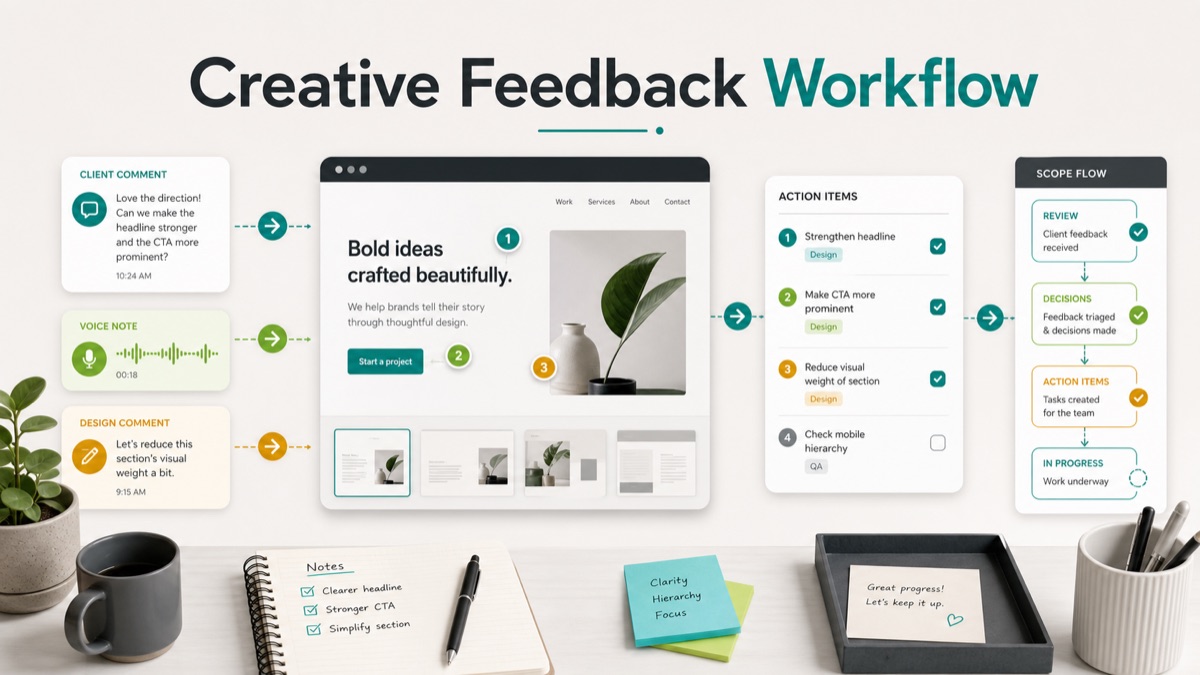
Creative agencies rarely struggle because a client has feedback. They struggle because feedback arrives without enough context to act on: a Figma comment, an email from marketing, a voice note from the founder, a screenshot from sales and one request that quietly changes scope.
For creative agencies, studios and freelancers, the goal is not to collect more comments. The goal is to turn client feedback into decisions, action items, open questions and scope labels before designers, writers or producers start another revision round.
This guide gives you a practical client feedback workflow for creative agencies, including a review packet, triage table, voice prompt, raw-feedback example, action-item format and FAQ.
Quick Answer
A client feedback workflow for creative agencies is a repeatable process for collecting client comments, preserving the original context, classifying feedback, turning confirmed changes into action items and confirming scope before production continues.
The best workflow is to keep asset-specific comments attached to the creative work, ask for voice feedback when the reasoning is hard to type, triage every comment before it becomes a task and send a short confirmation summary before the next revision starts.
Client feedback to action items is the workflow of converting raw client comments into specific tasks with an owner, expected outcome, scope status and next deadline. Voice feedback for agencies is useful when written comments are too vague to explain priority, stakeholder tension or business context.
| Feedback stage | What the agency needs | Best format |
|---|---|---|
| First review | Direction, blockers and missing context | Comments plus optional voice note |
| Revision triage | Decisions, questions, scope labels and dependencies | Internal feedback summary |
| Production | Confirmed edits with owner and due date | Action-item table |
| Scope check | New deliverables, added rounds or changed approvals | Written scope note |
| Client confirmation | Shared interpretation before work starts | Follow-up email |
For a product-led workflow, combine async client feedback, an async client feedback tool, voice feedback for agencies, client feedback to action items, client voice notes to action items, client feedback software for agencies and scope creep client intake.
Why Creative Agency Feedback Breaks Down
Creative feedback is not just a list of edits. It usually mixes taste, strategy, approval politics, audience assumptions, brand memory, deadlines and commercial risk.
That is why a comment like “make it more premium” can mean several different things:
- the design does not feel credible enough for enterprise buyers;
- the client wants more proof above the fold;
- leadership dislikes the visual direction;
- the brand tone is too playful;
- the client is comparing the work to a competitor;
- a new stakeholder is entering the process late;
- the request would add new copy, pages, assets or review rounds.
Figma’s guide to comments in Figma is useful because it keeps feedback close to the work. Location matters. But creative agencies also need meaning: why the comment matters, whether it blocks approval and whether it changes scope.
GitLab’s handbook on asynchronous communication reinforces the value of documenting context so work can move without everyone being present at the same time. Client feedback needs the same discipline.
The Creative Agency Feedback Packet
Before asking for feedback, send a small review packet. This reduces vague replies and gives the client a clearer way to respond.
1 | Creative review packet |
Async client feedback helps agencies collect richer revision context without scheduling another meeting. The review packet makes the async process specific enough to protect production time.
Decision Table: Comment, Task, Question Or Scope Risk?
Do not turn every client comment into a task. Triage first.
| Raw feedback signal | Classification | Agency response |
|---|---|---|
| “Change the hero CTA to Start a project.” | Action item | Assign the copy edit if it is in scope |
| “This feels too generic.” | Open question | Ask what audience, competitor or outcome feels wrong |
| “Leadership wants a new case study section.” | Scope risk | Confirm whether this is part of the current agreement |
| “The first concept is approved.” | Decision | Lock the direction and document approval |
| “Sales and marketing disagree.” | Decision needed | Ask for one final decision owner |
| “We can send product screenshots next week.” | Dependency | Track client-owned input before the next revision |
| “Can we also make social assets from this?” | New request | Price, defer or swap against existing scope |
A good creative agency feedback workflow separates comments from commitments. The team should only act on confirmed work.
Raw Client Feedback To Structured Agency Output
Here is a realistic before-and-after example.
Raw Client Feedback
1 | The campaign direction is close, but it still feels a bit safe. The headline is better, although the founder thinks it should sound more premium. Could we make the visual system feel more like the competitor example we shared? |
Structured Feedback Output
| Signal | Structured output |
|---|---|
| “Feels a bit safe” | Open question: clarify whether the issue is tone, visual energy or market positioning |
| “Founder wants more premium” | Decision needed: define premium as trust, restraint, proof, layout or copy style |
| “More like competitor example” | Context: compare only the approved attributes, not full imitation |
| “Stronger proof points” | Action item if proof block is in scope; client dependency for testimonials |
| “Add a customer quote block” | Scope check: may add copy and layout work |
| “Version for LinkedIn” | New deliverable unless already included |
| “Mobile mockup feels long” | Action item: review hierarchy and reduce mobile content density |
Action Items
| Action item | Owner | Scope status | Due |
|---|---|---|---|
| Clarify what “premium” means for this campaign | Client decision owner | Open question | Before revision starts |
| Reduce mobile content density | Agency designer | Included revision | Next draft |
| Draft proof block placement option | Agency strategist | Scope check | After client confirms scope |
| Send approved testimonials | Client marketing lead | Dependency | This week |
| Estimate LinkedIn adaptation | Agency PM | New request | Before approval |
This structure protects the agency from doing invisible extra work while still helping the client move forward.
Best Workflow For Creative Agencies
Step 1: Keep Feedback Attached To The Asset
Use design-file comments, page comments, document comments or a single review link so every note points to the exact asset being discussed.
When comments arrive through email or chat, copy the original wording into the feedback record and attach the related asset. Do not summarize too early. The original language often reveals uncertainty, urgency or stakeholder tension.
Step 2: Ask For Voice When Context Is Missing
Some creative feedback is too nuanced for a short comment box. Use voice when the client says:
- “I do not know how to explain it”;
- “it does not feel right”;
- “make it more premium”;
- “sales is worried”;
- “leadership is not aligned”;
- “this should be quick”;
- “can we also add…”
With voice feedback for agencies, a client can explain the reason behind a revision request. VocalJet can then help turn that voice note into a transcript, summary, scope labels, action items and follow-up-ready text.
Step 3: Classify Before Production Starts
Run every meaningful comment through five labels:
| Label | Meaning | Example |
|---|---|---|
| Decision | Client approved or chose something | “Use concept B” |
| Action | In-scope work is clear | “Replace the CTA copy” |
| Question | Missing context blocks the task | “What does premium mean?” |
| Dependency | Client input is required | “Send testimonials” |
| Scope risk | Work may exceed agreement | “Add LinkedIn versions” |
Atlassian’s guide to project collaboration emphasizes documenting context, responsibilities and decisions. Creative feedback becomes easier to manage when those same fields are captured before execution.
Step 4: Convert Only Confirmed Work Into Action Items
Asana’s guide to action items is useful because action items need clarity about what must happen, who owns it and when it is due.
For creative agency feedback, add one more field: scope status.
1 | Action item format |
If scope status is unclear, the item is not ready for production.
Step 5: Send A Confirmation Summary
Before the team starts work, send one short recap.
1 | Thanks for the feedback. Here is how we are interpreting this round: |
This gives the client a chance to correct the interpretation before the agency spends time on the wrong revision.
Creative Feedback Workflow Checklist
Use this checklist after each review round:
- One review asset is identified.
- The review goal is clear.
- The decision owner is named.
- Raw comments are preserved.
- Voice notes are transcribed or summarized.
- Every comment is labeled as decision, action, question, dependency or scope risk.
- Scope-changing requests are not assigned as normal tasks.
- Client-owned inputs have owners and deadlines.
- Confirmed work has owner, outcome, scope status and due date.
- The client receives a confirmation summary before production resumes.
This is the click-worthy part of the workflow: it turns feedback into an operating record, not another vague conversation.
When To Use Comments, Voice Notes Or A Meeting
| Channel | Best for | Avoid when |
|---|---|---|
| Asset comments | Specific visual, copy or layout edits | The comment needs strategy or stakeholder context |
| Voice note | Nuance, uncertainty, subjective reactions and scope-sensitive requests | The edit is a simple typo or factual correction |
| Written summary | Confirmation, accountability and next steps | The client has not explained the request clearly |
| Meeting | High-risk decisions, negotiation or live stakeholder conflict | The goal is only to collect first-pass comments |
Creative agencies do not need to replace every meeting. They need to stop using meetings as the default container for unclear feedback.
How VocalJet Fits The Workflow
VocalJet fits between raw client feedback and agency execution.
A client records a voice note when written comments are too thin. VocalJet helps turn that spoken context into a transcript, summary, structured feedback record, scope risks, action items and follow-up-ready text. The agency can then confirm the interpretation, assign only the right tasks and keep the client aligned without another call.
That makes VocalJet especially useful for creative teams handling campaign reviews, website revisions, brand concepts, proposal feedback, stakeholder comments and async approval loops.
FAQ
What is a client feedback workflow for creative agencies?
A client feedback workflow for creative agencies is a repeatable process for collecting comments, preserving context, classifying feedback, assigning confirmed action items and confirming scope before the next revision starts.
How should a creative agency handle vague client feedback?
A creative agency should preserve the original comment, ask what outcome the client wants, request voice context if the issue is hard to type and label the feedback before turning it into a task.
What should be included in a feedback summary?
A feedback summary should include confirmed decisions, action items, open questions, client dependencies, scope risks, owners, deadlines and the recommended next step.
When should agencies use voice feedback instead of comments?
Agencies should use voice feedback when the client needs to explain nuance, stakeholder tension, brand direction, priority or a scope-sensitive request that would be hard to capture in a short written comment.
How does a feedback workflow reduce scope creep?
A feedback workflow reduces scope creep by labeling new deliverables, added rounds, changed approvals and unclear dependencies before the team starts unpaid work.