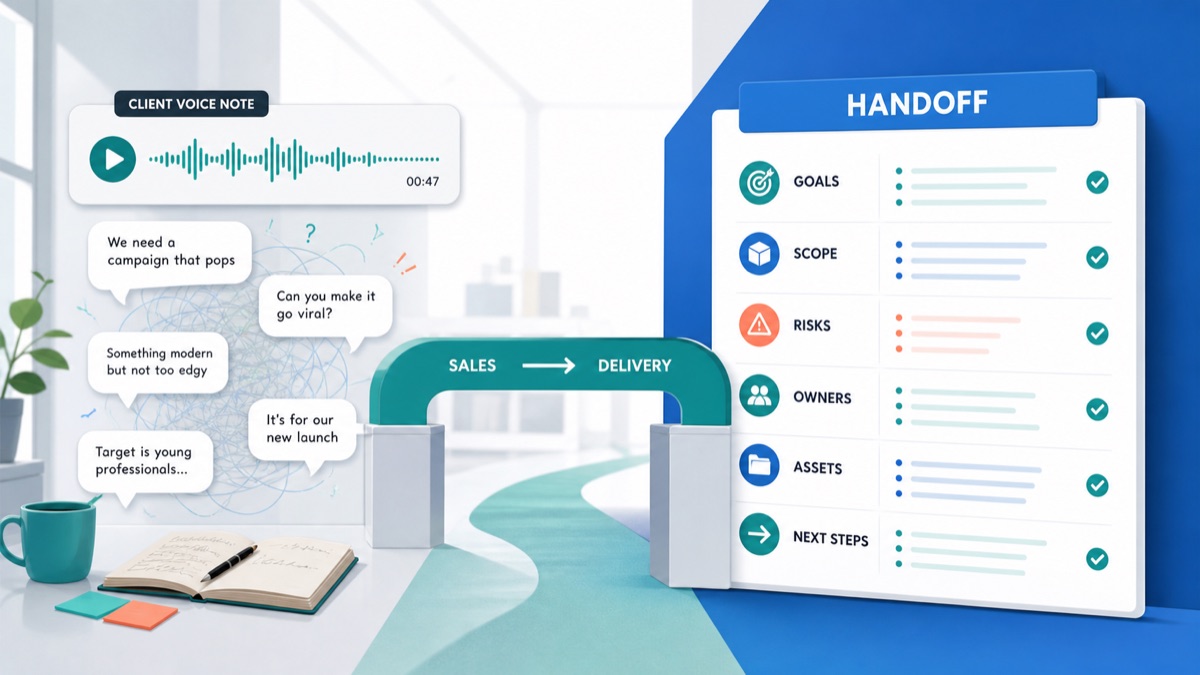
A client handoff is where a sold promise becomes delivery work. For agencies, consultants, creative studios and freelancers, this moment is risky because the client already explained goals, constraints and preferences during sales, but the delivery team often receives only a proposal, a Slack note or a rushed kickoff invite.
When the handoff is weak, the client has to repeat themselves, the project manager reconstructs scope from scattered notes, and the team starts delivery with missing context. That creates awkward clarification emails, kickoff rework, unpaid revisions and scope creep before the first real task begins.
This guide gives client-facing teams a practical handoff checklist for moving from sales or account ownership into delivery. It also shows how a short voice note can become a structured handoff brief, scope-risk list, action items and follow-up summary in VocalJet.
Quick Answer
A client handoff checklist is a structured list of the goals, commitments, scope boundaries, stakeholders, risks, assets, owners and next steps that must transfer from sales or account ownership to the delivery team before work starts.
For agencies, the handoff should happen after a deal, approval or new phase is confirmed, but before the team commits kickoff dates or starts assigning production tasks. The goal is not to create more admin. The goal is to prevent the delivery team from inheriting assumptions.
Use this quick version before every kickoff:
| Handoff area | What to transfer | Why it matters |
|---|---|---|
| Client goal | Business outcome, urgency and success criteria | Keeps delivery tied to the reason the client bought |
| Scope promise | Deliverables, exclusions, review rounds and assumptions | Prevents unpaid work from entering quietly |
| Stakeholders | Buyer, approver, reviewers and day-to-day contact | Avoids conflicting feedback and approval delays |
| Assets and access | Files, credentials, content, examples and dependencies | Stops kickoff from becoming asset chasing |
| Risks | Timeline pressure, budget limits, sensitive topics and unclear requests | Lets the team clarify before work starts |
| Next steps | Owners, dates, questions and client-facing follow-up | Turns the handoff into execution |
The strongest workflow is to collect the hard facts in your project system, then capture the relationship context in the client’s or salesperson’s own words. VocalJet fits when that context is easier to explain by voice: record the handoff note, turn it into a transcript, summarize the promise, extract scope risks and create action items the delivery team can trust.
What A Client Handoff Should Transfer
A client handoff is the transfer of project context from one owner to the next so the client does not experience a gap between selling, onboarding and delivery.
For an agency, the handoff is not only a file transfer. It is a context transfer. The delivery team needs to know what was promised, what the client cares about, what was not decided, who has authority and what needs confirmation before work starts.
Asana’s post-sales handoff template separates hard data from context such as goals, key contacts, commitments, risks and next steps. Teamwork’s client handoff checklist template also emphasizes transferring project and communication details when ownership changes.
For client services, the practical rule is simple: the handoff is complete only when delivery can answer the first client questions without asking sales to reconstruct the deal.
Why Agency Handoffs Break
Most agency handoffs fail because the information exists, but not in a delivery-ready form.
Common failure points include:
- the proposal says what was sold, but not why the client bought it;
- sales remembers a sensitive stakeholder issue, but it is not written down;
- the client promised assets, but nobody knows which files are missing;
- review rounds were discussed verbally, but the delivery lead only sees a vague timeline;
- the kickoff call is scheduled before scope risks are resolved;
- the project manager receives notes, but not decisions or owners.
GitLab’s communication handbook says asynchronous communication should move projects forward without requiring everyone to be available at the same time, and it stresses writing down conclusions from offline conversations. That principle matters in client handoffs: if sales context only lives in someone’s memory, the delivery team cannot use it asynchronously.
A sales-to-delivery handoff is the workflow that turns closed-won context into delivery-ready goals, scope, risks and actions.
The Client Handoff Checklist For Agencies
Use this checklist after a proposal is accepted, a new retainer phase starts, an account owner changes or a client project moves from discovery into delivery.
1. Client And Commercial Context
Capture the basics first.
1 | Client: |
Do not skip commercial context. Delivery does not need every sales detail, but it does need to understand the shape of the promise: fixed fee, retainer, discovery phase, implementation phase, urgent sprint or advisory engagement.
If the project came from a larger intake flow, connect the handoff to your client intake software for agencies so the team can see the original request, files and scope signals.
2. Client Goal And Success Criteria
Write the outcome in plain language.
1 | The client is buying this work because: |
Atlassian’s project kickoff play frames kickoff around purpose, roles, responsibilities and success markers. A good agency handoff prepares those answers before the kickoff happens.
Client handoff context is the operational memory that helps delivery understand what the client already said, bought, feared and expected.
3. Scope Promise And Scope Gaps
Separate confirmed scope from possible scope.
| Handoff item | Status | Delivery action |
|---|---|---|
| Included deliverable | Confirmed | Add to project plan |
| Optional deliverable | Possible | Price, defer or clarify |
| Verbal promise | Needs evidence | Confirm before delivery |
| Assumption | Unverified | Convert into a question |
| Client dependency | Client-owned | Add owner and due date |
| Exclusion | Out of scope | Keep visible in kickoff notes |
This is where many agencies protect margin. A handoff should not turn every sales conversation into included work. It should show what is included, what is excluded and what still needs a decision.
Use scope creep client intake when the handoff exposes vague phrases such as “quick refresh,” “small campaign,” “a few pages,” “light copy help” or “just one more stakeholder.”
4. Stakeholders, Owners And Approval Rules
List people by decision role, not just name.
| Person or group | Role | What they can decide | Risk if unclear |
|---|---|---|---|
| Buyer | Commercial owner | Budget, contract changes, renewal | Delivery escalates to the wrong person |
| Day-to-day client contact | Working owner | Assets, schedules, comments | Questions stall |
| Final approver | Sign-off owner | Approval or rejection | Feedback loops stay open |
| Reviewers | Input providers | Comments and subject-matter feedback | Suggestions become instructions |
| Agency delivery lead | Internal owner | Plan, tasks, quality and timeline | Nobody owns translation from promise to work |
If feedback later arrives from multiple reviewers, connect it to an async client feedback workflow instead of treating every comment as a task.
5. Assets, Access And Dependencies
The handoff should make missing inputs visible before kickoff.
Ask:
- Which files has the client already sent?
- Which files were promised but not received?
- Which credentials or permissions are required?
- Which examples, brand guidelines or prior work should the team review?
- Which client decisions block meaningful progress?
- Which assets change the timeline if they arrive late?
If the client needs to explain file status or dependencies, a voice intake form can be faster than another spreadsheet. The client can describe what exists, what is missing and what needs internal approval, then the team can turn that into an asset-status list.
6. Risks, Sensitivities And Watchouts
Add the details that rarely fit in a form.
1 | Relationship context: |
These notes should be factual and useful. Avoid gossip. Write only what helps the delivery team communicate clearly and protect the client relationship.
7. Next Steps And Follow-Up
End the handoff with actions.
| Next step | Owner | Due date | Client-facing? |
|---|---|---|---|
| Confirm final approver | Account lead | Before kickoff | Yes |
| Request missing brand files | Project manager | Today | Yes |
| Review SOW exclusions | Delivery lead | Before project plan | No |
| Convert open questions into kickoff agenda | Project manager | Before kickoff | Yes |
| Create first delivery tasks | Delivery lead | After scope check | No |
The handoff is not done when notes are shared. It is done when open questions have owners and the client receives a clear next message.
Raw Handoff Note To Structured Output
Here is a realistic before-and-after example.
Raw Sales Voice Note
1 | We closed the website refresh for Northstar. The buyer is Priya, but Marcus from marketing will run day to day. They care most about making the services page easier for prospects before the October event. We sold messaging direction, one revised services page, homepage CTA cleanup and two review rounds. They kept asking about case studies, but I told them that would be a later phase unless we add budget. They have brand files and some customer quotes, but legal has not approved the quotes yet. Priya is sensitive about timeline because the last agency missed a launch date. Marcus likes async updates and does not want lots of meetings. |
Structured Handoff Brief
| Field | Extracted handoff context |
|---|---|
| Client goal | Make the services page clearer before the October event |
| Buyer | Priya |
| Day-to-day owner | Marcus from marketing |
| Included scope | Messaging direction, one revised services page, homepage CTA cleanup, two review rounds |
| Possible add-on | Case studies, later phase unless budget is added |
| Assets | Brand files and customer quotes exist |
| Dependency | Legal approval needed for customer quotes |
| Relationship risk | Client is sensitive about missed launch dates |
| Communication preference | Marcus prefers async updates and fewer meetings |
| Scope risk | Case studies may reappear as an assumed deliverable |
| Open questions | Are quotes approved? Who signs off on final page? What is the exact event deadline? |
Handoff Action Items
| Action item | Owner | Type | Timing |
|---|---|---|---|
| Ask Marcus for brand files and current customer quotes | Project manager | Asset request | Today |
| Confirm whether legal-approved quotes are required for the first draft | Project manager | Scope question | Before production |
| Add case studies to excluded or optional scope | Delivery lead | Scope protection | Before kickoff |
| Confirm Priya as final approver | Account lead | Approval rule | Before kickoff |
| Send an async kickoff summary with timeline and two-review-round rule | Project manager | Follow-up | Before kickoff |
This is the workflow VocalJet is designed to support. A salesperson, account lead or client can record the messy context naturally. VocalJet can help turn the voice note into a transcript, structured summary, scope risks, action items and follow-up-ready text.
Best Workflow For Agencies, Consultants And Freelancers
The best handoff workflow is lightweight, but it has a clear sequence.
Step 1: Preserve The Original Promise
Keep the signed proposal, SOW, brief or approval record attached to the project. The delivery team should not rely on someone’s memory of what was sold.
If the brief still needs structure, use an AI client brief generator to turn raw client notes into goals, constraints, risks and next steps before the handoff meeting.
Step 2: Add The Human Context By Voice
Ask the person closest to the client to record a short handoff note.
1 | In two minutes, explain: |
Voice is useful because handoff context is often nuanced. It includes tone, urgency, hesitation, stakeholder dynamics and “they said this three times” signals that do not survive a CRM field.
Step 3: Convert The Note Into A Handoff Brief
Turn the recording into:
- a client goal summary;
- a confirmed-scope list;
- an exclusions list;
- stakeholder roles;
- missing assets;
- open questions;
- scope risks;
- action items;
- a client-facing follow-up summary.
Use client voice notes to action items when the next step is not another meeting, but a clean list of owners and tasks.
Step 4: Run A Scope Check Before Kickoff
Before kickoff, review the handoff brief against the agreement.
| Question | If yes | If no |
|---|---|---|
| Are deliverables clear enough to plan? | Create tasks | Ask scope questions |
| Are exclusions visible? | Keep in kickoff notes | Add exclusions before kickoff |
| Is one final approver named? | Set approval workflow | Confirm decision owner |
| Are assets and access ready? | Start delivery planning | Assign dependency follow-up |
| Are risks owned? | Track them | Escalate before dates are promised |
This prevents kickoff from becoming the first time the delivery team discovers that the client expects more than the project includes.
Step 5: Send The Client A Confirmation Summary
Send a concise handoff follow-up before the kickoff call or async kickoff packet.
1 | Subject: Project handoff summary before kickoff |
This kind of summary reduces repeated explanations and gives both sides a written record before work begins.
Client Handoff Decision Table
Use this table to decide which workflow fits the handoff.
| Situation | Best handoff format | Why |
|---|---|---|
| Simple repeat project | Checklist plus project link | Most context already exists |
| New fixed-scope project | Checklist, agreement review and voice context note | Delivery needs promise, nuance and exclusions |
| High-stakes consulting engagement | Internal handoff call plus written brief | Relationship context and risks matter |
| Async-first client | Voice note, structured brief and written confirmation | Reduces meetings without losing detail |
| Account owner changes mid-project | Handoff checklist and active-work summary | Protects continuity for the client |
| Scope is unclear | Do not start delivery yet | Clarify before kickoff |
The right handoff is the lightest process that gives delivery enough context to act without guessing.
FAQ
What should be included in a client handoff checklist?
A client handoff checklist should include the client goal, signed agreement or scope source, deliverables, exclusions, stakeholders, approval owner, assets, dependencies, risks, open questions and next actions.
When should an agency run a client handoff?
An agency should run a client handoff after a deal, phase or approval is confirmed and before kickoff dates or production tasks are committed.
Who owns the client handoff in an agency?
The outgoing owner should transfer context, but the delivery owner should accept the handoff only when scope, risks, owners and next steps are clear enough to act on.
How does a handoff checklist prevent scope creep?
A handoff checklist prevents scope creep by separating confirmed deliverables from assumptions, optional work, verbal promises and client dependencies before the team starts delivery.
Can a voice note replace a handoff meeting?
A voice note can replace a handoff meeting when the scope is clear and the goal is context transfer. Complex or sensitive projects may still need a short internal discussion, but the conclusions should be written down.
How does VocalJet help with client handoffs?
VocalJet helps teams capture handoff context by voice, then turn it into a transcript, structured summary, action items, scope risks and follow-up-ready text for the delivery team.
Final Recommendation
Treat the client handoff as a delivery readiness check, not an internal courtesy. Before kickoff, the team should know what the client bought, why it matters, what is included, what is excluded, who approves, what is missing and what happens next.
For agencies that sell through conversation, the highest-risk details are often spoken. Capture them before they disappear. A short voice handoff, converted into a structured brief and action list, can prevent the delivery team from starting with assumptions and the client from repeating context they already gave.