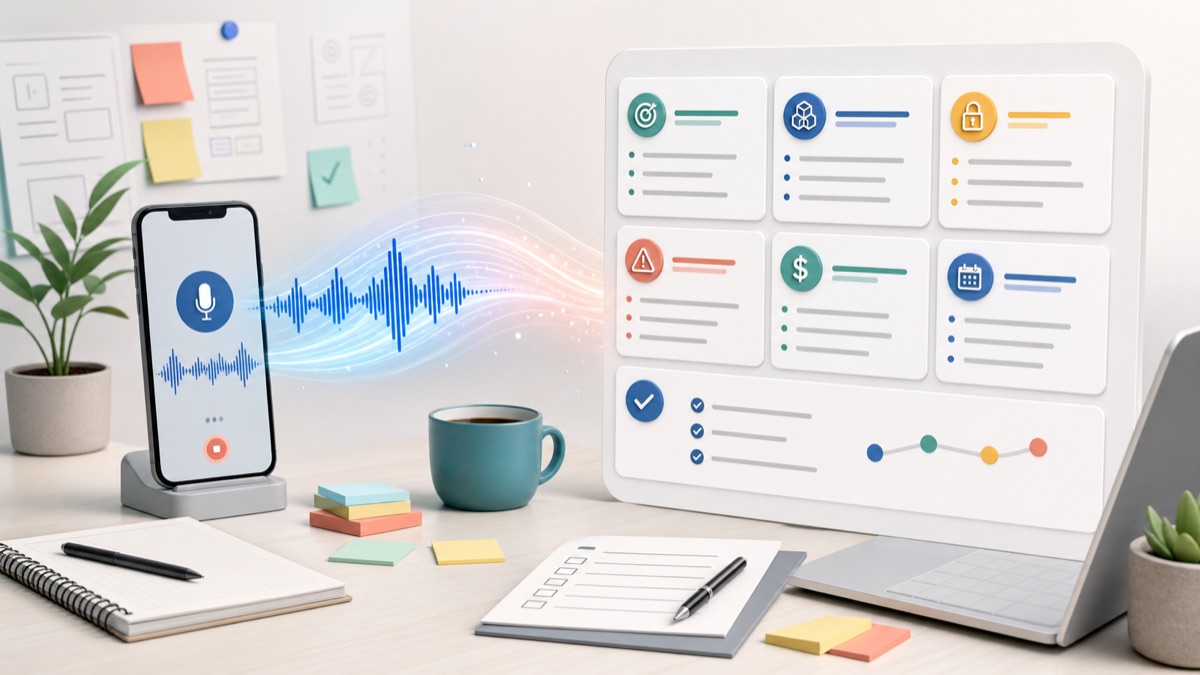
Client intake forms are useful when the questions are simple and the client has time to write. They are weaker when the project is messy, the client is unsure what matters, or the real context is trapped in scattered emails, screenshots, voice notes and meetings.
Quick Answer
The best client intake form alternative for context-heavy work is a voice-first intake workflow. Use a short form for basic details, then let the client explain goals, constraints, stakeholders and scope risks by voice. Convert that recording into a transcript, structured brief, open questions and next steps.
For agencies, this is stronger than a long static form because it captures the “why” behind the project before proposal, pricing or kickoff. VocalJet supports this workflow through client intake software for agencies, voice intake forms and client voice notes to action items.
For agencies, consultants and freelancers, that is where a voice-first intake workflow can work better. The client explains the project in their own words. You turn that spoken context into a structured brief, open questions, scope risks and next steps.
Voice client intake is a workflow where clients explain project context asynchronously by voice. Instead of asking them to complete a long static form, you ask focused prompts and convert their answer into a reusable project brief.
This guide explains when a voice intake workflow beats a traditional form, how to structure it, and how to use it to reduce vague requests, missed context and scope creep.
Why Client Intake Forms Break Down
A form works when the client already knows what they need. Many client projects do not start that cleanly.
Common problems include:
- The client skips open-ended questions.
- The answers are too short to reveal context.
- The real business goal is hidden behind a requested deliverable.
- Stakeholders disagree but the form only captures one person’s view.
- The client says “simple website,” “quick refresh” or “small update” without defining what that means.
- Follow-up questions move into email threads and get separated from the original request.
For a service business, weak intake is not just an admin problem. It creates rework, vague proposals, unclear expectations and unpaid scope expansion.
PMI describes scope creep as a recurring project management problem and points to customer changes and poorly defined specifications as important drivers in its guide to controlling scope creep. Agencies and consultants see the same pattern in client work: the project starts before the request is clear enough to protect the team.
What A Voice Intake Workflow Does Differently
A voice intake workflow does not remove structure. It changes the order.
Instead of asking the client to write perfect answers, you ask them to speak through the context first. Then you structure the answer into a brief.
The output should not be a raw transcript. It should become:
- Project goal.
- Background context.
- Target audience.
- Current problem.
- Desired outcome.
- Known constraints.
- Timeline and urgency.
- Budget signals.
- Stakeholders.
- Assets and access needed.
- Open questions.
- Scope risks.
- Next steps.
An AI client brief generator turns spoken client context into structured goals, constraints, risks and next steps. That is why voice intake is not just a different input method. It is a better way to capture messy project context before it becomes a delivery problem.
For VocalJet, this is the natural workflow: use voice client intake to collect richer context, then turn that voice note into an AI client brief your team can review, edit and share.
Client Intake Form vs Voice Intake
Use the comparison below to choose the right intake method.
| Intake method | Best for | Weakness | Output quality |
|---|---|---|---|
| Static form | Simple repeatable requests | Clients give short answers or skip nuance | Structured but often thin |
| Discovery call | Complex projects and relationship building | Hard to schedule, easy to lose details | Rich but expensive |
| Email thread | Quick follow-ups | Context gets scattered | Messy and hard to reuse |
| Voice intake | Context-heavy projects where client writing is slow | Needs transcription and summarization | Rich, structured and async |
The point is not that forms are bad. The point is that many agencies use forms for work that actually needs narrative context.
If the client can answer with a checkbox, use a form. If the client needs to explain why the project exists, what went wrong before, who will approve it and what “done” means, voice is usually faster.
When To Use A Voice Client Intake Alternative
Use voice intake when the project has ambiguity.
Good fits include:
- Website redesigns.
- Brand strategy projects.
- Landing page projects.
- Content strategy retainers.
- Paid audits.
- Consulting engagements.
- Creative revisions with many stakeholders.
- Client onboarding for monthly services.
- Complex support or implementation requests.
Voice is especially useful when the client says something vague:
- “We need the site to feel more premium.”
- “The current workflow is not working.”
- “The last agency did not understand us.”
- “This should be quick.”
- “We just need a few changes.”
- “Can you make it more modern?”
Those phrases are not enough for a brief. But they are good starting points for a voice prompt.
The 7-Part Voice Intake Prompt
Do not ask the client to “send thoughts.” That creates rambling audio. Give them a simple structure.
Send this script:
Please record a 3-5 minute voice note. Do not worry about making it polished. Walk through these seven points: what you need, why now, what is not working today, who the project is for, what success looks like, what constraints we should know, and what would be out of scope.
Then ask seven focused prompts:
- What are you trying to accomplish?
- Why is this project happening now?
- What is not working today?
- Who needs to approve or use the final result?
- What would make this project successful?
- What constraints should we know about?
- What should not be included in this project?
The last question matters. “What is not included?” is one of the simplest ways to surface scope boundaries before the proposal.
Turn The Voice Note Into A Project Brief
Asana’s guide to project briefs frames a brief as a concise document that captures goals, scope, timeline and audience. For client services, you can adapt that into a practical intake brief.
Use this structure:
| Brief section | What to extract from the voice note |
|---|---|
| Client goal | The business outcome the client wants |
| Background | Why this project exists now |
| Target audience | Who the work is for |
| Current problem | What is broken, slow, confusing or underperforming |
| Deliverables | What the client thinks they need |
| Success criteria | How the client will judge the project |
| Constraints | Budget, timeline, approvals, tools, legal or brand rules |
| Risks | Missing assets, vague approvals, unclear scope, dependencies |
| Out of scope | What the client does not expect you to handle |
| Next questions | What must be clarified before proposal or kickoff |
This is where a voice intake workflow becomes valuable. The transcript is only the raw material. The brief is the asset your team can use.
With VocalJet, you can turn client voice notes into transcripts, summaries and reusable follow-up notes. For projects that need more structure, route the same recording into a brief workflow and connect it to client voice note to action items.
A Practical Workflow For Agencies
Here is a simple workflow you can run before a proposal or kickoff.
Step 1: Send A Voice Intake Link
Send the client a short email:
Thanks for reaching out. Before we suggest a scope, could you record a short voice note with the context behind the project? It is usually faster than filling out a long form. Please cover the goal, why now, current pain, audience, constraints, timeline and what should be out of scope.
Keep it casual. The goal is to get honest context, not polished copy.
Step 2: Convert The Recording Into A Brief
Transcribe the recording and summarize it into the sections above. Do not send the raw transcript as the final artifact. Clean it into a client-ready brief.
The result should be short enough to scan:
- One paragraph of context.
- Five to eight bullets of requirements.
- Three to five open questions.
- A scope risk note.
- Clear next step.
Step 3: Mark Scope Risks Early
Look for phrases that signal hidden work:
- “Just a small change.”
- “Similar to our competitor.”
- “We will provide content later.”
- “The team will decide after seeing options.”
- “We may need integrations.”
- “We are not sure who approves this.”
- “Can you include SEO?”
These are not bad requests. They are risk markers. Capture them before you price.
Step 4: Send Back A Confirmation Summary
Send the client a short confirmation:
Based on your voice note, I understand the project as follows: [summary]. The main deliverables appear to be [deliverables]. The open questions are [questions]. Before I scope this, I want to clarify [scope risks].
This gives the client a chance to correct you before the proposal.
Step 5: Convert The Brief Into Tasks
Once the scope is clear, convert the brief into action items:
- Assets to request.
- Stakeholders to confirm.
- Research to review.
- Decisions to make.
- Proposal sections to draft.
- Risks to price or exclude.
This is the bridge from intake to delivery. The best intake process does not stop at “we captured context.” It turns context into action.
How Voice Intake Reduces Scope Creep
Scope creep often starts before delivery. It begins when the original request is too vague to protect either side.
Voice intake helps because it captures the client’s reasoning, not just their requested deliverable. That makes it easier to separate:
- Goals from deliverables.
- Requirements from preferences.
- Revisions from new requests.
- Constraints from assumptions.
- Must-haves from nice-to-haves.
Atlassian’s project kickoff play emphasizes alignment around purpose, roles and success markers. A voice intake brief gives you a cleaner starting point before that kickoff even happens.
For agencies, the practical win is simple: fewer surprises. If the client says “we need a landing page” but spends three minutes explaining CRM routing, ad campaigns, legal review and five stakeholders, you know the real project is larger than the initial phrase.
That is why VocalJet also supports scope creep client intake workflows. The earlier you capture unclear requirements, the easier it is to turn them into either scope, exclusions or paid follow-up work.
Voice Intake Template
Use this template inside your intake process.
Client Context
- What prompted this project?
- What is happening in the business right now?
- What has been tried before?
- What should we understand before suggesting a solution?
Project Goal
- What should be different after this project?
- What result matters most?
- What would make this a success?
- What would make this a failure?
Audience And Stakeholders
- Who is this for?
- Who approves the work?
- Who will use it day to day?
- Who else needs to be consulted?
Scope And Deliverables
- What do you think you need?
- What is definitely included?
- What is definitely not included?
- What might be added later?
Constraints
- Is there a deadline?
- Is there a budget range?
- Are there brand, legal, technical or platform constraints?
- Are there existing assets or tools we must use?
Next Steps
- What do you need from us next?
- What decision do you need to make internally?
- What information is missing?
- What would help you move forward?
This template is intentionally practical. It gives the client enough structure to stay focused, while still leaving room for context that a form might miss.
Async Intake Without More Meetings
Async client intake does not mean “never meet.” It means you use meetings where they are actually useful.
GitLab’s handbook on asynchronous communication argues for choosing async where feasible and reflecting on which meetings could have been handled asynchronously. Agencies can apply the same idea to discovery.
Use async voice intake for:
- First-pass context.
- Stakeholder background.
- Feedback collection.
- Revision explanation.
- Follow-up after a call.
- Capturing details the client forgot during a meeting.
Use a meeting for:
- High-trust sales conversations.
- Live decision-making.
- Conflict or misalignment.
- Strategy workshops.
- Final scope negotiation.
Async client feedback helps agencies collect richer revision context without scheduling another meeting. The same logic applies to intake: collect the context asynchronously, then use calls for alignment and decisions.
Example: From Voice Note To Brief
Imagine a web design client sends this voice note:
We need a new homepage. The current one feels outdated, and sales keeps saying prospects do not understand what we do. We need it before our conference next month. We can provide brand assets, but the messaging is not final. Our CEO wants to approve the hero section. We may also need new case study cards, but I am not sure if that is part of this.
A weak intake form might reduce that to: “Need homepage redesign.”
A voice intake brief would capture:
| Field | Extracted context |
|---|---|
| Goal | Explain the offer more clearly to prospects |
| Deliverable | Homepage redesign |
| Deadline | Before next month’s conference |
| Constraint | Messaging is not final |
| Stakeholder | CEO approves hero section |
| Scope risk | Case study cards may be requested |
| Next question | Are case study cards included in phase one or separate? |
That gives you a better proposal, a better kickoff and a cleaner boundary around change requests.
When A Form Is Still Better
Voice intake is not always the answer.
Use a form when:
- You need standardized data.
- The request is low-value or high-volume.
- You need required fields for routing.
- The client must upload files or choose from fixed options.
- You are qualifying leads before spending time on them.
The best workflow is often hybrid:
- Short form for basic details.
- Voice intake for project context.
- AI brief for internal review.
- Confirmation summary for the client.
- Proposal or kickoff.
That gives you structure without forcing the client to write a long essay.
FAQ
What is a client intake form alternative?
A client intake form alternative is any workflow that collects project context without relying only on static written fields. Voice intake is one option: the client records a short explanation, and the team turns it into a brief, questions and next steps.
Is voice intake better than a discovery call?
Voice intake is better for first-pass context and asynchronous follow-up. A discovery call is still better for live trust-building, negotiation and complex decisions. Many agencies should use both: voice first, call second.
How long should a client voice intake be?
Three to five minutes is usually enough. If the topic needs more time, split the intake into prompts: goals, audience, constraints, scope, feedback and next steps.
How does voice intake prevent scope creep?
Voice intake prevents scope creep by capturing assumptions before pricing or kickoff. It helps you identify hidden stakeholders, unclear deliverables, missing assets, risky deadlines and requests that should be excluded or priced separately.
Where does VocalJet fit?
VocalJet helps client-facing teams collect voice context, transcribe it, summarize it, turn it into structured briefs and convert client notes into action items or follow-up emails. It is built for workflows where spoken context is faster than another form or meeting.
Final Recommendation
Do not replace every intake form with voice. Replace the parts where clients struggle to explain context in writing.
Use forms for basic facts. Use voice for nuance. Use an AI brief to turn that nuance into scope, questions, risks and next steps.
For agencies, consultants and freelancers, this is a more practical intake system: less blank-form friction for the client, more context for your team, and fewer surprises when the project starts.