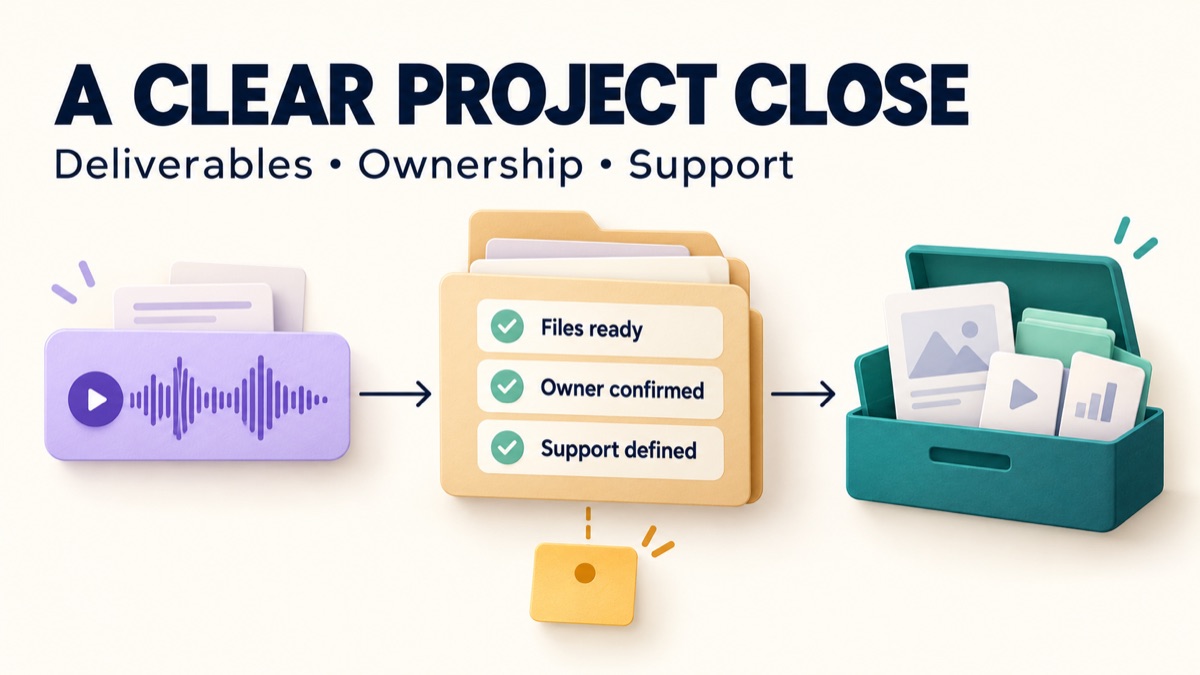
You sent the final files. The client approved the work. A week later, someone asks where the editable version lives, another person needs a walkthrough, and a new request arrives as “one last thing.” For agencies, consultants, creative studios and freelancers, this is how a finished project keeps consuming delivery time.
A client offboarding checklist gives that last stage a clear structure. It connects what you delivered with the person who will use it, the questions still open and the support arrangement that applies after the project. Sending a folder is only one part of that transition.
This guide includes a closeout record, six questions to ask the receiving client, a request-routing table and a project closure email. When the remaining questions are easier to explain aloud, a short VocalJet voice reply can supply the context for a reviewed summary and next steps before you confirm the handover.
Quick Answer
Client offboarding is the transition from active delivery to client ownership, documented remaining obligations and an agreed route for future requests. For an agency, the checklist should cover final versions, acceptance evidence, the receiving owner, usable access, instructions, unresolved items and the support terms already agreed with the client.
Check two things for each important deliverable: whether the agreed work has been supplied and accepted, and whether the receiving person can use it. These checks can have different answers. An approved presentation may still be unusable to the person who needs its editable source file.
Start preparing the record during the final delivery milestone. Ask the client to check the actual materials, resolve or explicitly assign the remaining items, and send a written closeout summary. Keep incomplete work visible; a closing email should not silently convert it into completed work or create new support terms.
| Closeout check | Evidence to record | If it is missing |
|---|---|---|
| Delivery and acceptance | Final version, agreed requirements and approval reference | Confirm the exact outstanding work or decision |
| Receiving owner | Named person taking responsibility for use | Ask the client to nominate the owner |
| Practical readiness | Owner can find, open and use the required materials | Identify the access or knowledge gap |
| Remaining obligations | Open item, responsible person and agreed handling | Keep the item open and assign the next action |
| Future requests | Contact route, provider and applicable support limits | Clarify the arrangement before promising help |
Offboarding Is More Than Final Approval
Final approval records a decision about a particular deliverable. Offboarding checks the transition around that deliverable: who receives it, what they need to use it and what happens after delivery ends.
That also makes offboarding different from a sales-to-delivery handoff. The earlier handoff transfers the client’s context into the agency. Offboarding transfers finished work and operating context back to the client or their next provider.
Asana’s project closure guide includes checking remaining work, completing administration and communicating next steps. For a service business, apply those principles to a specific receiving person, rather than assuming that a link sent to the main contact reaches everyone who will use the work.
If acceptance is still unclear, resolve it through your client approval workflow. A positive comment such as “looks great” may leave the version, decision authority or remaining corrections uncertain. Offboarding should reference the resulting approval record, not try to reconstruct it from memory.
The Client Offboarding Checklist
Use the checklist for a normally completed project or a completed phase. An early termination needs its own agreed handling of unfinished work, commercial obligations and access; do not label that situation a routine successful completion.
1. Identify The Final Package
List the deliverables the client should receive under the agreement. For each, record the final version, location, expected format and acceptance status. Distinguish an editable file from an export and a reusable template from a one-time output.
For example, “training materials delivered” is vague. “Facilitator guide version 4, participant PDF version 3 and editable workshop deck version 5” gives the client something concrete to check.
Keep old drafts distinguishable from the final package. Label any item that is still waiting for a correction, missing content or approval. If a deliverable is no longer required, record the agreed decision instead of simply removing it from the list.
2. Check Readiness With The Actual User
Delivery evidence and client readiness answer different questions: what was supplied and whether the receiving owner can use it. Ask the person doing the work to try one realistic task with the supplied materials.
For a design studio, that might mean opening the editable template and exporting the intended format. For a consultant, it might mean locating the latest operating procedure and explaining who will maintain it. For a web agency, it could mean a designated editor locating the instructions for an agreed routine update.
Atlassian’s project closure guidance treats ownership, access, documentation and training context as parts of the handoff. Your readiness check makes those needs observable. “I received the folder” and “I can use the approved template” should remain separate statements.
3. Give Every Unresolved Item A Disposition
Use three working statuses: ready, open, and transferred with agreement. “Transferred” requires a named receiving owner and confirmation of what that person will handle. It does not mean the agency removed an inconvenient task from its own list.
A closeout exception is a named unresolved item with an owner, next action and agreed handling; it is not evidence that the whole project is complete.
Keep these distinctions visible:
- Incomplete agreed work: identify the remaining delivery action and date.
- Unclear use or access: establish what prevents the receiving owner from using the material.
- New request: assess it separately before agreeing scope, price or timing.
- Disputed item: preserve both positions and name the person responsible for resolving the disagreement.
If an open item affects an essential deliverable, report that the closeout is still in progress. If the parties agree to move a remaining obligation into a separate support or delivery arrangement, reference that arrangement explicitly.
4. Record The Support Arrangement In Concrete Terms
A support boundary identifies covered work, the contact route, the responsible provider and applicable dates or limits. It should reflect what has actually been agreed.
Replace “message us if anything comes up” with specific information:
1 | Support or handover help covered by the agreement: |
Do not invent a standard support period at project end. If ongoing support was never settled, name it as an open decision. Likewise, a new estimate for an additional deliverable does not resolve an existing obligation to correct agreed work.
VocalJet’s scope clarity workflow can help surface expectations in a client’s explanation. A person still compares those expectations with the project records and confirms the response.
5. Finish Access, Administration And The Record
Check the access changes required by the handover, including who owns relevant accounts and who still needs access for agreed support. Coordinate changes with the receiving owner and verify the transition before removing access needed for the work. Keep passwords and secrets out of voice notes and closeout emails.
Record invoice and payment status through your normal finance process. Keep that status separate from delivery, acceptance and operational readiness so “paid” does not stand in for all four.
Teamwork’s client offboarding template includes final deliverables, open tasks, access, commercial items and retrospective feedback. Use those categories as a completeness check, then keep your client’s closeout record focused on their actual project.
Save the final package references, approvals, exceptions and confirmation together. A short client feedback request can follow separately, so providing a testimonial or answering a survey does not get confused with accepting work.
Copyable Client Closeout Record
Keep one row or record per significant deliverable. The distinction between delivery evidence and receiving-owner readiness is what makes this useful when the client says the work is “done” but still needs help.
1 | CLIENT PROJECT CLOSEOUT |
Mark unknown facts as unknown. A generated summary may suggest a plausible owner or date, but plausibility is not confirmation. Leave the field open until the responsible person agrees.
Six Offboarding Questions Clients Can Answer By Voice
Send the final package with the questions. Ask for a reply from the person who will use the materials, or separate replies if different people own different parts.
- Which final files or deliverables have you opened, and which versions did you check?
- What is the first real task you need to complete with them?
- What could you do successfully, and where did you get stuck?
- Who will own each deliverable or process after this project?
- What help do you expect after handover, and what do you understand the current support arrangement to cover?
- Is anything missing from the agreed package, or are you asking for something additional?
You can introduce them with this prompt:
Please try the final materials before replying. Tell us what you opened, what you need to do next and anything that is unclear. Name the file or task when you can. We will compare your questions with the agreed work and send a written record of remaining actions and support responsibilities.
An async client feedback tool gives the client a way to explain these details without finding a shared meeting time. Voice is useful for context; file links, screenshots or demonstrations may still be needed to show an exact problem.
Before And After: A Training Kit Handover
Consider this fictional example. A consultant has delivered an approved training kit containing a workshop deck, a facilitator guide and participant worksheets. The agreement includes one facilitator handover session; it does not include producing additional learning formats.
Raw Client Voice Reply
“The workshop materials look good. Maya will run the sessions now. She opened the PDF but can’t find the editable slides. She’s also unsure how to run the breakout exercise. Could you turn the worksheets into an online quiz? And if she has questions over the next few months, can she just message you?”
A rushed response might promise to “finish the handover, add a quiz and support Maya.” That bundles an access problem, an included session, a new deliverable and an undefined support expectation into one commitment.
Reviewed Closeout Record
| Client input | Check against the project record | Disposition and next action |
|---|---|---|
| Maya will run the sessions | Confirm the receiving owner and contact details | Maya checks the handover package; client lead confirms ownership |
| Editable slides cannot be found | Editable deck is included and already stored in the final folder | Open: consultant sends the precise link; Maya confirms she can open it |
| Breakout instructions are unclear | One facilitator handover session is included | Open: consultant asks which step is unclear and agrees the session with Maya |
| Online quiz requested | No quiz appears in the agreed deliverables | Separate request: clarify format and use, then assess effort and approval |
| Questions over several months | No ongoing arrangement is confirmed in this example | Open decision: explain the existing coverage and discuss any additional support |
The outcome is specific: the kit is approved, but receiving-owner readiness still has two open checks. The quiz has not become part of the final package. Ongoing support has not been promised.
VocalJet’s client voice note to action items workflow helps turn the recording into a transcript, summary, scope signals and next steps. The consultant verifies the extracted facts, checks the agreement and copies the reviewed actions into the closeout record.
Route Requests Without Reopening Everything
At the end of a project, the timing of a request does not tell you whether it is included. Its relationship to the agreed work does.
| Request received during offboarding | First response | Record to update |
|---|---|---|
| “The agreed final file is missing” | Check the delivery record and supply or complete what is owed | Deliverable and readiness status |
| “I cannot perform the documented task” | Ask for the failing step and assess the access, instruction or delivery issue | Open exception and responsible owner |
| “Can you create another format?” | Check whether that format is included; assess it separately if additional | Change request, when applicable |
| “Can you manage this every month?” | Clarify the ongoing service requested and existing coverage | Separate support proposal or arrangement |
| “We disagree that this meets the brief” | Identify the requirement and evidence; arrange a focused review | Unresolved acceptance issue |
Use your client change request workflow for additional deliverables. Keep genuine completion issues in the original closeout record until they are resolved or explicitly assigned through an agreed arrangement.
Project Closure Email Template
Send this once the record reflects the actual state. If essential items remain open, use “handover actions” in the subject and describe the project as awaiting completion instead of announcing closure.
1 | Subject: [Project] closeout record and future support |
Remove sections that do not apply. Do not describe unanswered questions as resolved or introduce terms the client has not agreed to.
Best Workflow For Agencies, Consultants And Freelancers
Choose one closeout lead, even if finance, delivery and account management contribute different records. Prepare the final package first, then ask the receiving client to try it. That makes the exchange about observable gaps rather than a broad “any feedback?” request.
For nuanced questions, send a VocalJet voice feedback link. Review the transcript and summary against the deliverables, extract the remaining actions and prepare a follow-up. Keep the reviewed closeout record in the project system your team already uses.
Use a call or demonstration when the client cannot complete a practical task, the evidence is disputed, or several owners disagree. Bring the open items to that conversation and record the result afterward. A simple confirmation of file location can usually stay asynchronous.
VocalJet supports the collection and structuring of spoken context; the agency remains responsible for checking readiness, confirming terms and arranging access changes. If that collection step is where your projects stall, review VocalJet pricing and try the six-question prompt on one closeout.
FAQ
What should a client offboarding checklist include?
Include final deliverables and versions, acceptance evidence, the receiving owner, access and instructions, unresolved items, agreed support coverage, commercial follow-up and the final record location. Check both delivery status and the client’s ability to use the materials.
When should an agency start client offboarding?
Prepare the checklist during the final delivery milestone, before sending the closing email. This gives the receiving owner time to check the materials and lets the agency resolve access, knowledge and responsibility gaps while the project context is still available.
Is offboarding the same as final client approval?
Final approval records acceptance of specific work. Offboarding covers the transition around it, including ownership, practical readiness, remaining obligations and future support. An approved deliverable can still require a handover action before the receiving owner can use it.
Can a project close with outstanding tasks?
Record each outstanding obligation and its agreed handling. Essential incomplete work should remain visible as a reason closure is pending. If the parties agree to transfer an item to a separate arrangement, name the receiving owner and confirmation rather than marking the task completed.
How do agencies avoid open-ended support after delivery?
State the support coverage, provider, contact route and applicable dates or limits already agreed with the client. Clarify undefined expectations and assess additional services separately. Do not use a closing email to invent new limits or dismiss existing delivery obligations.
Can client offboarding happen without a meeting?
Yes, when the receiving owner can check the materials and confirm the remaining actions asynchronously. A voice reply can explain unclear instructions or expectations. Use a focused call or demonstration when a practical task, disputed requirement or ownership decision remains unresolved.