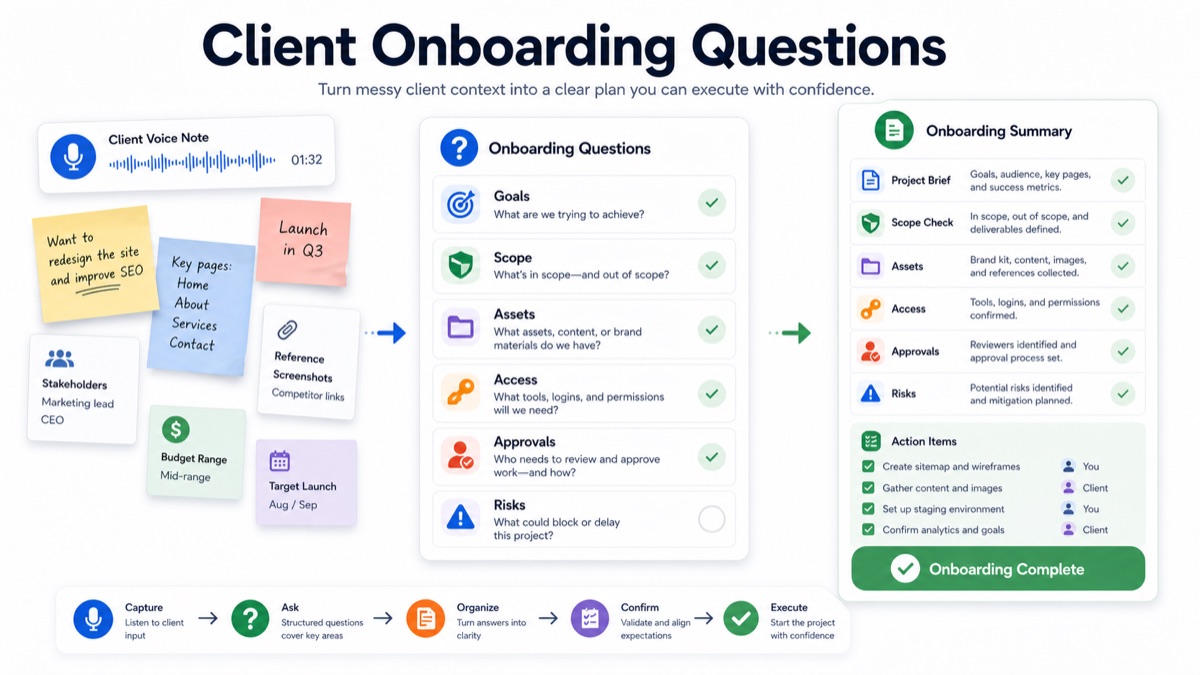
Client onboarding questions are the questions freelancers and consultants ask after a client says yes but before delivery starts. They turn the excitement of a new project into usable context: goals, scope, assets, access, stakeholders, risks, deadlines and next steps.
For client-facing service businesses, the danger is not asking too many questions. The danger is starting with a vague email thread, a half-finished intake form, missing files, unclear approvals and assumptions nobody has confirmed. That is how small projects become late projects, and how friendly requests become unpaid revisions.
This guide gives you a practical onboarding question bank, a decision table, a raw-client-answer example, a follow-up email script and a workflow for turning onboarding answers into a project brief and action items.
Quick Answer
Client onboarding questions help freelancers and consultants collect the context they need before delivery starts: business goals, success criteria, deliverables, exclusions, client inputs, access, stakeholders, approval rules, risks and next steps.
A good onboarding workflow should not only collect answers. It should convert those answers into a brief, a scope check and a task list. That is where async intake helps: the client can explain the project in their own words, and the service provider can turn that context into structured work.
Use this short version:
| Onboarding area | Question to ask | Output you need |
|---|---|---|
| Goal | What should this project achieve? | Business outcome |
| Scope | What is included and not included? | Deliverables and exclusions |
| Assets | What files, copy, links or references exist? | Client inputs |
| Access | Which tools or accounts do we need? | Permissions checklist |
| Approvals | Who gives feedback and final approval? | Decision owner |
| Risks | What could delay or block the project? | Risk and dependency list |
| Next steps | What should each side do next? | Action items with owners |
For a product-led setup, combine voice client intake, a voice intake form, an AI client brief generator, scope creep client intake, and client voice notes to action items.
Why Onboarding Questions Matter After The Client Says Yes
New-client onboarding is where the project record becomes real. Sales conversations, proposal notes and emails are useful, but they are rarely complete enough for delivery.
Atlassian’s project kickoff play focuses on aligning purpose, roles, responsibilities and success markers. Freelancers and consultants need the same alignment, even when there is no large project team.
Asana’s guide to a project brief also points to a practical baseline: a project needs goals, scope, audience, timeline, ownership and deliverables in one clear place. Client onboarding questions are how you collect that information before the work becomes expensive.
Client onboarding questions are not a replacement for expertise. They are the intake layer that gives your expertise something solid to work from.
The Client Onboarding Question Template
Use this template after proposal acceptance and before kickoff or production.
1 | Client onboarding questions |
This is a reusable onboarding checklist, but it should not become a long form that clients abandon. If the answer needs nuance, ask for a short voice response.
Voice client intake is a workflow where clients explain project context asynchronously by voice. It is especially useful when the client has details, tradeoffs or internal politics that would be painful to type into a form.
Forms, Calls Or Voice Intake: Which Should You Use?
The right onboarding format depends on the kind of information you need.
| Format | Best for | Weakness | Best output |
|---|---|---|---|
| Form | Short facts, links, dates and yes/no answers | Produces thin answers for nuanced context | Intake record |
| Live call | Trust building, conflict and strategic decisions | Scheduling friction and weak written record | Shared discussion |
| Voice intake | Nuanced context without another meeting | Needs structured follow-up | Brief, risks and action items |
| Hybrid | Complex project with some async prep | Can duplicate questions | Shorter call and clearer kickoff |
Miro’s guide to asynchronous work is useful here because async work depends on context, clarity and shared visibility. A voice intake flow only works when the answers are converted into a written record the client can confirm.
That is the bridge between client intake software for agencies and freelance onboarding. The tool should not merely collect responses. It should help you turn client context into something you can deliver against.
Best Workflow For Freelancers And Consultants
Step 1: Ask For Context In The Client’s Own Words
Start with one focused onboarding prompt:
1 | Before I start, please explain the project in your own words. |
This prompt works because it does not force the client to think like a project manager. It lets them explain the reality of the project.
Step 2: Turn Answers Into A Structured Brief
Do not forward raw onboarding answers into your task list. Convert them into a brief with clear sections.
| Raw answer signal | Brief section |
|---|---|
| “We need this ready before the partner event” | Timeline and launch risk |
| “The homepage matters, but the pricing page is the real issue” | Priority deliverables |
| “Our founder and sales lead both want to review” | Stakeholders and approval risk |
| “We have copy, but it needs work” | Asset dependency |
| “Maybe include a case study if possible” | Scope clarification |
An AI client brief generator turns spoken client context into structured goals, constraints, risks and next steps. For freelancers and consultants, that structure protects the project from memory, scattered notes and unclear assumptions.
Step 3: Run A Scope Check Before Delivery Starts
Before doing the work, separate four categories:
| Category | Meaning | Example |
|---|---|---|
| Included | Approved work in this phase | One landing page audit |
| Excluded | Not included unless approved later | New landing page copywriting |
| Assumption | Believed true but not confirmed | Client provides analytics access |
| Open decision | Needs client confirmation | Whether the event page is in scope |
Scope clarification questions help freelancers separate requested deliverables from assumptions before kickoff. This is where onboarding becomes commercially useful, not just organized.
Step 4: Convert Gaps Into Action Items
Asana’s guide to action items defines the operational value well: tasks should make clear who is responsible and what must happen next.
Use an action-item table after every onboarding intake:
| Gap found during onboarding | Action item | Owner |
|---|---|---|
| Missing brand assets | Upload logo, font and color files | Client |
| Approval owner unclear | Name one final approver | Client |
| Scope idea not priced | Confirm whether the case study is phase two | Freelancer |
| Access missing | Grant CMS and analytics access | Client |
| Feedback process unclear | Confirm one feedback channel | Consultant |
Client notes to action items is the workflow of turning raw client context into tasks with owners, deadlines and scope impact.
Step 5: Send A Confirmation Summary
Before work starts, send a written summary the client can approve.
1 | Thanks for the onboarding context. Here is my current understanding: |
This simple email reduces follow-up friction because it gives the client one clean place to correct assumptions.
Raw Client Answer To Onboarding Summary
Here is how onboarding should transform vague context into usable work.
Raw Client Answer
1 | We want to refresh the consulting page before the conference. The page feels outdated and does not explain our process clearly. The CEO wants to see the messaging, and sales has a few comments too. We have some customer quotes somewhere. It would be good to add a downloadable checklist, but only if that is not too much. We can give access to the site later this week. |
Structured Onboarding Output
| Section | Structured output |
|---|---|
| Goal | Improve the consulting page before the conference |
| Success criteria | Clearer process explanation and stronger sales enablement |
| Priority deliverable | Consulting page refresh |
| Possible extra scope | Downloadable checklist needs separate confirmation |
| Assets | Customer quotes exist but are not collected yet |
| Access | Website access expected later this week |
| Stakeholders | CEO reviews messaging; sales contributes comments |
| Risk | Multiple reviewers and unclear checklist scope |
| Client action items | Provide quotes, access and final approver |
| Consultant action items | Confirm page scope and checklist estimate |
This is the difference between “I think I understand” and “we have a project record.”
Onboarding Questions By Project Type
Different service businesses need different emphasis.
| Service type | Questions to emphasize | Why it matters |
|---|---|---|
| Freelance designer | Assets, feedback owner, revision rounds | Prevents unclear creative review |
| Marketing consultant | Goal, audience, metrics, constraints | Connects advice to business outcome |
| Web consultant | Access, pages, content, technical dependencies | Avoids launch delays |
| Creative studio | Stakeholders, references, approvals | Reduces subjective feedback loops |
| Strategy advisor | Decision process, scope boundaries, success criteria | Keeps advisory work from expanding silently |
For revision-heavy work, connect onboarding to async client feedback so the feedback process is clear before the first review round.
Follow-Up Email Script After Client Onboarding
Use this script when the client answered your onboarding questions but some details remain unclear.
1 | Subject: Confirming onboarding details before we start |
The script is intentionally direct. Client onboarding should create clarity without making the client feel like they are being sent back through sales.
FAQ
What are client onboarding questions?
Client onboarding questions are questions used after a client agrees to work with you and before delivery starts. They collect goals, scope, assets, access, stakeholders, risks and next steps so the project can begin with a clear record.
How many onboarding questions should freelancers ask?
Freelancers should usually ask 10 to 20 focused onboarding questions. The exact number matters less than covering goals, scope, inputs, approvals, risks and next steps without overwhelming the client.
Should client onboarding happen in a form or a meeting?
Use a form for short facts, a meeting for high-risk alignment and voice intake when the client needs to explain nuance without scheduling another call. Many freelancers and consultants use a hybrid workflow: async intake first, shorter call only if needed.
What is the most important onboarding question?
The most important onboarding question is: “What should this project achieve, and what would make it successful?” It connects the work to the business outcome instead of only collecting deliverables.
How do onboarding questions prevent scope creep?
Onboarding questions prevent scope creep by separating included work, excluded work, assumptions, dependencies and open decisions before delivery starts. That makes later requests easier to classify as included, changed or out of scope.
How can VocalJet help with client onboarding?
VocalJet helps clients explain project context asynchronously by voice, then turns that context into structured summaries, briefs, scope checks, action items and follow-up language that freelancers and consultants can confirm before work starts.