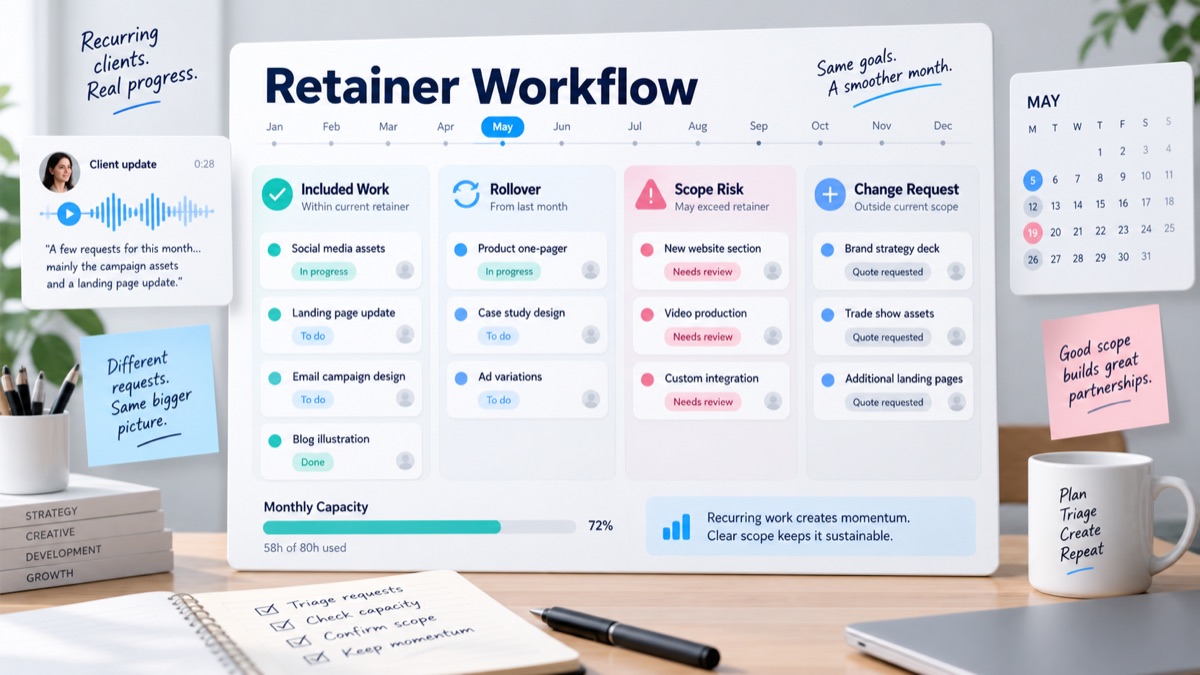
A monthly client retainer needs a repeatable way to turn incoming requests into agreed work. For agencies, consultants and creative studios, the difficulty often starts after the relationship is established: a client sends a quick voice note, another stakeholder adds feedback, and a small revision becomes an extra deliverable. Everyone expects progress, but nobody has checked what fits this month.
A client retainer workflow connects those conversations to the monthly plan. It records the requested outcome, checks the agreed service boundaries, identifies remaining capacity and gives the client a clear next step. It also distinguishes unfinished work from unused allowance, two things that can otherwise become a confusing promise about next month.
This guide provides a request triage table, a monthly operating rhythm and a reusable template. The example shows how spoken client feedback can become separate requests with scope questions, owners and follow-up text before the delivery team commits to dates.
Quick Answer
A client retainer workflow is a recurring process for collecting, assessing, approving, delivering and reviewing client work within an agreed service arrangement. It connects individual requests to the current month’s priorities, capacity and scope boundaries.
Agencies should check scope and capacity separately. A request can be included in the service but exceed this month’s available capacity. Conversely, spare hours do not automatically make an excluded service part of the retainer.
Use the following routing model as an operating template. Apply the actual retainer terms when deciding what can carry forward or needs approval.
| Request signal | Route | Next step |
|---|---|---|
| Included service, clear outcome, capacity available | Current-month queue | Confirm priority, owner and delivery date |
| Included service, capacity already committed | Scheduling decision | Ask what to replace or defer |
| Prior-month work still unfinished | Carry-forward review | Record remaining effort and why it is unfinished |
| Unclear deliverable or service boundary | Scope clarification | Ask a focused question before estimating |
| New service, extra deliverable or changed commitment | Change request | Assess impact and obtain a decision |
What A Client Retainer Workflow Should Capture
Start with a monthly record linked to the agreed service description. An hours-based retainer needs a time allowance; a deliverable-based retainer needs counts, definitions and revision limits. An advisory retainer may need availability and response expectations instead. Use the unit that actually governs the engagement.
| Field | What to record | Why it matters |
|---|---|---|
| Period and service boundaries | Month, included services, exclusions, agreement reference | Gives requests a baseline |
| Allowance and commitments | Available units, used units, remaining committed work | Prevents overbooking |
| Request context | Original message, asset version, desired outcome | Preserves what the client meant |
| Scope and scheduling status | Included, unclear or change requested; planned month | Separates eligibility from availability |
| Priority and approver | Client priority owner and agency decision owner | Resolves competing requests |
| Dependencies | Assets, access, answers and approval needed | Explains blockers |
| Carry-forward record | Remaining work, allowance treatment and approval | Avoids counting work twice |
Keep request details in one queue even when they arrive through different channels. A client intake template for agencies helps capture consistent context; the monthly record adds the recurring capacity check.
Included Work, Rollover, Scope Risk And Change Requests
Rollover is the agreed treatment of unused allowance across periods. Carry-forward work is unfinished work moved into a later period. Keep separate records for the two, because unfinished delivery does not establish how unused allowance should be treated.
| Situation | Example | Decision to record |
|---|---|---|
| Included work | Update copy on an existing page within the service definition | Estimate and place in the queue |
| Capacity conflict | Included copy updates would displace an approved campaign | Confirm which item takes priority |
| Unused allowance | Five uncommitted hours remain at month-end | Apply the documented expiry or rollover rule |
| Unfinished work | An approved page is waiting for client assets | Record remaining effort and its next-period treatment |
| Scope risk | “Refresh the page” could mean copy edits or a redesign | Clarify the expected output |
| Change request | Build a new landing page outside the included services | Review effort, timing and commercial impact |
The scope labels in this table are proposed workflow categories. They do not decide entitlement or pricing by themselves. The account lead should compare the request with the agreed baseline and confirm any changes with the appropriate client contact.
Asana’s change-control guidance describes recording proposed changes, assessing their impact and documenting approval or rejection. A retainer can use that same sequence for a new deliverable or changed commitment. Source: Asana change control process.
A Monthly Retainer Workflow In Six Steps
1. Open The Month With A Capacity Snapshot
List the monthly allowance, eligible rollover, work already consumed and remaining effort on approved tasks. For an illustrative hours-based engagement: 30 monthly hours plus 4 eligible rollover hours, minus 10 hours already used and 18 hours still committed, leaves 6 hours uncommitted. Do not subtract the full original estimate again when some of it is already included in time used.
Review deadlines and dependencies alongside the number. Six free hours do not establish that a specialist is available tomorrow. For deliverable-based engagements, track remaining deliverables and revision rounds instead of presenting hours as a client entitlement.
2. Capture Each Request With Its Intended Outcome
Ask for the asset or page, requested change, reason, desired date and business priority. A short voice feedback request can help a client explain nuanced context. Keep the recording or transcript linked to the request so the team can revisit ambiguous wording.
Split a message containing three deliverables into three queue entries. The entries can share the same source without sharing the same scope status or approval.
3. Check Scope Before Scheduling
Compare each request with included services and exclusions. Mark unresolved assumptions explicitly. “Probably a small edit” is not a sufficient estimate or a scope decision.
Then check remaining capacity. If the work fits the service but cannot fit the current plan, give the client concrete options: replace a named priority, defer the request or review additional capacity. Scope clarification helps surface these decisions before work starts.
4. Confirm The Plan And Create Action Items
Record the decision, who made it and what changed in the monthly plan. Convert approved requests into tasks with an owner, acceptance criteria and a confirmed date. Keep requested dates distinct from promised dates.
Use the feedback-to-action-items workflow to turn client comments into explicit next steps. Questions and requests awaiting approval should remain visible without appearing as committed delivery.
5. Send A Weekly Queue Update
Summarize completed work, the next priorities, blockers and decisions needed. Link to the current queue and use the same capacity units each time. An asynchronous update lets the client review context before responding; GitLab’s communication handbook provides a practical example of a documented, async-first communication approach. Source: GitLab communication handbook.
Use a short conversation when priorities remain disputed, then write the agreed outcome back into the record. The async client feedback workflow supports this rhythm between discussions.
6. Close The Period Explicitly
Reconcile completed work, actual consumption, unfinished tasks and any eligible unused allowance. For every unfinished item, record the remaining estimate, blocker, owner and proposed next month. For rollover allowance, record its origin, expiry and any cap specified by the engagement.
Review recurring change requests. Repeated demand for the same excluded service is a useful topic for the next retainer review. It should prompt a deliberate service discussion before becoming an assumed monthly commitment.
Client Retainer Request Template
Use one monthly header and repeat the request block for each deliverable. Keep this in your existing project tool or shared document.
1 | MONTHLY RETAINER RECORD |
Raw Client Voice Note To Retainer Queue Example
Consider this fictional message to a studio with an existing-site maintenance retainer:
“Can you change the homepage headline this week? The offer has changed. Also, could we have a separate campaign page with a signup form? We never finished the case study last month because I still owe you the photos. Can we use our leftover time for everything?”
The message contains three requests and an unresolved capacity assumption. A reviewed transcript and summary can preserve that distinction:
| Queue entry | Proposed assessment | Next action |
|---|---|---|
| Update homepage headline | Potentially included; final wording missing | Client supplies copy; agency estimates and confirms timing |
| New campaign page and signup form | Potential change request under this example’s service boundaries | Clarify form behavior, review scope and estimate separately |
| Finish case study | Prior-month work blocked on assets | Client supplies photos; agency records remaining effort |
| Apply leftover time | Allowance question, not delivery approval | Account lead checks recorded balance and rollover terms |
The account lead must verify these assessments. A voice summary cannot establish the retainer balance or authorize additional work. Copy the reviewed entries into the monthly queue and send a follow-up such as:
1 | Subject: This month's requests and two decisions needed |
Best Workflow For Agencies, Consultants And Freelancers
Agencies should give the account lead responsibility for scope and priority decisions, while delivery leads own estimates and scheduling. This keeps client commitments tied to actual team capacity.
Consultants should distinguish advice, research and implementation when those services have different boundaries. A question answered during an advisory retainer can produce a new implementation request that needs its own assessment.
Freelancers can use a single shared queue with one weekly review. Keep the monthly capacity snapshot, approval record and next action visible; a small operation still benefits from separating requested work from promised work.
VocalJet fits at the conversation-to-record stage. Clients explain context by voice, and VocalJet helps turn it into transcripts, summaries, scope signals, action items and follow-up text. Review the output, then transfer the relevant details into your retainer queue. Keep capacity accounting, scheduling and final approval in the systems and records you already use.
FAQ
What Is A Client Retainer Workflow?
A client retainer workflow is a recurring process for collecting, assessing, approving, delivering and reviewing client requests against agreed service boundaries and monthly priorities.
What Should A Retainer Request Include?
A retainer request should include the desired outcome, relevant asset, reason, requested date, priority, source context and approver. The agency adds its scope assessment, estimate, dependencies and confirmed schedule.
How Do Agencies Prevent Scope Creep In Retainers?
Agencies reduce scope creep by comparing each request with the agreed service boundaries, clarifying ambiguity and recording approval before changing deliverables or commitments. They check capacity separately from scope.
When Should Retainer Work Become A Change Request?
Use a change request when proposed work changes an agreed service, deliverable or commitment and needs a new decision. Assess the scope, capacity, timing and commercial impact before confirming delivery.
How Should Agencies Track Unused Retainer Time?
Track unused allowance separately from unfinished tasks. Apply the engagement’s documented rollover or expiry rule, and record the source period, eligible amount, expiry and remaining effort on carried-forward work.
How Can Voice Notes Help With Retainer Clients?
Voice notes let clients explain context and priorities asynchronously. A reviewed transcript and structured summary can turn a mixed message into separate requests, open questions and follow-up actions for the retainer queue.
Sources
- Asana: Change control process - documenting requests, impact assessment and approval.
- GitLab: Communication handbook - documented communication and asynchronous collaboration.