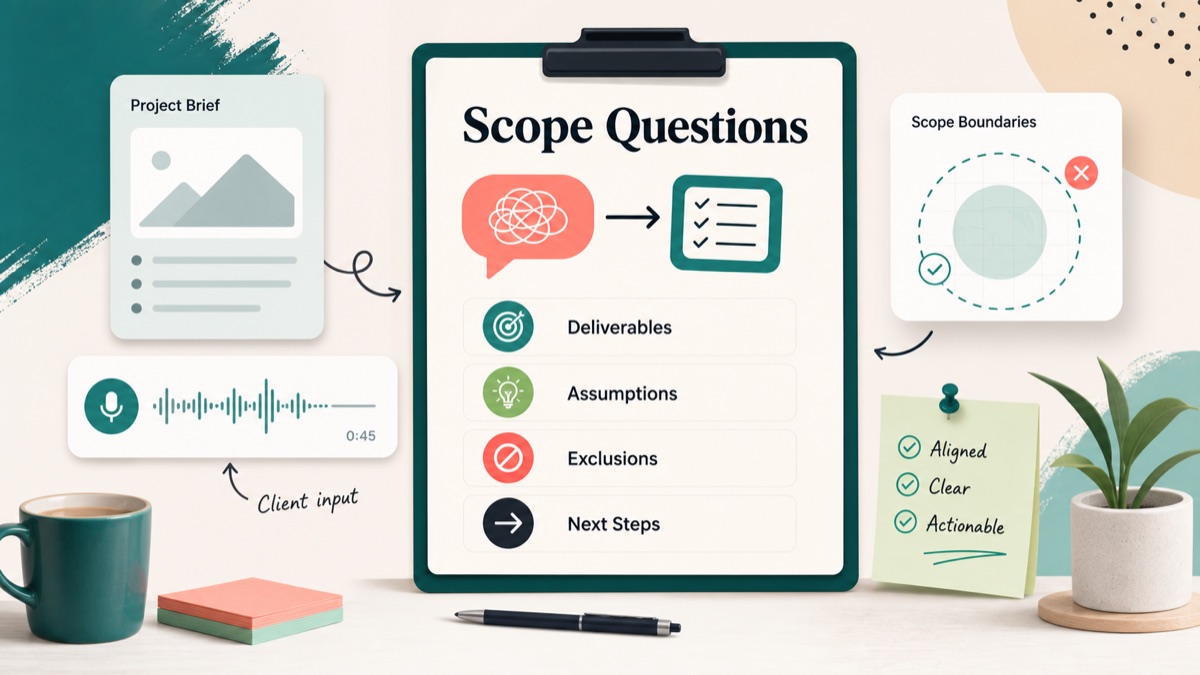
Client scope clarification questions help agencies turn a promising but vague client request into a project the team can price, schedule and deliver without guessing.
For agencies, consultants, studios and freelancers, the expensive part of unclear scope is rarely the first conversation. It is the hidden work that appears later: another stakeholder, a missing content owner, a “small” extra page, a new approval round, a platform constraint or a deliverable the client assumed was included.
This guide gives you a practical question bank, a scope clarification workflow, a before-and-after example and client-ready scripts you can use before proposal, kickoff or the next revision round.
Quick Answer
Client scope clarification questions are questions that separate what the client wants, what is included, what is excluded, what is assumed, who approves the work and what happens when the request changes.
Agencies should ask scope clarification questions before proposal and again before kickoff. The goal is not to interrogate the client. The goal is to turn vague language into deliverables, boundaries, dependencies, risks and next steps.
Scope clarification questions help agencies separate requested deliverables from assumptions before proposal or kickoff. A strong workflow combines voice client intake, an AI client brief generator, and client voice notes to action items so the client’s spoken context becomes a structured scope summary.
Use this table as the short version:
| Scope area | Clarifying question | Output you need |
|---|---|---|
| Deliverables | What exactly should exist at the end? | Included work |
| Exclusions | What should we not include in this phase? | Out-of-scope list |
| Assumptions | What are we assuming the client will provide? | Pricing assumptions |
| Stakeholders | Who gives input and who gives final approval? | Decision owner |
| Dependencies | What access, content or decisions could block work? | Risk list |
| Change rules | What counts as a new request? | Change process |
For product-led client intake, connect the question bank to scope creep client intake, client intake software for agencies, and a voice intake form.
Why Agencies Need Scope Questions Before They Need A Contract
A contract or statement of work is only as clear as the discovery that came before it.
Asana’s guide to project scope frames scope as the boundaries of a project: goals, deadlines, deliverables and what falls outside the work. That is exactly where agency projects usually get messy. The client asks for a website, campaign, brand refresh, audit, launch plan or consulting sprint, but the first request leaves out the boundaries.
Atlassian’s scope creep guide also connects scope creep to changing project boundaries, timing and resources. For client service businesses, the practical translation is simple: unclear intake becomes unclear pricing.
Good scope clarification turns this:
1 | We need a new landing page and maybe some messaging help. It should be quick, but we want it to feel more premium. There may be a few stakeholders involved. |
Into this:
1 | Included: one landing page wireframe, copy structure and design direction. |
A scope clarification workflow turns client input into scope boundaries, open questions and assigned next steps before the team promises work.
Client Scope Clarification Questions Template
Use this template before proposal, kickoff or a high-risk revision round.
1 | Client scope clarification |
This template works best when the client can answer in their own words. A form is useful for short facts. Voice is better when the client needs to explain context, tradeoffs, internal politics or why the work matters.
The Question Bank Agencies Can Reuse
You do not need to ask every question every time. Pick the questions that match the risk of the project.
Outcome Questions
- What business problem are we solving?
- Why does this project matter now?
- What should change after the project is complete?
- What metric, behavior or stakeholder opinion would prove success?
- What is the cost of doing nothing?
Outcome questions stop the team from treating the requested deliverable as the whole brief.
Deliverable Questions
- What exact deliverables are expected?
- How many versions, pages, concepts, assets or sessions are included?
- Which deliverables are required for launch?
- Which deliverables are optional or future-phase ideas?
- What acceptance criteria should each deliverable meet?
Asana describes project scope statements as written documents that can include goals, deliverables, boundaries, constraints and acceptance criteria. For agencies, deliverable questions make those boundaries concrete before pricing.
Exclusion Questions
- What should we explicitly exclude from this phase?
- Is strategy, copywriting, development, migration, training or QA included?
- Are support, maintenance or implementation included after delivery?
- Are new stakeholder requests included automatically?
- What would require a separate estimate?
Client scope clarification questions are most useful when they create a clear “not included” list, not only a bigger list of included work.
Stakeholder Questions
- Who will give feedback?
- Who has final approval?
- Is there a legal, leadership, compliance, IT or finance reviewer?
- What happens if stakeholders disagree?
- Who can approve scope, budget or timeline changes?
Atlassian’s project kickoff play emphasizes aligning people around purpose, roles, responsibilities and success markers. Agency scope questions should do that before the project becomes expensive.
Dependency Questions
- What content, files, logins or access do we need?
- What decisions must happen before work can begin?
- Are there other vendors, systems or internal teams involved?
- What external approval could delay the timeline?
- What information is not ready yet?
Dependencies are where “quick project” requests often become slow projects.
Revision And Change Questions
- How many revision rounds are included?
- What kind of feedback belongs in each round?
- What counts as a new deliverable?
- What happens when feedback arrives after approval?
- How will new requests be estimated and approved?
Revision questions protect both sides. The client knows what is included. The agency knows when to continue, clarify, price or pause.
Scope Question Decision Table
Use this table when you are deciding what to ask next.
| Client signal | Risk | Best scope question | Agency response |
|---|---|---|---|
| “We just need something simple” | Hidden deliverables | What exactly should exist at the end? | Define quantity and format |
| “Stakeholders will weigh in later” | Approval churn | Who gives final approval? | Name one decision owner |
| “We may add that after kickoff” | Expansion risk | Is this included now or future scope? | Price as option or exclude |
| “We do not have content yet” | Timeline risk | Who owns content and by what date? | Add dependency and assumption |
| “Make it more strategic” | Unpriced consulting | What strategic output do you expect? | Define advisory vs deliverable |
| “Can you handle everything?” | Responsibility risk | Which parts are agency-owned vs client-owned? | Split ownership clearly |
This table is the difference between hearing a vague request and turning it into a controlled project.
Raw Client Request To Structured Scope Summary
Here is a realistic before-and-after example.
Raw Client Request
1 | We need help launching the new service page. The current copy is not strong enough and the design feels dated. We want a more polished version before the sales push next month. It should probably include the page, some messaging, maybe a few social posts, and feedback from leadership. The dev team can help, but they are busy. We can send examples later. |
Scope Clarification Output
| Raw signal | Scope interpretation | Follow-up question |
|---|---|---|
| “New service page” | Core deliverable | Is this one page, one template or a set of page sections? |
| “Copy is not strong enough” | Possible copywriting scope | Do you need copy direction, final copy or only editing? |
| “Design feels dated” | Design deliverable | Is the visual update limited to this page? |
| “Before the sales push next month” | Timeline constraint | What exact launch date is fixed? |
| “Maybe a few social posts” | Optional extra deliverable | Are social posts included now or future scope? |
| “Feedback from leadership” | Approval risk | Who has final say if leadership disagrees? |
| “Dev team can help” | Dependency | Who owns implementation and QA? |
| “Examples later” | Input risk | By what date will references be provided? |
Structured Scope Summary
1 | Included for proposal: |
This is the output your team needs before writing the proposal. It is also the output VocalJet can help create from a client voice note: capture the client’s explanation, summarize the scope, extract action items and produce the follow-up email.
Best Workflow For Agencies, Consultants And Freelancers
Step 1: Capture The Client’s Request In Their Own Words
Start with the raw request. Do not translate too early. If the client thinks better out loud, use voice client intake so they can explain goals, constraints and worries asynchronously.
Voice client intake is a workflow where clients explain project context asynchronously by voice, then the agency turns that recording into structured scope context.
Step 2: Extract Scope Buckets
Turn the request into:
- outcomes;
- deliverables;
- exclusions;
- assumptions;
- dependencies;
- stakeholders;
- open questions;
- action items.
This is where an AI client brief generator is useful. The goal is not a polished transcript. The goal is a scope-ready brief.
Step 3: Ask Only The Missing Questions
Do not send the client a giant questionnaire if you already know half the answers. Send the missing questions in a tight list.
1 | Thanks for the context. Before I shape the proposal, I need to confirm five scope points: |
Step 4: Convert Answers Into Action Items
Every unclear answer should become an action item, a decision or an exclusion.
| Client answer | Convert into |
|---|---|
| “We will confirm later” | Decision needed before proposal |
| “Our team owns that” | Client action item |
| “Can you include it?” | Scope decision |
| “Not for this phase” | Exclusion |
| “The CEO decides” | Approval owner |
GitLab’s asynchronous communication handbook is a useful reference for documenting decisions and context in distributed work. Client scope clarification needs the same discipline: the answer should live somewhere the team can act on it.
Step 5: Send A Confirmation Summary
Before proposal or kickoff, send a short summary.
1 | Thanks. Here is the current scope summary: |
This confirmation gives the client a chance to correct assumptions before those assumptions become unpaid work.
When To Use A Form, Voice Note Or Meeting
Not every scope question needs a call.
| Channel | Best for | Avoid when |
|---|---|---|
| Intake form | Short facts, budgets, dates and contact details | The client needs to explain nuance |
| Voice note | Goals, context, tradeoffs, stakeholder dynamics and hidden concerns | The answer is a simple yes/no field |
| Written summary | Confirmation, accountability and next steps | The underlying request is still unclear |
| Live meeting | High-risk stakeholder conflict or commercial negotiation | The goal is only to collect first-pass context |
For many agencies, the best workflow is hybrid: collect baseline facts with a form, let the client explain nuance by voice, then send back a structured summary.
That is the practical bridge to VocalJet. The client records context once. Your team gets a searchable summary, scope questions, action items and a follow-up email instead of another long call.
FAQ
What are client scope clarification questions?
Client scope clarification questions are questions that turn a vague client request into clear deliverables, exclusions, assumptions, dependencies, approval rules and next steps.
When should an agency ask scope clarification questions?
Ask them before proposal, before kickoff and whenever feedback introduces a new deliverable, stakeholder, dependency or timeline risk.
How many scope questions should I send to a client?
Send only the questions needed to remove the biggest risk. For a simple project, that may be five questions. For a complex project, use a longer intake template and then summarize the answers.
What is the difference between scope questions and intake questions?
Intake questions collect context about the client and project. Scope questions specifically define what is included, excluded, assumed, blocked, approved and priced.
How does voice intake help with scope clarification?
Voice intake helps clients explain nuance, tradeoffs and hidden concerns faster than a long form. The agency can then turn that spoken context into scope boundaries, open questions and action items.
What should I do when a client asks for work outside scope?
Name the request, connect it to the agreed scope, then offer a choice: estimate it separately, defer it to a later phase or trade it for another deliverable.