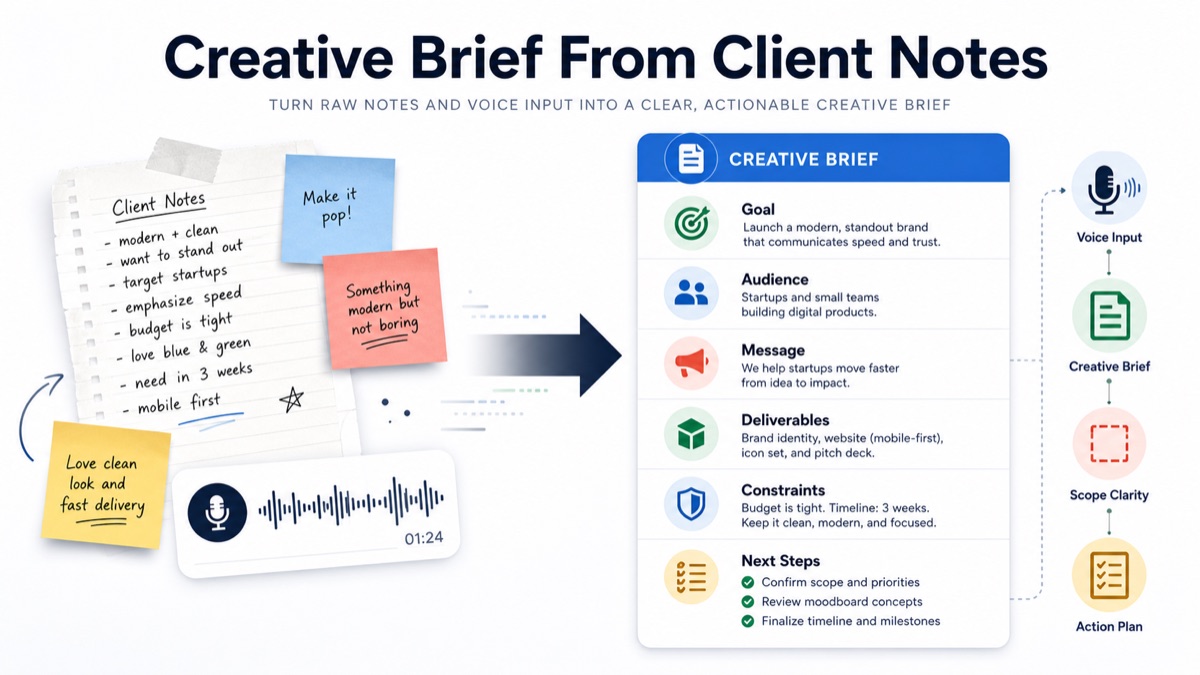
Creative projects often start with useful but messy client notes. A client explains the goal in a meeting, adds brand preferences by email, shares a few examples in a chat thread, then records a voice note with the real reason the campaign matters.
For agencies, freelancers and creative studios, the risk is not a lack of input. The risk is that the input never becomes a clear creative brief. When that happens, the team starts designing, writing or pitching against assumptions instead of confirmed context.
This guide shows how to turn client notes into a creative brief that captures the goal, audience, message, deliverables, constraints, risks and next steps before creative work begins.
A creative brief from client notes is a structured document that converts raw client context into the strategic direction, message, audience, deliverables and constraints a creative team needs to produce the work. It is not a transcript. It is the decision-ready version of the client’s scattered context.
Quick Answer
To create a creative brief from client notes, first preserve the raw notes, then extract the client’s goal, audience, offer, message, tone, deliverables, constraints, approvals and open questions. Finally, mark what is confirmed, what is assumed and what needs clarification before creative production starts.
The best workflow is to collect client context asynchronously, let the client explain nuance by voice when needed, then use a repeatable brief structure to turn that context into creative direction, scope decisions and action items.
Use this quick extraction table:
| Raw note type | What to extract | Creative brief output |
|---|---|---|
| Business context | Why the project exists now | Background and objective |
| Audience notes | Who the work must persuade | Target audience and insight |
| Brand reactions | What the client likes or dislikes | Tone, style and reference guardrails |
| Deliverable mentions | What the client expects to receive | Scope and production list |
| Constraints | Budget, deadline, compliance, assets | Boundaries and risks |
| Next-step comments | What must happen next | Action items and owners |
For a product-led workflow, combine voice client intake, an AI client brief generator, client voice notes to action items, and scope creep client intake.
Why Client Notes Do Not Become Creative Briefs
Client notes usually fail because they mix five different things:
- confirmed facts;
- client preferences;
- business goals;
- personal taste;
- implied deliverables.
That mix is normal. Clients think in context, examples and reactions. Creative teams need direction, boundaries and decisions.
Asana’s guide to a project brief is useful because it frames a brief as a concise source for project goals, scope, timeline and audience. A creative brief needs the same discipline, but with stronger attention to message, audience insight, tone and creative constraints.
The creative brief is where client context becomes creative direction.
Creative Brief From Client Notes Template
Use this template after a client call, async intake, voice note or feedback thread.
1 | Creative brief from client notes |
This template is intentionally practical. It gives the creative team enough direction to start work while giving the project lead enough structure to protect scope.
Raw Client Notes To Creative Brief Example
Here is a realistic transformation.
Raw Client Notes
1 | We need the launch to feel more polished than our last one. The audience is mostly founders and operators, but investors might see it too. The product is technical, so we do not want it to feel cold. We like the Stripe-style clarity but not the generic SaaS look. It needs a landing page, a few LinkedIn posts, maybe an email sequence, and some visuals for the deck. The deadline is tight because the announcement is in three weeks. We have screenshots but not final copy. The CEO cares a lot about the story. Legal may need to review claims. |
Structured Creative Brief
| Brief section | Structured output |
|---|---|
| Background | Product launch needs a stronger, more polished creative system than the previous launch |
| Objective | Communicate a technical product clearly without making it feel cold |
| Audience | Founders and operators first; investors may also review the materials |
| Core message | Technical credibility plus approachable business value |
| Tone | Clear, polished, modern, not generic SaaS |
| Deliverables | Landing page confirmed; LinkedIn posts, email sequence and deck visuals need scope confirmation |
| Constraints | Three-week deadline, unfinished copy, legal review for claims |
| Stakeholders | CEO has strong story input; legal may review |
| Scope risks | “Maybe” deliverables could expand production work |
| Next steps | Confirm deliverable list, copy owner, legal review timeline and final decision owner |
An AI client brief generator turns spoken or written client context into structured goals, constraints, risks and next steps. That is useful because the raw note contains the project, but not yet the decisions needed to run the project.
Creative Brief Vs Project Brief Vs Scope Of Work
These documents should support each other, not replace each other.
| Document | Main job | When to use it | Key question |
|---|---|---|---|
| Creative brief | Guide message, audience, tone and creative direction | Before concepting or production | What should the work communicate? |
| Project brief | Align project goals, timeline, team and scope | Before kickoff | What are we doing and why? |
| Scope of work | Define paid deliverables, exclusions and terms | Before work starts | What is included and approved? |
| Feedback summary | Convert review comments into next actions | During revisions | What changes next? |
Milanote’s creative brief template is a useful reference because it treats the brief as a central place for objectives, audience, message, deliverables and creative direction. For client work, the missing layer is often scope clarity: what is confirmed, what is optional and what needs a decision.
Scope clarification questions help agencies separate creative direction from new deliverables before production begins.
Best Workflow For Agencies And Creative Studios
Step 1: Capture Client Context In Their Words
Start with the raw material. That may be a discovery call, email, questionnaire, stakeholder comments, voice note or project management thread.
If the client thinks out loud better than they write, use a voice client intake workflow. Voice client intake is a workflow where clients explain project context asynchronously by voice, then the agency turns that recording into structured project context.
Step 2: Separate Facts From Interpretation
Before writing the brief, separate:
- what the client explicitly said;
- what the agency inferred;
- what still needs confirmation;
- what could affect scope, timeline or budget.
This prevents a creative preference from becoming an assumed deliverable.
Step 3: Turn Notes Into Brief Sections
Map the notes into the template. Do not polish too early. First, capture the decisions.
| Client note | Brief section | Follow-up needed |
|---|---|---|
| “We want it to feel premium” | Tone and style | What examples define premium? |
| “Founders are the audience” | Audience | Founder at what company stage? |
| “Maybe add emails too” | Deliverables | Included now or future scope? |
| “Legal will review” | Constraints | How long does legal review take? |
| “The CEO cares about story” | Stakeholders | Is the CEO final approver? |
Step 4: Convert Open Questions Into Action Items
Do not leave the brief full of uncertainty. Convert uncertainty into assigned next steps.
Asana’s guide to action items describes action items as specific tasks with an owner and deadline. That same standard should apply to creative brief gaps.
| Open question | Action item |
|---|---|
| Which deliverables are included? | Client confirms asset list by Friday |
| Who owns final copy? | Agency sends copy ownership options |
| What references define the tone? | Client shares three approved examples |
| Who approves the final creative? | Client names one decision owner |
| Is legal review required? | Client confirms review timeline and reviewer |
This is where client voice notes to action items becomes directly useful.
Step 5: Send A Confirmation Summary
Before creative production starts, send the client a short confirmation:
1 | Thanks for sharing the context. Here is the current creative brief summary: |
This gives the client one clean checkpoint before assumptions turn into work.
When Voice Notes Beat Forms
Forms are useful for known inputs. Voice is better when the client needs to explain nuance.
| Use a form when | Use voice when |
|---|---|
| The deliverables are already known | The project is still fuzzy |
| The client can answer in short fields | The client needs to tell the story |
| The goal is collecting logistics | The goal is capturing nuance and context |
| There is one stakeholder | Multiple stakeholders need to add perspective |
GitLab’s handbook on asynchronous communication reinforces a practical point for distributed work: important context should be written down where others can reuse it. For creative teams, the creative brief is that reusable context.
How VocalJet Fits This Workflow
VocalJet is useful when the best creative context is trapped in spoken client notes.
Instead of asking a client to fill out a long form or booking another clarification call, the agency can ask the client to record context by voice. VocalJet helps turn that voice note into a searchable summary, creative brief sections, open questions, scope risks, action items and follow-up-ready text.
That makes the workflow practical for:
- creative studios turning client ideas into briefs;
- agencies scoping campaign and launch assets;
- freelancers clarifying deliverables before concepts;
- account managers collecting stakeholder context asynchronously;
- project leads protecting margin before production starts.
If the brief later turns into review rounds, async client feedback and voice feedback for agencies help convert revision comments into action items instead of another scattered thread.
What Not To Put In A Creative Brief
Avoid turning the brief into a dumping ground. Leave out:
- every raw note that does not affect creative direction;
- unapproved deliverables;
- personal preferences with no business context;
- internal agency tasks that the client does not need to confirm;
- legal terms that belong in a contract;
- unresolved stakeholder debates presented as decisions.
Nielsen Norman Group’s article on design critiques is a useful reminder that feedback should evaluate work against goals, not personal taste. The same principle applies before the work starts: a creative brief should anchor creative decisions in the client’s audience, objective and constraints.
Atlassian’s project kickoff guidance also points to the value of aligning on purpose, roles and success before execution. A strong creative brief lets the kickoff confirm direction instead of discovering basic context.
FAQ
What is a creative brief from client notes?
A creative brief from client notes is a structured document that turns raw client context into the objective, audience, message, tone, deliverables, constraints and next steps a creative team needs.
What should be included in a creative brief?
A creative brief should include background, objective, audience, core message, tone, deliverables, constraints, stakeholders, open questions and next steps.
How do you turn messy client notes into a brief?
Start by preserving the raw notes, then extract confirmed facts, assumptions, scope signals and open questions. Map those into brief sections and turn missing decisions into action items.
Is a creative brief the same as a project brief?
No. A creative brief guides message, audience, tone and creative direction. A project brief aligns the broader project goal, team, timeline and scope.
Can a client voice note become a creative brief?
Yes. A client voice note can become a creative brief when the spoken context is transcribed, summarized and structured into goals, audience, message, deliverables, constraints, open questions and next steps.