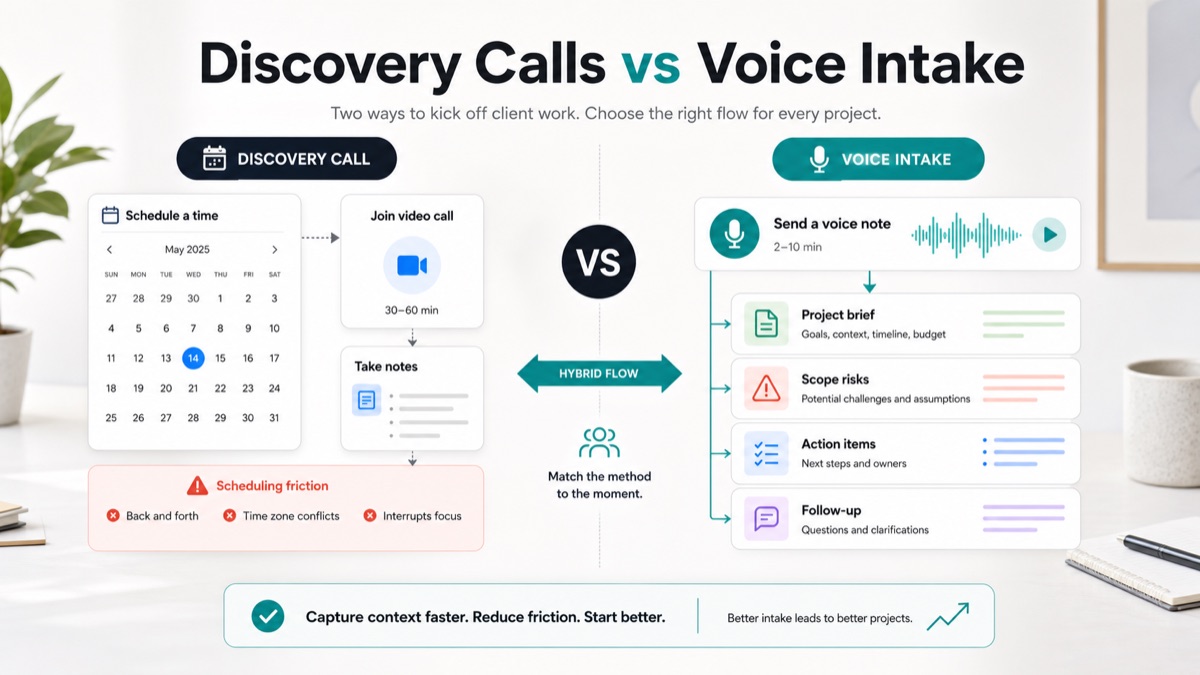
Discovery calls are useful when a client needs to build trust, compare options or make a decision live. They are also expensive when every early question becomes a calendar event. Agencies, consultants, creative studios and freelancers often lose days waiting for a call that mostly collects background context, unclear requirements and notes that still need to be rewritten afterward.
Voice intake gives clients a faster way to explain what happened, what they need and where the project feels unclear. The agency still gets the nuance of spoken context, but the output can become a searchable brief, scope clarification list, action items and follow-up email before anyone books another meeting.
This guide compares discovery calls and voice intake for client projects, then shows a hybrid workflow that keeps live calls for judgment while using async voice notes for first-pass context.
Quick Answer
Discovery calls are best when the client relationship needs live trust, strategic advice, commercial negotiation or a real-time decision. Voice intake is better when the team needs project context, revision background, constraints, stakeholder notes or scope risks before deciding whether a meeting is necessary.
Voice client intake is a workflow where clients explain project context asynchronously by voice, then the agency turns that recording into structured notes, questions and next steps. A discovery call is a live conversation used to qualify, align or decide, but it should not be the default container for every piece of client context.
For most client projects, the strongest workflow is hybrid: collect basic facts, ask the client for a short voice note, generate a discovery brief, then use a call only when there are strategic, commercial or emotional decisions to handle.
| Intake method | Best for | Weakness | Best output |
|---|---|---|---|
| Discovery call | Trust, fit, negotiation, live tradeoffs | Scheduling friction and weak written records | Decision notes and agreed next step |
| Voice intake | Context, constraints, goals, feedback, scope risks | Not ideal for sensitive negotiation | Project brief and clarification list |
| Form intake | Simple facts, contact data, structured fields | Thin answers and missing nuance | Intake record |
| Hybrid intake | Complex client work with limited meetings | Requires a clear handoff process | Brief, call agenda, action items |
If you are replacing bloated forms, start with a voice intake form or a client intake form alternative. If your agency needs a broader intake system, connect the workflow to client intake software for agencies, voice client intake, an AI client brief generator, client voice notes to action items and scope creep client intake.
What Discovery Calls Are Best For
A discovery call is a live client conversation used to qualify the opportunity, understand the decision context and decide what should happen next. It works well when there is ambiguity that needs judgment, not just information capture.
Use a discovery call when:
- The client is evaluating trust, expertise or commercial fit.
- There are multiple stakeholders with competing priorities.
- Budget, timeline or scope tradeoffs need live discussion.
- The project is sensitive, political or emotionally charged.
- You need to ask follow-up questions based on the client’s answer.
- You are closing a proposal, changing scope or handling a difficult expectation.
Atlassian’s project kickoff guidance emphasizes alignment around goals, roles, timing and risks before a team begins work. That kind of live alignment is valuable. The mistake is using a discovery call to collect raw background details that the client could have explained asynchronously first.
What Voice Intake Is Best For
Voice intake is best for collecting rich project context before the team spends time in a live meeting. It gives the client room to explain the problem naturally, while giving the agency a written artifact it can analyze, share and reuse.
Async client intake helps service teams collect project context without forcing every clarification into a scheduled call. This matters because first-pass client context is often messy: the client remembers details out of order, adds constraints while talking and mentions risks that never fit inside a form field.
Use voice intake when:
- The client has a vague request but can explain it better out loud.
- The agency needs background before deciding whether a call is worth scheduling.
- A stakeholder cannot attend a live call but can record context.
- The team wants a transcript, summary and action list attached to the project.
- The work may create scope creep if assumptions are not captured early.
- The client is giving feedback, revision context or new requirements.
GitLab’s async communication handbook frames asynchronous work around documenting context so people can contribute without waiting for a meeting. The same principle applies to client service work: capture the context once, make it readable and use live time for decisions.
Discovery Calls vs Voice Intake Decision Matrix
The practical question is not whether calls are good or bad. The question is which client communication job you are trying to do.
| Client situation | Use discovery call | Use voice intake | Why |
|---|---|---|---|
| New high-value lead wants to evaluate fit | Yes | Before or after | Trust and commercial fit are live decisions. |
| Client sends a vague project request | Maybe | Yes | Voice creates richer context before the team reacts. |
| Agency needs goals, constraints and timeline | Maybe | Yes | These can become a project brief before a call. |
| Budget conflict or pricing concern appears | Yes | No | Live conversation reduces misunderstanding. |
| Stakeholder has revision feedback | Maybe | Yes | The team needs exact context, examples and next steps. |
| Scope is unclear before proposal | Yes | Yes | Voice surfaces assumptions; a call resolves tradeoffs. |
| Existing client needs a small change | No | Yes | A meeting is usually too heavy for simple context. |
| Multiple departments disagree | Yes | Before the call | Async notes expose disagreements before live alignment. |
Voice intake should not replace human judgment. It should prevent human judgment from being wasted on avoidable context gathering.
Best Workflow For Agencies, Consultants And Freelancers
The best workflow for agencies, consultants and freelancers is to collect async voice context before the discovery call, then use the call only if the brief reveals open decisions, risk or commercial complexity.
1. Collect The Basic Facts First
Use a lightweight form or client portal field for contact details, company name, project type, deadline and budget range. Do not ask the client to write long essays in a form if the answer depends on nuance.
2. Ask For A Short Voice Intake
Use a prompt that tells the client exactly what to cover:
1 | Please record a 3-7 minute voice note explaining: |
This prompt works because it gives the client structure without forcing them into short text fields.
3. Turn The Recording Into A Discovery Brief
An AI client brief generator turns spoken client context into structured goals, constraints, risks and next steps. Asana’s project brief guidance treats a brief as a central artifact for goals, scope, stakeholders and timing; voice intake gives you the raw material for that artifact without asking the client to write it from scratch.
Your discovery brief should include:
- Business goal
- Current problem
- Desired outcome
- Audience or users
- Known constraints
- Stakeholders and approvers
- Scope risks
- Open questions
- Recommended next step
4. Decide Whether A Call Is Needed
Use this call/no-call checklist:
| Question | If yes | If no |
|---|---|---|
| Is there a budget, timeline or scope tradeoff? | Book a focused discovery call. | Continue async. |
| Does the client need to evaluate trust or expertise? | Book a call. | Send a written summary. |
| Are there conflicting stakeholder priorities? | Book a call with decision makers. | Ask one async clarification. |
| Is the request already clear enough for a proposal? | Send proposal or next-step email. | Ask for more voice context. |
| Could a misunderstanding create unpaid revisions later? | Clarify before proposal. | Move to production intake. |
5. Use The Call For Decisions, Not Raw Context
If a call is needed, send the brief beforehand and keep the agenda tight:
- Confirm the goal.
- Validate constraints.
- Resolve scope questions.
- Agree on next steps.
- Assign owners.
That call is shorter because the context already exists.
6. Send A Confirmation Summary
After the call or async clarification, send a summary that includes agreed scope, exclusions, open questions and action items. This is where voice intake becomes scope protection, not just a convenience feature.
Raw Voice Intake To Structured Discovery Brief
Here is what the transformation can look like.
Raw client voice note
1 | We need help refreshing our product pages before the September launch. The current pages are too technical and sales keeps saying prospects do not understand the differences between plans. We have a designer internally, but she is booked on the app redesign. We probably need copy and page structure first. The CEO wants this live before the sales event, but product may still change one feature. I am not sure if we need landing pages or just the existing pages cleaned up. |
Structured output
| Brief field | Extracted detail |
|---|---|
| Business goal | Improve product page clarity before the September launch. |
| Current problem | Pages are too technical; prospects struggle to compare plans. |
| Likely deliverables | Messaging, page structure and copy for existing product pages. |
| Internal constraints | Internal designer is unavailable; product feature may change. |
| Stakeholders | Sales, CEO, product team and internal designer. |
| Scope risks | “Landing pages” vs “existing pages” is unresolved. |
| Open questions | Which pages are in scope? Who approves copy? What feature may change? |
| Action items | Confirm page list, deadline, approver and product-change risk. |
Client feedback to action items is a workflow where vague spoken context becomes named tasks, owners and follow-up questions. The value is not the transcript alone; it is the structured project record that prevents assumptions from becoming unpaid work.
When A Discovery Call Is Better Than Voice Intake
Use a discovery call when the client needs to feel heard live, when the agency needs to read reactions or when the answer changes depending on the client’s response.
Discovery calls are better for:
- New relationships where trust has not been established.
- Complex consulting work with unclear diagnosis.
- Pricing conversations.
- Proposal walk-throughs.
- Sensitive feedback.
- Projects with high political risk.
- Moments where the client must choose between tradeoffs.
In these cases, voice intake can still prepare the call. It should not remove the call entirely.
When Voice Intake Is Better Than A Discovery Call
Voice intake is better when the client has context to unload and the agency needs a reusable record.
Voice intake is better for:
- First-pass project background.
- Creative or website revision context.
- Stakeholder notes from people who cannot attend.
- Capturing examples, URLs, constraints and concerns.
- Intake before proposal writing.
- Scope clarification before kickoff.
- Turning client notes into a brief, action list or follow-up email.
Async voice intake helps agencies reduce unnecessary discovery calls while keeping the nuance that simple forms often lose.
How VocalJet Fits This Workflow
VocalJet is built for client communication workflows where spoken context needs to become usable project work. A client records a voice note, and the team can turn that input into a transcript, summary, brief, clarification questions, scope risks, action items and follow-up text.
For agencies, consultants, studios and freelancers, that means the discovery workflow can start before the meeting. The client explains the context in their own words. VocalJet helps the team structure it, search it, share it and decide whether a live call is needed.
The practical result is not “no more calls.” It is fewer unnecessary calls, better prepared discovery conversations and clearer written records before scope becomes expensive.
FAQ
Is voice intake a replacement for discovery calls?
Voice intake is not a full replacement for discovery calls. It replaces the raw context-gathering part of discovery, while live calls remain useful for trust, negotiation, diagnosis and decisions.
When should an agency use a discovery call?
An agency should use a discovery call when the client needs live guidance, when scope or budget tradeoffs must be discussed, or when several stakeholders need alignment before work starts.
What should a voice intake prompt ask?
A voice intake prompt should ask why the project matters now, what needs to change, what has already been tried, what constraints exist, who approves the work and what outcome would count as success.
How can voice intake reduce discovery calls?
Voice intake reduces discovery calls by collecting project background, constraints and vague requirements asynchronously before the agency decides whether a meeting is needed.
How do you turn voice intake into a project brief?
Turn voice intake into a project brief by extracting the client’s goal, current problem, desired outcome, deliverables, constraints, stakeholders, scope risks, open questions and next steps.
How can VocalJet help with client discovery?
VocalJet helps with client discovery by turning client voice notes into transcripts, summaries, briefs, scope clarification questions, action items and follow-up-ready text.