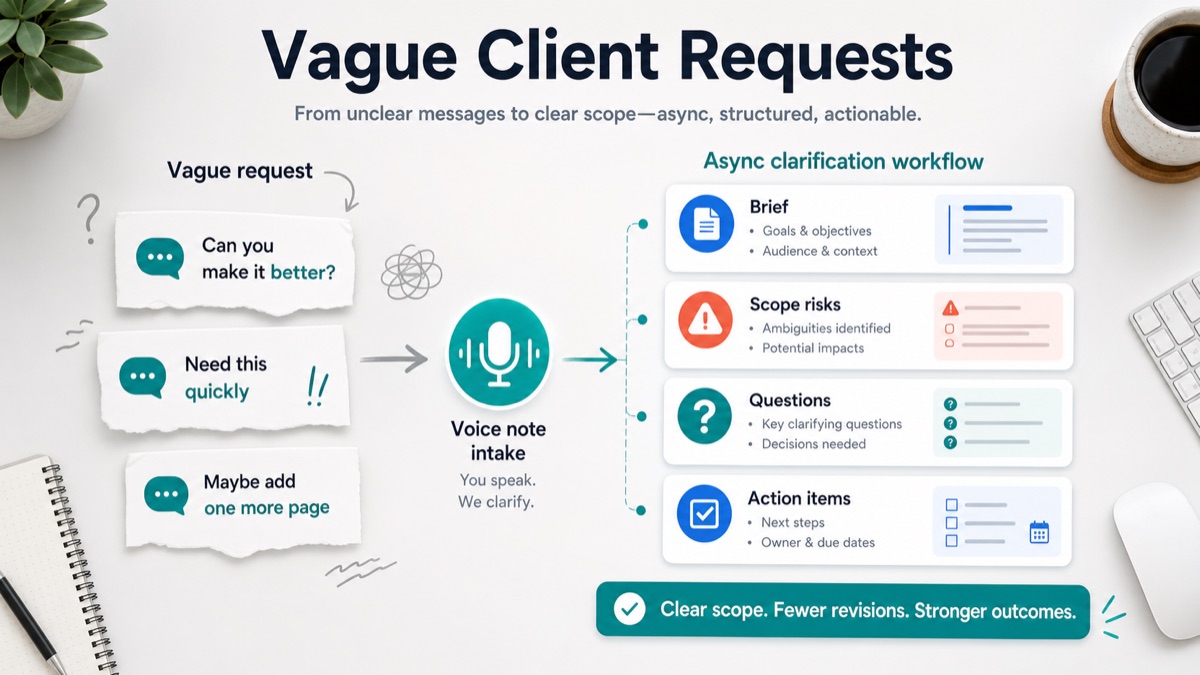
Vague client requests are expensive because they sound simple before they become scope, revision and approval problems. A client says “make it more premium,” “can we add one more page,” “this should be quick,” or “we need it to convert better,” but the request does not say what outcome matters, what deliverable is included, who approves it, what assets are missing or whether the work changes the original agreement.
For agencies, consultants, studios and freelancers, the goal is not to force every unclear request into another meeting. The goal is to capture the missing context asynchronously, turn it into a structured brief, label scope risk and send a clear next step the client can approve.
This guide gives you a no-call workflow, decision table, clarification prompt, response script, raw-request example and FAQ for handling vague client requests without losing momentum.
Quick Answer
To handle vague client requests without extra calls, preserve the original request, identify what is missing, ask a short set of clarification questions, offer a voice response for nuance, then convert the answer into scope, open questions, action items and a confirmation summary.
A vague client request is a client message that names a desired change or outcome without enough context to price, scope, assign or execute the work safely.
Async clarification is a workflow where the client adds context by written reply or voice note, and the agency turns that context into a brief, scope decision and next steps without scheduling another live meeting.
| Request signal | What it may hide | Best no-call response |
|---|---|---|
| “Make it better” | Undefined quality criteria | Ask for goal, audience and examples |
| “This should be quick” | Unpriced effort | Ask what is included and what can wait |
| “Can we also add…” | New deliverable | Label as potential scope change |
| “It needs to convert” | Strategy or copy problem | Ask for conversion goal and current blocker |
| “The team has comments” | Multiple approvers | Ask for final decision owner |
For a product-led workflow, connect voice client intake, a voice intake form, client intake software for agencies, an AI client brief generator, scope creep client intake, client voice notes to action items, and async client feedback.
Why Vague Requests Turn Into Extra Calls
Vague client requests are not always a sign of a bad client. Most clients are describing a business problem in the language they have.
The problem is that agency delivery requires more precision than the client message contains.
A vague request usually misses at least one of these:
- business outcome;
- target audience;
- current blocker;
- requested deliverable;
- deadline;
- approval owner;
- included vs optional work;
- assets or dependencies;
- budget or effort limit;
- definition of done.
If the agency responds by guessing, the project absorbs risk. If the agency responds with a meeting every time, the workflow becomes slow. The better path is async clarification: ask for the missing context in a structured way and keep the written record attached to the work.
Asana’s guide to project scope is useful because it frames scope as project boundaries, including goals, deliverables and what falls outside the work. Vague client requests are risky because those boundaries are missing.
Vague Request Triage Matrix
Before replying, classify the request.
| Request type | Example | Risk | What to ask |
|---|---|---|---|
| Outcome vague | “Make it convert better” | Strategy may be missing | What conversion action matters most? |
| Deliverable vague | “Add a resources section” | New scope may be hidden | How many pages, states or assets are included? |
| Quality vague | “Make it premium” | Subjective revision loop | What examples match the target direction? |
| Timeline vague | “We need it quickly” | Deadline pressure | What date is fixed and what can move? |
| Ownership vague | “The team has feedback” | Approval conflict | Who is the final decision owner? |
| Dependency vague | “We will send copy later” | Delivery blocker | Who owns the asset and by when? |
Scope clarification questions help agencies separate requested deliverables from assumptions before proposal, kickoff or revision work begins.
The No-Call Clarification Workflow
Use this workflow when the request is too vague to act on, but not complex enough to justify another meeting yet.
Step 1: Preserve The Original Request
Keep the raw wording. Do not rewrite it before analysis.
1 | Client request: |
The original wording matters because it shows uncertainty, urgency and possible scope expansion.
Step 2: Identify The Missing Context
Turn the request into a gap table.
| Missing context | Why it matters |
|---|---|
| What “stronger” means | Could mean copy, design, offer, proof or UX |
| What “premium” means | Subjective unless examples are provided |
| Whether proof section is included | Possible new deliverable |
| Who approves before leadership review | Approval risk |
| What date is fixed | Timeline and prioritization |
| What content exists | Asset dependency |
This step keeps the agency from turning assumptions into unpaid work.
Step 3: Ask One Clarification Packet
Send one compact message instead of a scattered list of follow-up emails.
1 | Thanks. I can help clarify this without adding another call. |
This script works because it is collaborative, specific and does not make the client feel blocked by process.
Step 4: Offer Voice For Nuance
Some clients will not write a useful paragraph. A short voice note is often faster.
1 | If easier, record a two-minute voice note instead. Please explain: |
Voice client intake is useful because clients can explain nuance, uncertainty and tradeoffs faster than they can format a perfect brief.
Step 5: Convert The Reply Into A Scope Summary
Atlassian’s guide to scope creep frames scope creep as work expanding beyond the original agreement without matching time, budget or resources. For client services, the practical fix is to make the tradeoff visible before the work starts.
After the client replies, send a structured summary.
| Section | Structured output |
|---|---|
| Confirmed goal | Improve demo request clarity before leadership review |
| Included work | Rewrite hero copy and adjust proof block layout |
| Potential new scope | Net-new proof section if no existing component exists |
| Client dependencies | Provide quotes, screenshots and logo approvals |
| Open question | Is the proof section required in this phase? |
| Next action | Agency sends two options: included adjustment vs add-on estimate |
The output should make the next decision obvious.
Raw Request To Structured Output Example
Raw Client Request
1 | Can we make the landing page stronger before launch? |
Structured Clarification Output
| Field | Output |
|---|---|
| Business goal | Improve leadership confidence and conversion readiness before launch |
| Current ambiguity | “Stronger” and “premium” are not defined |
| Scope risk | A new proof section may add design, copy and approval work |
| Deadline risk | Leadership review next week may compress feedback |
| Client dependency | Proof assets, quotes or screenshots are needed |
| Clarification question | Is the proof section required now or a phase-two add-on? |
| Recommended next step | Ask for a voice reply, then send an included vs add-on recommendation |
Follow-Up Summary
1 | Here is how I would frame the request: |
The agency has not said no. It has turned a vague request into a decision.
When To Reply By Text, Voice Or Meeting
Not every vague request needs the same response.
| Situation | Best response | Why |
|---|---|---|
| One missing fact | Text reply | Fastest path |
| Several missing facts | Clarification packet | Keeps questions together |
| Client has context but cannot structure it | Voice note | Captures nuance quickly |
| Budget, strategy or conflict is involved | Call | Needs live discussion |
| Request changes signed scope | Written scope summary | Protects agreement |
Use calls for judgment, negotiation and relationship moments. Use async clarification for missing context.
What To Put In The Confirmation Summary
Atlassian’s guide to scope of work emphasizes objectives, deliverables, inclusions, exclusions, roles, responsibilities and timelines. A good no-call summary should cover the same operating details in plain language.
Include:
- original request;
- interpreted goal;
- confirmed deliverables;
- excluded or optional items;
- assumptions;
- dependencies;
- open questions;
- owner for each next step;
- whether the request affects timeline, budget or scope.
Asana’s guide to a project brief is also useful because a brief gives the team one written place for goals, scope, audience, timeline and ownership.
Best Workflow For Agencies, Consultants And Freelancers
The best workflow is not “never take calls.” It is “do not use a call to compensate for every vague sentence.”
Use this operating rhythm:
- Capture the raw request.
- Label the missing context.
- Ask one clarification packet.
- Offer voice intake for nuance.
- Convert the reply into a brief, scope risks and action items.
- Send a confirmation summary.
- Only schedule a call if the decision needs negotiation.
In VocalJet, the product path is straightforward: the client records the context, VocalJet helps turn it into a transcript and summary, and the agency can structure the output into a brief, scope clarification, action items and follow-up-ready text.
That makes VocalJet useful when:
- the client request is too vague to quote;
- a form answer is too thin;
- a feedback comment may change scope;
- the agency needs action items before work starts;
- another call would slow the project down.
FAQ
How do you respond to a vague client request?
Respond to a vague client request by acknowledging the request, naming the missing context, asking a short set of clarification questions and confirming that you will turn the answer into scope and next steps.
What should you ask before quoting a vague client request?
Before quoting a vague request, ask what outcome the client wants, which deliverables are included, what is optional, who approves the work, what assets are ready and whether the timeline is fixed.
Should every vague request become a meeting?
No. Many vague requests can be clarified asynchronously with a structured question packet or short voice note. Use meetings for negotiation, conflict, strategic tradeoffs or high-value relationship moments.
How does voice intake help with vague client requests?
Voice intake helps because clients can explain context, constraints, uncertainty and priorities in their own words. The agency can then turn that spoken context into a brief, scope risks and action items.
How do vague client requests create scope creep?
Vague requests create scope creep when unclear ideas become unapproved deliverables, extra revision rounds, new stakeholders, missing assets or strategy work that was not priced in the original agreement.
How can VocalJet help agencies clarify vague requests?
VocalJet lets clients explain vague requests by voice and helps agencies turn that context into transcripts, summaries, briefs, scope risks, action items and follow-up-ready text.