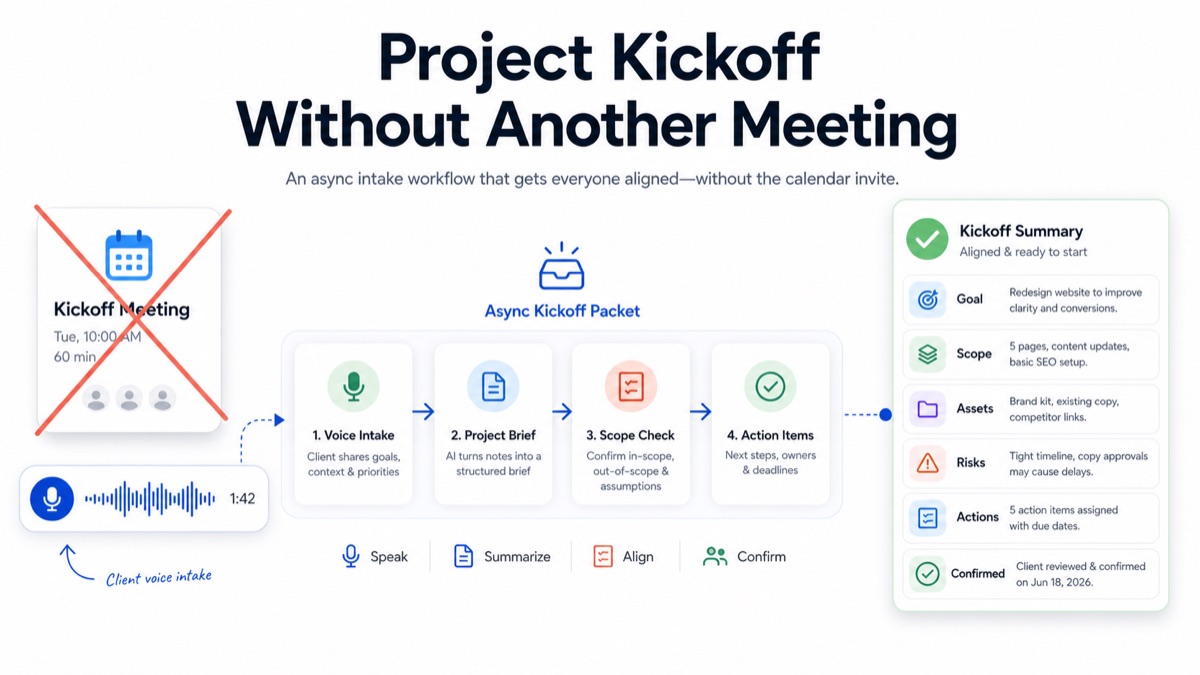
Project kickoff meetings often feel necessary because the team needs alignment before work starts. But for agencies, consultants, studios and freelancers, many kickoff calls repeat information the client already shared across emails, intake forms, sales calls, files and voice notes.
The problem is not the meeting itself. The problem is using a meeting to collect context that could have been captured, structured and confirmed asynchronously before the team spends an hour on a call.
An async project kickoff workflow replaces the default kickoff meeting with a structured intake packet, client voice context, a project brief, a scope check, action items and a confirmation summary the client can approve before delivery starts.
Project kickoff without another meeting means aligning the client and delivery team asynchronously before work begins. The workflow captures goals, deliverables, assets, stakeholders, risks, open questions and next steps without requiring a live calendar slot.
Quick Answer
To run a project kickoff without another meeting, send the client an async kickoff packet that asks for goals, success criteria, deliverables, assets, stakeholders, constraints, timeline and open questions. Then turn their answers into a kickoff summary with scope, risks, action items and confirmation language.
This works best when the project is clear enough to start but still has operational details to confirm. If stakeholders disagree, the scope is unresolved, or a strategic decision is blocked, use a live meeting. Otherwise, async kickoff can reduce scheduling friction while improving the written project record.
Use this decision table:
| Kickoff format | Best for | Risk | Best output |
|---|---|---|---|
| Live kickoff meeting | High-risk alignment, stakeholder conflict or strategy decisions | Expensive scheduling and weak notes | Shared discussion |
| Async kickoff packet | Known project with missing details | Needs clear prompts | Brief, scope check and action items |
| Voice intake kickoff | Client needs to explain nuance | Needs structured extraction | Client context in their own words |
| Hybrid kickoff | Complex project with async prep first | Can duplicate work | Shorter meeting and stronger record |
For a product-led workflow, combine voice client intake, a voice intake form, client intake software for agencies, an AI client brief generator, and client voice notes to action items.
Why Kickoff Meetings Become Intake Meetings
Kickoff meetings drift when the team still lacks basic project context:
- what the client wants to achieve;
- what deliverables are actually included;
- who approves the work;
- which assets already exist;
- what dependencies may delay the project;
- what feedback process the client expects;
- what is out of scope.
Atlassian’s project kickoff play focuses on alignment around purpose, roles, goals and working agreements. That is the right goal. But the information needed for that alignment does not always need to be collected live.
Asana’s guide to a project brief also reinforces a practical baseline: project goals, scope, audience, timeline and ownership need a concise written home. For client work, the async kickoff packet is how you create that home before the work starts.
The Async Kickoff Packet
Send this packet after the client has agreed to start but before production begins.
1 | Async project kickoff packet |
This packet is not a form for its own sake. It is a way to collect the context that usually gets trapped inside a kickoff call.
Async Kickoff Workflow For Agencies
Step 1: Send One Intake Link
Send a single link that tells the client what context you need before work starts. Keep the prompt focused on alignment, not every possible detail.
If the client is likely to write short, incomplete answers, ask them to record a short voice response instead. Voice client intake is a workflow where clients explain project context asynchronously by voice, then the agency turns that recording into structured goals, scope, risks and next steps.
Step 2: Convert Responses Into A Brief
Do not forward raw answers directly to the delivery team. Convert them into a structured kickoff brief.
| Intake answer | Kickoff brief section |
|---|---|
| “We need this live before the trade show” | Timeline and launch risk |
| “The homepage and pricing page matter most” | Priority deliverables |
| “Marketing and sales both need to review” | Stakeholders and approval risk |
| “We have copy but it is rough” | Asset dependency |
| “Can we maybe add a comparison page?” | Scope decision |
An AI client brief generator turns raw client context into structured goals, constraints, risks and next steps. That is the bridge between async intake and a usable kickoff summary.
Step 3: Run A Scope Check
Before production starts, separate four things:
| Category | Meaning | Example |
|---|---|---|
| Confirmed scope | Included and approved | Five-page website redesign |
| Assumption | Likely true but not confirmed | Client provides final copy |
| Dependency | Needed before work can move | Brand assets, access, legal approval |
| New request | Not included yet | Extra landing page or email sequence |
Scope creep client intake is useful here because the moment before kickoff is often the last clean chance to mark what is included, excluded and still undecided.
Step 4: Convert Gaps Into Action Items
Asana’s guide to meeting notes emphasizes that useful notes capture discussion points, action items, decisions and takeaways. An async kickoff summary should do the same, even when there was no meeting.
| Gap | Action item |
|---|---|
| Missing brand files | Client uploads logo, colors and font files by Tuesday |
| Approval owner unclear | Client names one final decision owner |
| Copy is not final | Agency sends copy freeze deadline |
| Scope request unclear | Agency prices or defers the extra deliverable |
| Feedback path undefined | Client confirms where feedback will be collected |
Action items should include an owner, a deadline and a reason they matter.
Step 5: Send A Confirmation Summary
Send the client a written kickoff summary before starting work.
1 | Thanks for the kickoff context. Here is the current project alignment: |
This makes the kickoff record explicit. If the client agrees, the team starts from confirmed context instead of memory.
Raw Client Intake To Kickoff Summary
Here is how the transformation should look.
Raw Client Intake
1 | We want the first version ready by the end of next month. The priority is making the service page clearer because sales keeps getting the same questions. We probably need homepage edits too, but the service page is the main thing. We have brand files somewhere and the copy is about 70 percent done. The founder wants to review the messaging, and our sales lead wants to check the CTA. We may need a case study section if there is time. |
Structured Kickoff Summary
| Section | Structured output |
|---|---|
| Goal | Reduce repeated sales questions by clarifying the service page |
| Priority deliverable | Service page revision |
| Possible additional work | Homepage edits and case study section need scope confirmation |
| Assets | Brand files and draft copy are not yet ready |
| Stakeholders | Founder reviews messaging; sales lead reviews CTA |
| Timeline | First version requested by end of next month |
| Scope risk | “If there is time” case study section could become unpaid work |
| Client actions | Provide brand files, final copy owner and approval owner |
| Agency actions | Confirm included pages, content deadline and review process |
Client notes to action items is the workflow of turning raw client context into tasks with owners, deadlines and scope impact. That is what makes an async kickoff operational instead of just convenient.
When Async Kickoff Works And When It Does Not
Async kickoff is not always the answer.
| Use async kickoff when | Use a live meeting when |
|---|---|
| Scope is mostly known | Scope is still being negotiated |
| Client can explain context clearly | Stakeholders disagree in real time |
| Main need is collecting assets and decisions | Main need is strategic debate |
| Timeline is normal | Project is high risk or politically sensitive |
| You need a written record | You need trust-building conversation |
Miro’s guide to asynchronous work is useful here because async collaboration depends on context, clarity and shared working space. A kickoff without a meeting only works if the written workflow is strong enough to replace the missing conversation.
Atlassian’s guide to project collaboration reinforces the same operating principle: documentation, responsibilities and shared context are what make distributed project work coherent.
How VocalJet Fits This Workflow
VocalJet is useful when the kickoff context is easier for the client to explain than to type.
Instead of scheduling another kickoff call, the agency can ask the client to record a short voice intake. VocalJet helps turn that spoken context into a searchable summary, project brief, scope clarification questions, action items and follow-up-ready text.
That makes the workflow practical for:
- agencies replacing low-value kickoff calls;
- freelancers who need client assets and decisions before work starts;
- consultants aligning stakeholders asynchronously;
- studios turning scattered intake context into a delivery plan;
- project managers creating a kickoff record the team can reuse.
If the project later enters review rounds, async client feedback helps collect revision context without turning every unclear comment into another meeting.
FAQ
Can you run a project kickoff without a meeting?
Yes. You can run a project kickoff without a meeting when goals, scope, stakeholders, assets, risks and next steps can be collected asynchronously and confirmed in writing before work begins.
What should an async kickoff include?
An async kickoff should include the project goal, deliverables, exclusions, audience, assets, stakeholders, approval process, constraints, risks, open questions and action items.
When should agencies still hold a live kickoff meeting?
Agencies should hold a live kickoff meeting when stakeholders disagree, scope is still being negotiated, trust needs to be built, or the project depends on a strategic decision that cannot be resolved asynchronously.
How does voice intake help with project kickoff?
Voice intake helps with project kickoff because clients can explain goals, context, constraints and concerns in their own words, then the agency can turn that recording into a structured brief and action list.
How do async kickoffs prevent scope creep?
Async kickoffs prevent scope creep by documenting confirmed deliverables, assumptions, exclusions, dependencies and new requests before production starts.