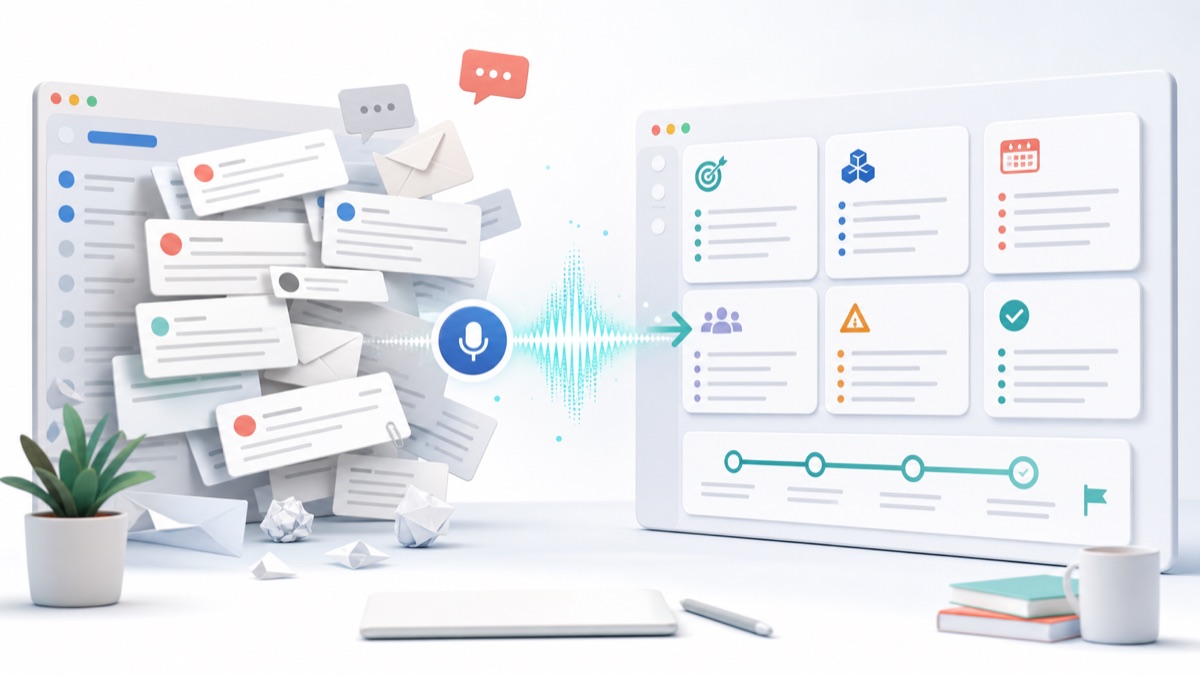
Vague client emails are common at the start of service work. A client asks for a “quick update,” a “more modern website,” a “simple campaign,” or “a few changes” without giving enough context to scope the work, price it, or brief the team.
If you answer too quickly, you risk building a proposal around assumptions. If you schedule another call every time, intake becomes slow and expensive. The better option is to turn the vague message into a structured project brief before the project moves forward.
Turning vague client emails into a project brief helps agencies clarify scope before pricing or kickoff. The brief becomes the shared source of truth for goals, deliverables, constraints, risks and next steps.
Quick Answer
To turn a vague client email into a clear project brief, extract the request, identify missing context, ask focused clarification questions, and convert the answer into a structured brief with goals, deliverables, scope boundaries, stakeholders, timeline, risks and next steps.
For service businesses, the fastest workflow is:
- Capture the client’s original request.
- Separate stated needs from assumptions.
- Ask for missing context asynchronously.
- Convert the answer into a short project brief.
- Confirm scope and next steps before pricing or kickoff.
A client brief generator turns vague client context into goals, constraints, risks and next steps. VocalJet supports this workflow through an AI client brief generator, voice client intake, and client voice notes to action items.
Why Vague Client Emails Create Project Risk
Most vague emails are not bad client behavior. They are compressed context.
The client may know the pain but not the scope. They may know the desired feeling but not the deliverables. They may be forwarding a request from another stakeholder. They may be trying to keep the ask short because they assume the details can be handled later.
Common examples include:
- “We need the homepage to feel more premium.”
- “Can you make the proposal more visual?”
- “We need a quick landing page for next month.”
- “The old workflow is not working anymore.”
- “Can you refresh the brand a little?”
- “We just need a few small changes.”
Each sentence looks simple. Each one can hide a large amount of work.
For an agency, consultant or freelancer, the risk is not the vague phrase itself. The risk is moving from that phrase directly into pricing, planning or production.
PMI’s guidance on controlling scope creep points to poorly defined specifications and customer changes as recurring drivers of scope expansion. In client services, those problems often begin in the intake stage, before the proposal is even written.
What A Clear Project Brief Should Include
A clear project brief does not need to be long. It needs to be specific enough that both sides can agree on what the work is, why it matters, and what is not included.
Asana’s guide to project briefs frames a brief around essential project information such as goals, scope, timeline and audience. For agency and consulting work, adapt that into a client-facing version.
Use this structure:
| Brief section | What it should clarify |
|---|---|
| Background | Why the client is asking now |
| Goal | The business outcome behind the request |
| Deliverables | What the client expects to receive |
| Audience | Who the work is for |
| Stakeholders | Who gives input and who approves |
| Scope | What is included in the engagement |
| Out of scope | What is explicitly not included |
| Constraints | Budget, timeline, tools, access, legal or brand limits |
| Risks | Missing decisions, assets, dependencies or approvals |
| Next steps | What happens before proposal, kickoff or delivery |
This format is useful because it turns a loose request into something the client can correct. The brief does not pretend every detail is known. It makes the unknowns visible.
Step 1: Preserve The Original Client Email
Do not rewrite the client’s request too early. Keep the original email as raw input.
Before you summarize anything, identify:
- The exact phrase the client used.
- The deliverable they seem to be requesting.
- The business problem they may be pointing to.
- The deadline or urgency signals.
- Any people, assets or constraints mentioned.
- Anything they did not say but you would need to know.
This keeps you from turning assumptions into “requirements.”
For example:
“We need the website to feel more modern before our investor meetings next month.”
You can extract:
| Signal | Possible meaning |
|---|---|
| “Website” | Could mean homepage only, full site, landing page or pitch page |
| “More modern” | Visual direction is undefined |
| “Investor meetings” | Audience may be investors, not customers |
| “Next month” | Timeline pressure |
| Missing | Pages, content, approvals, budget, success criteria |
At this stage, the goal is not to solve the request. The goal is to understand what must be clarified before the request can be scoped.
Step 2: Separate Facts From Assumptions
A vague email usually contains a few facts and many assumptions.
Create three lists:
| Category | Example |
|---|---|
| Known facts | The client wants a website update before investor meetings |
| Likely assumptions | They may care more about credibility than conversion |
| Missing context | Which pages, who approves, what “modern” means, what assets exist |
This simple split prevents a common intake mistake: treating your interpretation as the client’s requirement.
For a design agency, “modern” might imply visual redesign. For a strategy consultant, it might imply positioning. For a web freelancer, it might imply UX, copy, performance, accessibility or CMS work.
The same sentence can produce very different scopes. That is why the next step should be clarification, not quoting.
Step 3: Ask Better Clarification Questions
Do not ask the client to “send more detail.” That usually produces another vague answer.
Ask focused questions that map directly to the project brief:
- What outcome should this project create?
- Why is this important now?
- Who is the primary audience?
- What deliverables do you expect?
- What examples or references should we consider?
- Who needs to review or approve the work?
- What deadline or milestone matters most?
- What assets, access or decisions are already available?
- What should be considered out of scope?
- What would make this project unsuccessful?
The out-of-scope question matters. It helps reveal whether the client expects strategy, copy, design, development, revisions, stakeholder management or implementation support.
For scope-sensitive work, connect the email to a dedicated scope creep client intake workflow so hidden work is surfaced before the proposal.
Step 4: Let The Client Clarify By Voice
Some clients write short emails because writing project context is tedious. Asking them for another written response may not fix the problem.
Voice clarification helps clients explain missing context asynchronously without scheduling another meeting.
Instead of booking a call, send a short prompt:
Thanks for the context. Before I suggest a scope, could you record a 3-5 minute voice note explaining what prompted this request, what outcome you want, who needs to approve it, and what should be out of scope?
This gives the client a lower-friction way to explain nuance. It also creates richer input for the brief.
With voice client intake, the client can explain the request in their own words. The recording can then be turned into a transcript, structured brief, scope questions and action items.
Step 5: Convert The Response Into A Project Brief
Once you have the original email and the clarification response, convert them into a brief.
Use this format:
1 | Project brief |
This is where an AI client brief generator is useful. The goal is not to create a polished essay. The goal is to produce a working brief that makes the project easier to price, approve and execute.
Example: Vague Email To Clear Brief
Here is a simple transformation.
Original email:
“Can you help us clean up the website before our launch? It should be quick. We mostly need it to feel sharper and more credible.”
Clarification prompt:
“Could you record a short voice note covering what is launching, who will visit the site, which pages matter, what ‘sharper’ means to you, who approves changes, and what should not be included?”
Structured brief:
| Brief section | Result |
|---|---|
| Goal | Improve credibility before a product launch |
| Audience | Prospects, partners and press visiting after launch announcement |
| Deliverables | Homepage refresh, product page edits, updated proof points |
| Constraints | Launch date in three weeks, existing CMS, no full rebrand |
| Stakeholders | Founder approves messaging, marketing lead approves page updates |
| Out of scope | New brand identity, custom illustrations, full site migration |
| Risks | Copy may arrive late, stakeholder approval may delay launch |
| Next steps | Confirm priority pages, collect assets, price core scope and optional add-ons |
The scope is still not final, but it is now discussable. You can price a core engagement, name exclusions and suggest optional work without pretending the original email was clear enough.
A Checklist For Scope Clarity
Before you turn a vague request into a proposal, check whether the brief answers these questions:
- What business outcome is the client paying for?
- Which deliverables are actually included?
- Which deliverables are explicitly excluded?
- Who is the final approver?
- What decisions are already made?
- What assets does the client need to provide?
- What timeline is real, and what timeline is preferred?
- What could delay the work?
- What would trigger an additional fee?
- What happens immediately after approval?
If any answer is missing, mark it as an open question. Do not bury it in internal notes.
The best brief is not the one with the most detail. It is the one that makes scope assumptions visible before they become delivery problems.
Email Templates For Asking Follow-Up
Use these templates when the first email is too vague.
Template 1: Before Proposal
1 | Thanks for sending this over. Before I suggest a scope, I want to make sure I understand the context behind the request. |
Template 2: Before Kickoff
1 | Before kickoff, I want to confirm the working brief. |
Template 3: When Scope Is Expanding
1 | This sounds useful, but it appears to expand the original request. |
These templates work best when they are tied to a brief, not scattered across separate email threads.
Turn The Brief Into Action Items
A brief should not stop at context. It should produce action.
After the brief is confirmed, convert it into:
- Tasks for your team.
- Assets to request from the client.
- Decisions the client must make.
- Risks to monitor.
- Proposal sections to write.
- Follow-up emails to send.
- Out-of-scope notes to include in the agreement.
This is the bridge between intake and delivery. A vague request becomes a brief. The brief becomes tasks. The tasks become a clearer workflow.
VocalJet’s client voice note to action items workflow is built for this step: capture client context, summarize the useful parts, and turn the next steps into something the team can execute.
When To Use Async Feedback Instead Of Another Meeting
Not every unclear email needs a call. Calls are useful for relationship building, negotiation and complex decisions. They are not always necessary for intake clarification.
GitLab’s handbook on asynchronous communication emphasizes documenting context so people can contribute without requiring everyone to be present at the same time. For agencies and consultants, the same principle applies to client intake.
Use async clarification when:
- The client needs to explain background context.
- You need answers before preparing a proposal.
- The request is not urgent enough for a live call.
- Multiple stakeholders need to contribute.
- You want a written record of scope assumptions.
- You need clearer revision feedback after a delivery round.
For revision-heavy work, connect the same approach to async client feedback. Instead of chasing comments across calls, emails and screenshots, collect feedback in a structured format and convert it into next steps.
The Practical Rule
Do not quote from a vague email. Do not start from a vague email. Do not let your team interpret a vague email differently in three different places.
Turn the email into a brief first.
The brief can be short. It can be imperfect. But it should make the important things explicit: goal, scope, deliverables, constraints, risks, open questions and next steps.
That is how agencies, consultants and freelancers turn messy client communication into clearer projects without adding another meeting every time.