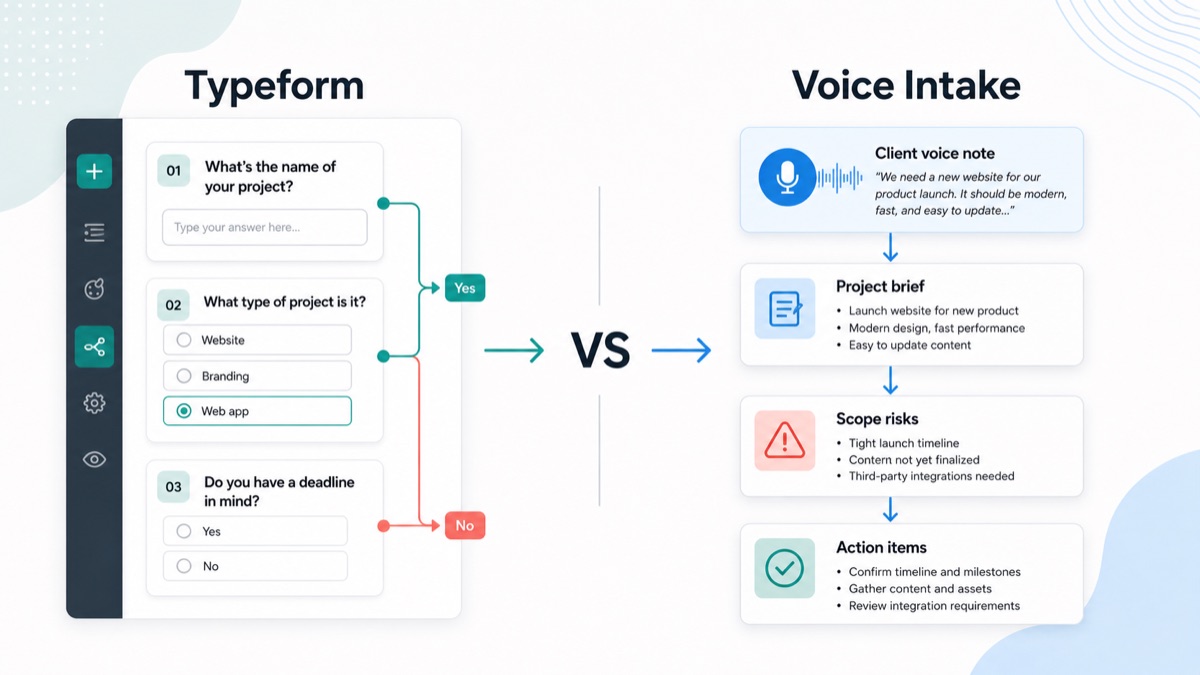
Typeform is useful when an agency wants a polished intake form with short answers, branching questions, file links, consent fields, lead qualification and repeatable client data. Voice intake is stronger when the client needs to explain messy project context: why the work matters, what changed, who needs to approve it, what is unclear and which requests may affect scope.
For agencies, consultants, creative studios and freelancers, the choice is not “form or no form.” The real question is whether the intake format gives your team enough context to write a brief, price the project, separate included work from assumptions and start without another clarification call.
This guide compares Typeform and voice intake for client projects, then gives you a decision matrix, hybrid workflow, prompt template, raw-answer example and FAQ.
Quick Answer
Use Typeform when the client needs to provide structured information: contact details, project type, budget range, timeline, links, file uploads, multiple-choice selections and qualification answers. Use voice intake when the client needs to explain context, priorities, constraints, stakeholders, uncertainty or scope risk in their own words.
For agency client intake, the strongest workflow is often hybrid: collect simple facts in Typeform, ask for one short voice response for context, then turn the voice answer into a brief, scope risks and action items.
| Intake format | Best for | Weakness | Best output |
|---|---|---|---|
| Typeform | Branded forms, branching questions, qualification and structured fields | Long open-text answers still get thin | Intake record |
| Voice intake | Goals, constraints, tradeoffs, hidden stakeholders and scope uncertainty | Needs structured extraction | Brief, risks and action items |
| Discovery call | Trust, negotiation and strategic disagreement | Scheduling cost and weak written record | Shared discussion |
| Hybrid intake | Facts first, voice context second | Needs a clear handoff | Better brief and fewer follow-ups |
For product-led intake, connect a Typeform alternative for client intake, a voice intake form, voice client intake, client intake software for agencies, an AI client brief generator, scope creep client intake, and client voice notes to action items.
What Typeform Is Best For
Typeform’s official site positions the product around forms and automated workflows, with form building, surveys, analytics, integrations and automation. That makes it useful when intake has repeatable fields and clear answer formats.
Use Typeform when the agency needs:
- contact details;
- project type;
- budget range;
- target launch date;
- file upload links;
- service category selection;
- consent or approval fields;
- lead qualification answers;
- a polished branded form;
- conditional questions based on previous answers.
Typeform is a strong fit when the agency already knows what it needs to ask and the client can answer without explaining much nuance.
The problem starts when the form becomes a substitute for discovery. A client can select “website redesign” and type “make it more premium,” but that does not explain the business pressure, approval path, missing assets or whether a requested page is included in the current scope.
What Voice Intake Is Best For
Voice intake is best when the client knows the story but does not know how to structure it.
Voice client intake is a workflow where clients explain project context asynchronously by voice, then the agency turns that recording into structured goals, constraints, risks and next steps.
Use voice intake when you need to understand:
- why the project matters now;
- what success should look like;
- what is not working today;
- which stakeholders influence approval;
- what the client is unsure about;
- which ideas are phase one vs later;
- what could delay the work;
- which request could become unpaid scope.
An AI client brief generator turns spoken client context into structured goals, constraints, risks and next steps. That is the bridge between a raw client explanation and usable project delivery context.
Typeform vs Voice Intake Decision Matrix
Use this matrix before choosing your intake flow.
| Client intake need | Typeform | Voice intake | Why |
|---|---|---|---|
| Capture contact details | Yes | No | Short factual field |
| Qualify lead fit | Yes | Maybe | Scoring and selections work well |
| Collect files and links | Yes | No | Form upload fields are clearer |
| Understand the business problem | Maybe | Yes | Needs narrative context |
| Reveal hidden stakeholders | Maybe | Yes | Clients explain politics better by voice |
| Clarify what is in scope | Maybe | Yes | Requires tradeoffs and follow-up questions |
| Build a project brief | Maybe | Yes | Needs interpretation, not just responses |
| Reduce discovery calls | Maybe | Yes | Async context can replace part of the call |
| Create action items | Maybe | Yes | Gaps need owners and next steps |
The practical rule: use Typeform for facts and voice intake for context.
Best Workflow For Agencies, Consultants And Freelancers
Step 1: Keep Typeform Short
Do not ask the client to write a strategy memo inside a long text field. Use Typeform for clean intake data.
1 | Client intake form fields |
This gives the agency a reliable intake record without forcing the form to capture everything.
Step 2: Add One Voice Context Prompt
After the form, ask for one voice answer.
1 | Please record a short voice note explaining: |
This prompt works because it lets the client speak naturally while still guiding them toward useful project context.
Step 3: Convert The Voice Answer Into A Brief
Asana’s guide to a project brief is useful because it puts project goals, scope, audience, timeline and ownership in one written home.
Do not leave the voice answer as a transcript only. Convert it into a brief.
| Voice answer signal | Brief section |
|---|---|
| “Sales keeps saying prospects do not understand the offer” | Business problem |
| “The service page matters more than the about page” | Priority deliverable |
| “The founder will review all positioning” | Approval risk |
| “A pricing page could come later” | Scope decision |
| “We have screenshots, but not final copy” | Asset dependency |
Client intake is only useful when the output can guide pricing, planning and delivery.
Step 4: Run A Scope Check
Before proposal or kickoff, separate five things.
| Category | Meaning | Example |
|---|---|---|
| Confirmed requirement | Clearly requested and included | Homepage and service page rewrite |
| Assumption | Likely true but not confirmed | Client provides final copy |
| Dependency | Needed before work moves | Brand assets and CMS access |
| Open question | Needs decision | Is the pricing page included? |
| New request | Outside the current scope | Additional comparison page |
Atlassian’s project kickoff play focuses on alignment around purpose, roles, responsibilities and success markers. For agencies, that alignment should start during intake, not after work has already begun.
Step 5: Turn Intake Gaps Into Action Items
Use a short action table after every intake review.
| Intake gap | Action item | Owner |
|---|---|---|
| Pricing page unclear | Confirm whether pricing page is phase one or future scope | Client |
| Final copy missing | Name content owner and delivery date | Client |
| Approval path unclear | Identify final approver | Client |
| CMS access missing | Share access or vendor contact | Client |
| Scope risk found | Send phase-one recommendation and optional add-on | Agency |
Client notes to action items is the workflow of turning raw client context into tasks with owners, deadlines and scope impact.
Raw Typeform Answer To Voice Intake Output
Here is how the difference looks in practice.
Thin Typeform Answer
1 | Project type: Website redesign |
Voice Intake Summary
1 | The current website is creating sales friction because prospects do not understand the service packages. The client wants the homepage and service page clarified before a September campaign. Sales and the founder both need to review messaging. The client has screenshots and rough copy, but final positioning is not approved yet. A pricing page is interesting, but should be treated as optional unless it fits the budget. |
Structured Agency Output
| Section | Structured output |
|---|---|
| Business goal | Reduce sales friction before the September campaign |
| Priority deliverables | Homepage and service page clarification |
| Stakeholders | Sales and founder review messaging |
| Assets | Screenshots and rough copy exist; final positioning is missing |
| Scope risk | Pricing page may be new scope |
| Client action items | Confirm positioning owner, final approver and pricing page priority |
| Agency action items | Prepare phase-one brief and optional pricing-page estimate |
The Typeform answer is not useless. It is just incomplete. Voice intake gives the agency the story behind the fields.
When Typeform Is Better Than Voice Intake
Choose Typeform when the intake is mostly structured.
| Use Typeform when | Why |
|---|---|
| You need repeatable answers | Easier to standardize |
| You need branching logic | Forms can adapt based on selections |
| You need file uploads or links | Form fields are clear |
| You need qualification data | Scoring and CRM routing are easier |
| The project type is simple | No narrative needed |
| You need pricing or plan details | The official Typeform pricing page is the source to check before choosing a plan |
Forms are not the problem. Overloading forms with questions that require nuance is the problem.
When Voice Intake Is Better Than Typeform
Choose voice intake when the project has ambiguity.
| Use voice intake when | Why |
|---|---|
| The client gives vague goals | Voice captures context |
| The request may affect scope | Spoken nuance reveals risk |
| Stakeholders are hidden | Clients can explain approval politics |
| The brief is incomplete | Voice adds narrative |
| Another call feels unnecessary | Async voice reduces scheduling |
| You need action items | Context can be converted into tasks |
Scope clarification questions help agencies separate requested deliverables from assumptions before proposal or kickoff. Voice intake gives clients a faster way to answer those questions in their own words.
How VocalJet Fits This Workflow
VocalJet is useful when Typeform gives you the facts but not enough context to start work.
Instead of adding more long-answer fields or scheduling another discovery call, ask the client to record a short voice intake. VocalJet helps turn that spoken context into a transcript, summary, project brief, scope risks, action items and follow-up-ready text.
That makes VocalJet a strong fit when:
- form answers are too short;
- the client needs to explain nuance;
- the agency needs a brief before proposal;
- scope risk is hidden inside vague language;
- the next step should become action items.
Voice intake is not a replacement for every Typeform field. It is the context layer that makes structured intake data useful for client work.
FAQ
Is Typeform good for client intake?
Typeform is good for structured client intake details such as contact information, project type, budget range, timeline, links, files and qualification answers. It is weaker when the client needs to explain project context, tradeoffs or scope risk.
When should an agency use voice intake instead of Typeform?
An agency should use voice intake when a client request is vague, strategic, stakeholder-heavy or likely to affect scope. Voice helps the client explain context that would be too thin in a form field.
Can Typeform and voice intake work together?
Yes. A strong hybrid workflow uses Typeform for short facts and voice intake for the story behind those facts. The agency then turns the voice response into a brief, scope risks and action items.
What should a voice intake prompt ask?
A voice intake prompt should ask what the client wants to achieve, why it matters now, what is not working, what must be included, what might be later, who approves the work and what could delay the project.
How does voice intake reduce scope creep?
Voice intake reduces scope creep by exposing assumptions, optional ideas, hidden stakeholders, missing assets and unclear priorities before proposal or kickoff. Those signals can then be labeled as included, excluded, dependent or new scope.
How can VocalJet help agencies replace long intake forms?
VocalJet lets clients explain project context by voice and helps agencies turn that context into transcripts, summaries, briefs, scope risks, action items and follow-up-ready text.