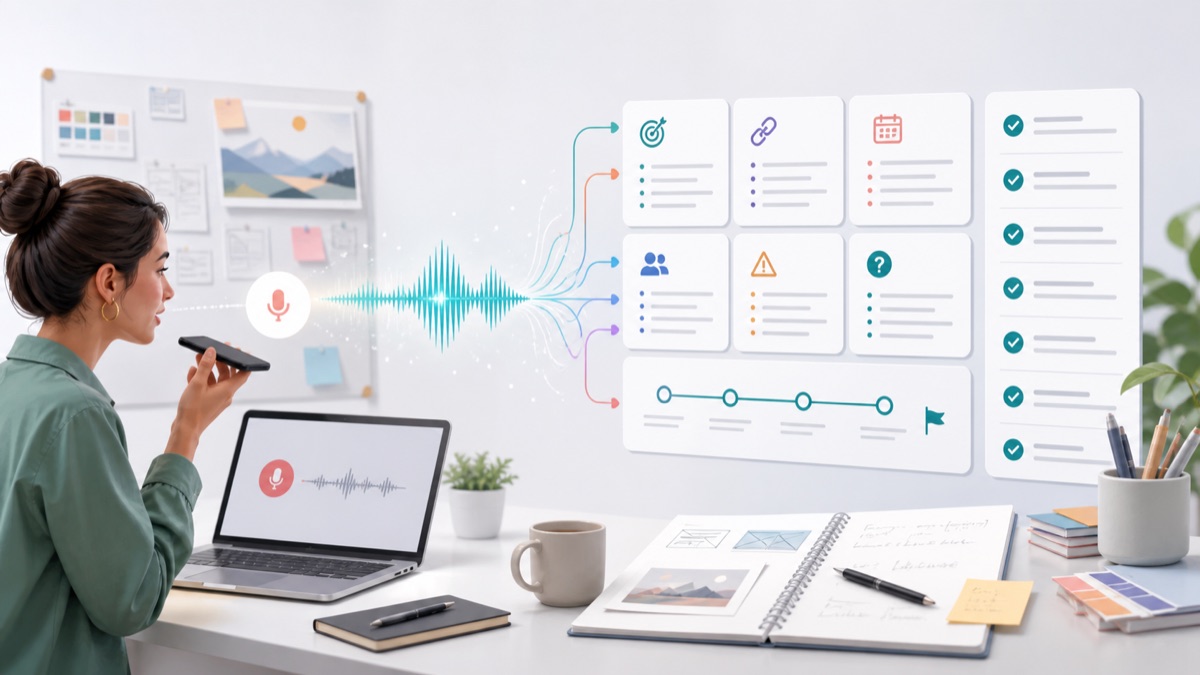
Voice client intake helps agencies, consultants and freelancers collect better project context before a proposal, kickoff or revision round. Instead of asking clients to complete a long form or book another meeting, you ask them to explain the request by voice and turn that recording into a structured brief.
The point is not to replace all forms or calls. The point is to capture the messy context that clients often skip when they write: why the project matters, who needs to approve it, what changed, what is unclear, and what should be out of scope.
Voice client intake is a workflow where clients explain project context asynchronously by voice. The recording becomes raw material for a project brief, scope clarification questions, action items and follow-up emails.
Quick Answer
Voice client intake is best for service businesses that need richer project context than a static form usually captures. A client records a short voice note answering guided prompts. The agency or freelancer transcribes it, summarizes it, and converts it into a brief with goals, deliverables, constraints, risks, open questions and next steps.
For agencies and freelancers, the simplest workflow is:
- Send a short intake link or prompt.
- Ask the client to record a 3-5 minute voice note.
- Convert the recording into a structured project brief.
- Mark missing information and scope risks.
- Send a confirmation summary before pricing or kickoff.
An async voice intake workflow lets clients explain context without scheduling another meeting. VocalJet supports this path with voice client intake, client intake software for agencies, a voice intake form, and an AI client brief generator.
| Intake method | Best for | Weakness | Best output |
|---|---|---|---|
| Static form | Simple repeatable requests | Clients often write short answers | Contact details and basic requirements |
| Discovery call | High-value or complex sales | Hard to schedule and easy to lose details | Relationship context and strategic discussion |
| Email thread | Quick clarification | Context becomes scattered | Short follow-up decisions |
| Voice client intake | Messy project context before scope | Needs transcription and summarization | Brief, scope risks and next steps |
Why Agencies Need A Voice Intake Workflow
Most client projects do not begin with a perfect brief. They begin with fragments:
- A vague email.
- A forwarded stakeholder request.
- A screenshot with no explanation.
- A short form response.
- A half-remembered call.
- A request that sounds simple but has hidden dependencies.
That is where scope and expectations start to drift.
Asana’s guide to project briefs emphasizes that a brief should align the team on goals, scope, timeline and audience. Atlassian’s project kickoff play also focuses on shared goals, roles and risks before execution begins.
For client services, intake is the moment where those inputs should be captured. If they are not captured there, they usually reappear later as unpaid clarification, rework, delayed approvals or scope creep.
Voice intake helps because clients can speak naturally. They do not need to organize the answer perfectly. Your workflow does that after the recording.
When To Use Voice Client Intake
Use voice intake when the project depends on context, not just facts.
Good use cases include:
- Website redesign intake.
- Brand strategy discovery.
- Creative campaign briefing.
- Consulting discovery notes.
- Client onboarding for retainers.
- Design revision context.
- Proposal scoping.
- Audit requests.
- Strategy workshops.
- Complex support or implementation requests.
Do not use voice intake for every tiny request. If the client only needs to send a file, approve a color, or choose between two dates, a form or email is enough.
Use voice when the client needs to explain “why,” not just “what.”
The 7-Part Voice Intake Prompt
The biggest mistake is asking the client to “send a voice note with your thoughts.” That creates rambling audio.
Give them a short structure instead.
Send this prompt:
1 | Please record a 3-5 minute voice note before we scope the project. |
This prompt is short enough for the client to follow and specific enough for your team to reuse.
The last question is important. Scope clarification questions help agencies separate requested deliverables from assumptions before proposal or kickoff.
What To Extract From The Voice Note
Do not treat the transcript as the deliverable. The transcript is raw material.
Turn it into a structured intake summary:
| Brief section | What to extract |
|---|---|
| Client goal | The business outcome behind the request |
| Trigger | Why the project matters now |
| Current problem | What is slow, confusing, broken or underperforming |
| Audience | Who the work is for |
| Deliverables | What the client believes they need |
| Stakeholders | Who gives input and who approves |
| Timeline | Real deadlines, preferred timing and dependencies |
| Constraints | Budget, access, brand, legal, technical or asset limits |
| Scope risks | Hidden work, missing decisions or unclear ownership |
| Open questions | What must be clarified before pricing or kickoff |
| Next steps | Actions for the client and your team |
This is where client voice notes to action items becomes useful. Intake should not end with “we recorded context.” It should create a brief and a list of next actions.
Best Workflow For Agencies And Freelancers
Here is a practical workflow you can run before a proposal or kickoff.
Step 1: Send The Intake Link
Send the client a short message:
1 | Thanks for reaching out. Before I suggest a scope, could you record a short voice note with the context behind the project? |
If you already use forms, keep a few required fields for contact details, budget range or project type. Then use voice for the context-heavy part.
This makes voice a Typeform alternative for client intake or a Google Forms alternative for client intake only when the project needs narrative context.
Step 2: Convert The Recording Into A Brief
Use the transcript to produce a short brief:
- One paragraph of context.
- Five to eight requirements.
- Three to five open questions.
- A scope risk note.
- A next-step checklist.
An AI client brief generator turns spoken client context into structured goals, constraints, risks and next steps.
Step 3: Mark Scope Risks
Look for phrases that sound small but can become expensive:
- “It should be quick.”
- “We just need a refresh.”
- “We can provide content later.”
- “The team will decide after seeing options.”
- “Can you also include SEO?”
- “We are not sure who approves this.”
- “Can you make it work like this competitor?”
These phrases do not mean the client is wrong. They mean the scope is not clear enough yet.
For higher-risk projects, connect intake to a scope creep client intake workflow before you price the work.
Asana’s guide to scope creep frames the issue as uncontrolled expansion beyond the original plan. In client services, that expansion often starts before the original plan is written.
Step 4: Send Back A Confirmation Summary
Send the client a short summary before the proposal:
1 | Based on your voice note, I understand the project as follows: |
This creates a visible checkpoint. The client can correct the brief before it becomes a proposal, kickoff document or task list.
Step 5: Convert Intake Into Action Items
Once the client confirms the brief, turn it into next steps:
- Assets to request.
- Stakeholders to confirm.
- Questions to answer.
- Proposal sections to write.
- Risks to price or exclude.
- Decisions to document.
- Tasks to create.
This is the product bridge for VocalJet: the client explains context by voice, then the workflow turns that context into a brief, scope questions, action items and follow-up-ready text.
Before And After Example
Here is a realistic intake transformation.
Raw client email:
“We need help improving the website before a partner launch next month. The current site feels confusing and not polished enough. It should not be a huge project.”
Voice prompt:
“Could you record a quick voice note explaining what is launching, who will visit the site, which pages matter, what feels confusing, who approves changes, and what should not be included?”
Structured output:
| Section | Intake summary |
|---|---|
| Goal | Improve clarity and credibility before a partner launch |
| Audience | Prospects, partners and internal stakeholders |
| Deliverables | Homepage update, partner page edits, messaging cleanup |
| Constraints | Launch next month, existing CMS, no full redesign |
| Stakeholders | Marketing lead owns content, founder approves final messaging |
| Scope risks | “Not a huge project” may hide unclear page count and revision expectations |
| Open questions | Which pages are included? Who supplies copy? How many revision rounds? |
| Next steps | Confirm pages, collect examples, define exclusions, price core scope plus optional add-ons |
The original email was not enough to scope. The voice note gives you the context needed to ask better questions.
Voice Intake Questions To Reuse
Use this checklist for agency or freelance intake.
Business Context
- What are you trying to achieve?
- Why is this project happening now?
- What happens if the project does not move forward?
- What has already been tried?
Project Scope
- What deliverables do you expect?
- Which parts are must-have?
- Which parts are optional?
- What should be out of scope?
Stakeholders
- Who will give feedback?
- Who has final approval?
- Who will provide assets or access?
- Are there conflicting opinions we should know about?
Constraints
- Is there a real deadline?
- Is there a budget range?
- Are there brand, legal or technical constraints?
- Are there tools, platforms or vendors involved?
Success
- What would make this project successful?
- What would make it unsuccessful?
- What should be easier after the project is done?
- What metric, milestone or approval matters most?
This checklist is useful whether you run a solo freelance business, a small studio or a larger client intake software for agencies workflow.
How Voice Intake Fits With Async Work
Voice intake works best when it is part of an asynchronous client workflow.
GitLab’s handbook on asynchronous communication emphasizes documentation and context so people can contribute without needing to be present at the same time. That principle applies directly to agency-client communication.
Async client intake does not mean “no communication.” It means communication is captured, structured and reusable.
Use async voice intake when:
- Time zones make calls slow.
- The client needs time to gather thoughts.
- Multiple stakeholders need to add context.
- You need a record of assumptions before scope.
- The work is not urgent enough for a live call.
- You want fewer discovery calls but better project briefs.
If the same project later needs revision context, connect intake to async client feedback. The pattern is the same: collect context asynchronously, summarize it, clarify open questions, and turn it into next steps.
What Not To Do
Avoid these common mistakes:
- Asking for an unstructured voice note.
- Sending a transcript as the final deliverable.
- Ignoring vague phrases because the client “sounds clear.”
- Pricing before scope risks are visible.
- Treating every client request as a meeting.
- Replacing all forms with voice.
- Letting the brief live only in your head.
Voice intake is not valuable because it is voice. It is valuable because it turns client context into a reusable operating asset.
FAQ
What is voice client intake?
Voice client intake is an asynchronous workflow where a client records project context by voice and the service provider turns that recording into a brief, scope questions, risks and next steps.
Is voice intake better than a client intake form?
Voice intake is better when the project requires explanation, nuance or context. A client intake form is still better for simple structured facts like contact details, budget range or project type.
How long should a client voice intake recording be?
A practical client voice intake recording should be 3-5 minutes. That is long enough to explain context, but short enough for the client to complete without preparation.
What should agencies extract from a voice intake note?
Agencies should extract the client goal, current problem, deliverables, audience, stakeholders, constraints, scope risks, open questions and next steps.
Can voice client intake reduce scope creep?
Voice client intake can reduce scope creep by making assumptions visible before proposal or kickoff. It helps the team identify unclear deliverables, missing assets, vague approvals and out-of-scope requests earlier.
When should I still schedule a discovery call?
Schedule a discovery call when the deal is strategic, high-value, politically complex or requires live negotiation. Use voice intake to collect context before the call so the meeting is shorter and more focused.
The Practical Rule
Use forms for clean facts. Use calls for live decisions. Use voice intake for messy context.
For agencies, consultants and freelancers, that is the workflow that protects scope and improves project quality: client voice note, structured brief, open questions, scope risks, action items, then proposal or kickoff.
That is how voice becomes more than a recording. It becomes a repeatable client intake system.